
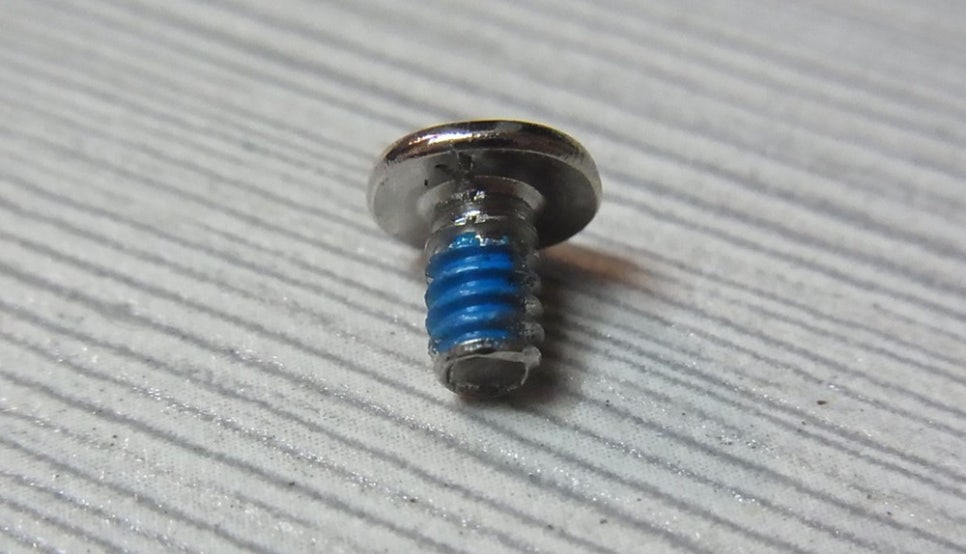
Why are the screws on the reel painted?
Even among those who have some knowledge of reel disassembly and assembly, there are surprisingly many who do not know the purpose of the paint applied to the threads when the reel is disassembled.
That’s why most people don’t prepare the necessary supplies, and this can cause other problems. So today, let’s find out why the screws (or threads, to be exact) used to assemble the reel are painted.
The screws used to assemble the reel are not actually painted, but rather a type of low viscosity liquid adhesive applied to maintain the bond of the screws, which may become loose as the reel is used .
Often times, when beginners first disassemble a reel and ask themselves, “Why are the screws so tight?”, this adhesive is often the cause.
The name of this adhesive applied to the screw threads is ‘screw-locking agent’. It is readily available on the market at a low price and is an essential item for reel maintenance, but it is rare to find someone who has ‘screw-locking agent’.
For example, among the bait reels I own, there are cases where the screw that secures the handle nut cover becomes loose and falls off. If the screw of the reel becomes loose like this, in the worst case, it may fall off or you may experience an unnatural feeling such as a rattling sensation, making it uncomfortable to use.
Since I mainly use spinning reels, let’s take a look at spinning reels as an example. When you first disassemble the reel you are using, unlike other reels, some have a ‘thread lock’ applied to the threads. Once the thread lock is applied, its lifespan ends when you disassemble it, so it is a good idea to reapply it when you reassemble it.

When a company releases a product, the screws on the line roller are the areas where this type of screw-loosening agent is mainly applied. If you disassemble it, you can see that it is covered in orange screw-loosening agent, as shown in the photo.

Screws coated with anti-loosening agent like this were designed to compensate for the possibility of loosening when released by the manufacturer, so it is necessary to re-coat screws coated with anti-loosening agent when disassembling and then reassembling them.

Of course, you don’t need to apply anti-loosener to every screw on your reel. However, at the very least, you should apply it to the screws on the line roller and the screws that secure the slider (Daiwa calls this the oscillating post, Shimano calls it the slider guide) that allows the spool of a spinning reel to move up and down.

Before we wrap up, let’s look at one more thing that anglers should have when maintaining and servicing their gear.
We often see cases where rust forms on the guide ring when the rod is not maintained and only then is it removed. It is good to wash it with water or use a tissue containing a salt remover to remove the salt, but it is also very useful to prepare anhydrous ethanol, which is easily available on the market.
Anhydrous ethanol is used to make mosquito repellent in the summer, but it also has a disinfecting effect, so if you wipe the EVA grip of a fishing rod or the handle knob of a reel with it, you can use it in a clean state. It is also very effective in removing stickiness that cannot be removed with just a wet towel or tissue, and it is also effective in restoring the luster of a rod grip that has faded from long-term use.


Leave a Reply
Want to join the discussion?Feel free to contribute!