
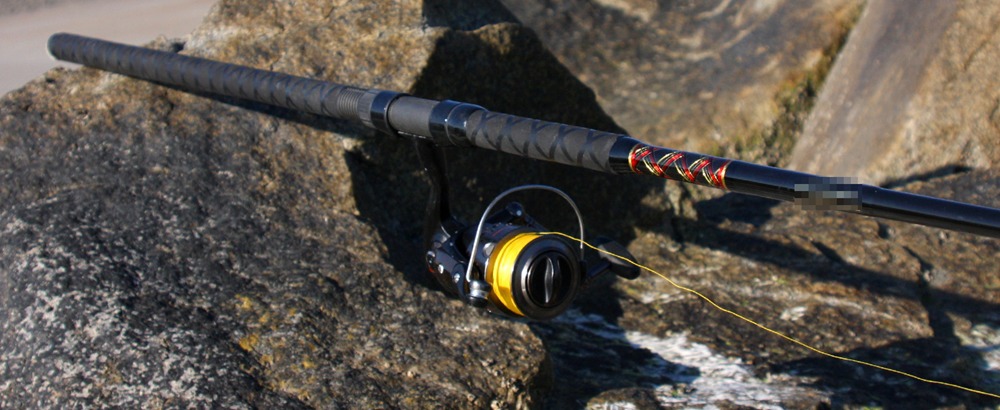
Where exactly are the diameter and distance of the fishing rod measured?
As water temperatures and temperatures rise, more and more people are looking to enjoy outdoor activities, and the number of people going fishing is also increasing.
Accordingly, I often receive questions about fishing rods from newbies to fishing. When choosing a rod, there are many factors to consider, but for those who are purchasing equipment for the first time, it is difficult to make the right purchase considering various variables, so they use recommendations from those around them and the specifications of the company selling the product as the criteria for selection.
If you look at the specifications provided by each company that sells rods, the diameter and diameter are mentioned first, followed by the dead weight, and then the hardness of the rod, the limits of the equipment that can be used, etc.

However, many people do not understand the exact measurement of the diameter and the distance, and we will look into whether it refers to the outer diameter or the inner diameter. Next, we will look into the allowable error in the specifications indicated by the company.
First, let’s look at the terms “선경” and “원경.” In Chinese characters, they are written as “선경” (先徑: 先径) and 원경 (元徑: 元径). As you can guess, these are expressions borrowed directly from Japanese expressions. In particular, the fact that the Chinese character for 원경 does not use the character “원” (遠), meaning “far,” is a difference from our way of thinking.
In Korea, there is an organization called the Korea Fishing Association (membership is open to individuals), which is made up of many fishing tackle makers and distributors, but I have never heard of them establishing standards for the notation of standard specifications and tolerances.
In comparison, in Japan, the “Fair Competition Regulations on Fishing Rod Labeling” and its “Enforcement Rules” were created and recommended by an organization called the “Fishing Rod Fair Trade Council.” In particular, before the regulations were newly revised, each company had its own standards for marking the line diameter and the distance between …
For example, in the case of Daiwa of Japan, the diameter of a float fishing rod is measured at a point 5cm from the end, and in the case of a cast rod, the diameter of the end is indicated as the diameter, and the measuring point was different for each product (even now, some products are measured differently), and this has been indicated differently for each company.
To prevent such confusion, the revised regulations provide clear standards for the distance and the line, and also set a range of tolerances for the specifications displayed on fishing rods, but these are not mandatory.
However, in Korea, where Japanese terms are borrowed and used, there is still no unified standard, so if you search for the diameter and diameter of a fishing rod on the Internet, you will often find that the diameter is generally the diameter of the very tip of the rod, and the diameter is the diameter of the very tip of the handle.
However, the diameter presented in Japan is defined as the outer diameter of the point closest to the front of the rod, where no parts (guides) are attached and where it can be measured directly, and the diameter is defined as the outer diameter of the point farthest from the rod, where no parts are attached and where it can be measured directly.
※ I think domestic companies are probably also following this standard.
That is why, if there is a guide at the end of the reed or a grip at the handle part, that is, the butt, the diameter measured from the back of the guide and the front of the grip should be called the diameter of the reed and the butt.

This diameter is called “Top Diameter” or “First Diameter” in English, and the original diameter is expressed as “Butt Diameter”. The word “Butt” that we commonly hear or use is derived from golf clubs and is used in fishing rods. The measurement of this Butt Diameter, or original diameter, is currently measured from the front of the grip as shown in the figure below.

Next, I saw an article from a domestic company that sells rods that said, “The international standard for weight tolerance is 5%.” However, there is no international standard for the tolerance of specifications for rods, and if there were, it would be a standard made in Japan.
The Japanese standard for the tolerance of fishing rods stipulates that the length (overall length) is measured when the rod is fully extended for the extended type and when the rod is fully inserted for the insert type, and that the tolerance should be within “+2cm, -1cm × number of sections.” The weight (self-weight) is measured as the weight including the guide, reel seat, grip, paint, etc., and that the tolerance should be within +5%.
Also, the length when folded is measured excluding the front plug (common in freshwater areas) and the back plug in the case of a sliding rod, and in the case of a plug-in rod, the longest length is measured, and the margin of error is set to be within ±3%.
With the rise of the domestic fishing population, many manufacturers are developing and diversifying their products. Just as Korean automobile manufacturing doesn’t have a long history, I don’t mean to nitpick the fact that terminology is being borrowed from Japan. However, I believe that standards for labeling specifications and product tolerances, which encourage informed consumption, should be established through the voluntary efforts of manufacturers, rather than being enforced.
For example, when I see that the weight error of a load made by a domestic company is as high as 9.45%, I think that it is time to set proper standards in Korea as well.


Leave a Reply
Want to join the discussion?Feel free to contribute!