
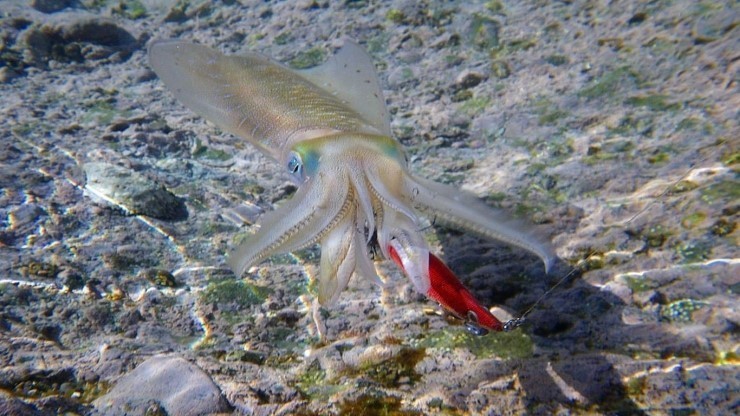
What is egi and egging fishing?
Egging is a type of fishing method for squid, and is based on lure fishing, but originally refers to a fishing method that changes the material of the bait to wood (egi). Since it is based on Western fishing methods, the etymology is that the English progressive tense ing is added to egi, which means wooden bait, and read in katakana as エギング.
Korean search sites state the origin of egi (餌木 · egi) as follows, but I think it is somewhat problematic to express facts that have not been completely verified as certain.
The origin of squid fishing lures (egi) is said to be in the Amami Islands of the Ryukyu Kingdom, which existed around Okinawa in southern Japan. It is said that a fisherman on the island noticed squid clinging to a piece of wood he had discarded after using it as a torch. He then attached a needle to the charred piece and began using it.
This was introduced to Satsuma (present-day Kagoshima, Japan) about 300 years ago, and since then, catching squid using squid jigs has become a traditional Japanese fishing method. (Source: Naver)
There are several theories that say that the squid (餌木: えぎ (egi)) is a type of lure that was passed down from ancient Japanese times, but the general theory is that it originated from the squid that would stick to the torches that fishermen dropped into the sea while working on a boat.
According to a curator at the Kagoshima Prefecture Historical Materials Center’s Meiyōkan, who spoke to SHIMANO, there are no clear records left, but it is believed that it was passed down from the mid to late Edo period.
This center houses the egis (egi) from that time, and it shows that the large fish-shaped egis gradually became smaller and developed into the current shrimp-shaped egis.
Currently, many types of squid (egi) have been developed, but they are basically shaped like shrimp with various patterns added, and are made of wood or plastic.
In addition, many have colored tapes, such as gold or marble, attached. Straight needles are attached to the bottom to hook squid tentacles, and these are called canna.


Also, a sinker is installed at the front lower part of the squid (餌木: えぎ (egi)), but its weight varies by manufacturer depending on the sinking posture and sinking speed. Recently, there has been a tendency for each manufacturer to develop squid (餌木: えぎ (egi)) specialized for each purpose, rather than the existing regional variations.
For example, there are various types of squid lures (egi) that have fast sinking speeds, slow sinking speeds, or those with improved jumping performance, and there are also types that produce a rattling sound when operated to attract squid.
There are many theories about the color of squid (餌木: えぎ (egi)), but the accuracy is established based on individual experience. It is known that the squid’s reaction varies depending on the state and shape of the sea, weather, fog, etc., and since the color that is best seen in each situation is different, each company is currently developing many colors.
And the size of the squid (egi) is also sold in various sizes, so you can choose the one that is suitable for the local conditions according to the size of the squid you are targeting.


There is no disagreement among producers or scholars that there is no difference in the quality of the squid depending on whether it is cheap or expensive, so please keep this in mind.


Leave a Reply
Want to join the discussion?Feel free to contribute!