
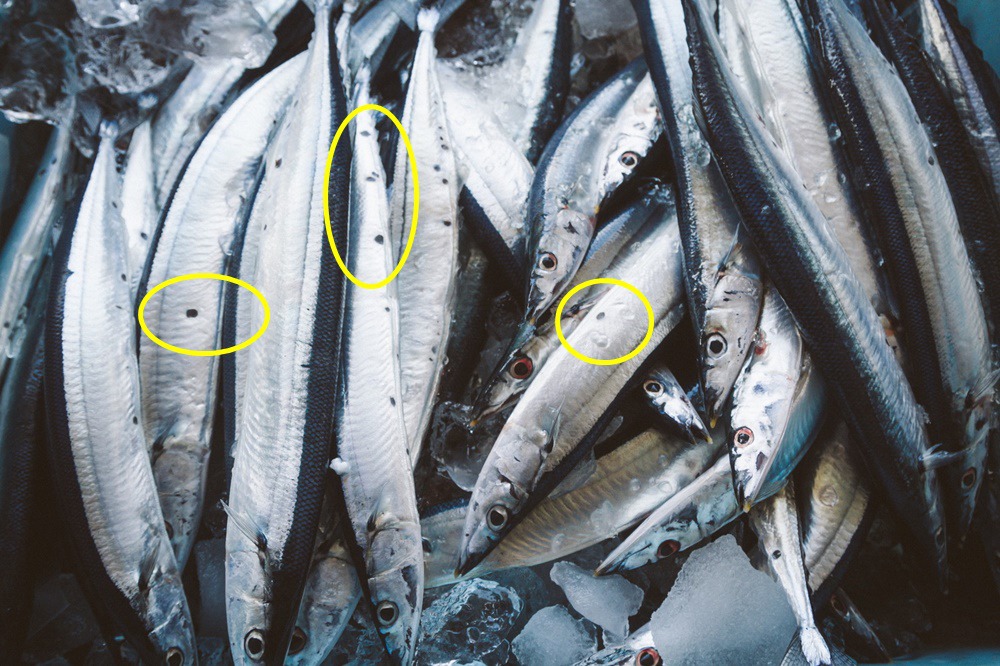
What are the blue spots on the skin of sauries?
Sauries, which is in season in the fall, has become a staple side dish served at raw fish restaurants year-round as it has become natural to eat frozen imported sauries due to the decrease in catch.
However, while purchasing sauries online, it seems that the seller does not know what the blue spots on the sauries’s skin are, so I would like to write a few words, even though it may be presumptuous.
If you look at the product description posted by the seller, the blue spots on the sauries are written as follows : “Just as people have spots, sauries and other fish also have spots. The blue spots on the surface of the sauries are not caused by a rotten product, but rather occur naturally on the sauries’s body~(omitted) . ”
However, these are not dots but scales of anchovies. Let’s find out why anchovies’ scales are embedded in the skin and why they are light blue in color.
Before we delve into that, let’s briefly examine Korea’s import situation for anchovies. Taiwan accounts for over 90% of Korea’s total anchovies imports, followed by Vanuatu. Combined, these two countries account for over 98% of imports.

Imported sauries is caught through net fishing, and when a large number of sauries are caught in large nets, the sauries collide with each other, causing their scales to come off. These scales are then swallowed by the sauries, and when freshly caught sauries is grilled and eaten, sometimes the scales come out of the intestines.

Image source: National Institute of Fisheries Science, Fisheries Operations Diagram
Most of the scales of sauries caught with a net fall off during the landing process, but those that remain are discovered during the rapid freezing and then thawing process.
Heme, the pigment part of hemoglobin that contains iron, is broken down in the liver and changes into biliverdin, a blue-green bile pigment, or bilirubin, a reddish-brown bile pigment. In some fish species, including sauries, biliverdin becomes calcium salt, turning the bones and scales blue.


The scales of the sauries that have turned sky blue like this are stuck to the skin and are noticeable to us during the thawing or preparation process.
Finally, there’s a lot of information out there on how to choose fresh sauries when buying live sauries, but I feel like I’m missing the most important part, so let’s just cover what it is and end this article.
When selecting a fresh sauries, the most important thing to keep in mind is its lower jaw . A yellowish lower jaw indicates freshness , meaning it was caught less than three days ago. After that, it begins to turn brown as freshness declines. It’s not easy to find such a fish, but it might be helpful to keep this in mind. ^^


Leave a Reply
Want to join the discussion?Feel free to contribute!