
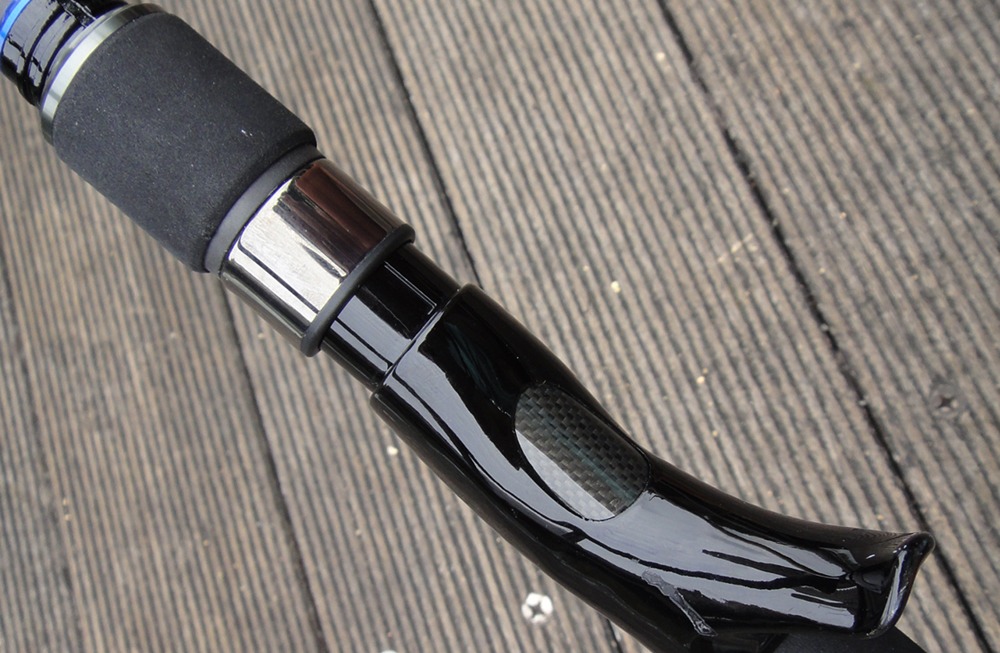
Types of reel seats for lure rods
I sometimes get asked what the difference is between the reel seats used in high-end and entry-level rods, as they use the same reel seats despite having a large price difference.
So this time, we will learn about the reel seat for lures from Fuji, a Japanese company that is currently the most widely used.
As you all know, there are two types of reel seats: plate type and pipe type. Pipe type reel seats are used for lures.
However, from the perspective of a company that produces rods, the thickness of the legs of the various reels that will be mounted on the rods produced is the most problematic part.
Some reel feet (reel legs) are thick and some are thin, so it is not necessarily the case that high-end rods use expensive reel seats, and that entry-level rods use cheap reel seats. Even for the same reel seat, the price can differ by 4 to 5 times depending on the specifications, but there are not many companies that accurately inform people of this.
For example, Fuji Industries’ VSS starts at 800 yen, while B VSS or SB VSS start at 3,400 yen, but companies that produce/sell rods do not disclose detailed specifications and only say that it is a VSS sheet (since VSS has the meaning of sheet, if it is called a VSS sheet, it will not fit as it has two sheets).
Also, in the case of spinning reel seats, there are down lock and up lock types, and there are many things to consider, including the material of the reel seat. Therefore, the dichotomous distinction of “which reel seat is good and which reel seat is bad” is not correct, and the preferred reel seat may differ depending on the user’s physical condition (hand size, finger length, etc.). Therefore, let’s take a look at the differences between the reel seats that are most commonly used in lure rods currently sold on the market.
First, when you think of the reel seat, you think of the picture below. To be precise, the picture below can be divided into parts called the reel seat and the hood. In the case of VSS, for example, if the shape of the hood attached to the back is SD type, it is simply called VSS, and those that use other hoods have a separate name in front, such as B VSS or SB VSS.


In addition to these hoods, the part below called the “wind check” can also be considered part of the reel seat (some products do not have a wind check).


So, let’s first look at IPS and VSS used in spinning lure rods.


The S is characterized by being slightly thicker than the VSS, and among the locking methods mentioned above, it mainly adopts the up lock method. The reason for not using the down lock is to avoid the disadvantage of the down lock that can cause strain (fatigue) to the hand, especially the fingers.


It has recently been receiving attention again because it can be held with light force, and thus it is easy to feel the sensitivity and allows for delicate action. The “Evergreen Poseidon Salty Sensation PSSS-53S”, which is sold for over 400,000 won, is a product that adopts IPS.
VSS is an abbreviation for “Versatile spinning seat” and as the name suggests, it is a reel seat that can be used in a variety of ways. It is easy to think that it is used in general-purpose rods (or all-purpose rods), but this is not necessarily the case and it is also used in expensive rods.
This is because, in the case of spinning, there are only three types: the most expensive DPS, IPS, and VSS.
An example of a load that adopted VSS is
JS Company Nix Inshore (around 130,000 won)
JS Company Big Sword N A4 (around 400,000 won)
There are NS Dark Horse (around 80,000 won), etc., and looking at this, you can see that the reel seat is not decided based on the price difference.
 Reel seat for bait
First, if we look at the release date of the most used or currently used reel seats, the order is TCS → ECS → ACS. Although the use of PTS, TVS, etc. has been increasing recently, it is still not that much compared to TCS, ECS, and ACS.
However, it is true that there are differences of opinion on the question of “Is it more sensitive to touch the blank of the rod directly or not?”, but when the TCS was first released, the explanation from the company was that the fish’s bite is transmitted to the line, and this passes through the guide and amplifies the vibration to the grip. Now, starting with the ECS, types with blanks (or should we say holes?) in the reel seat have been released one after another, and they are being promoted as showing even better sensitivity, which truly makes the saying “it depends” come to life.
So, let’s first look at the differences between TCS, ECS, and ACS using a diagram. You might not be able to tell the difference when the hoods are attached. (From top to bottom, in this order: TCS → ECS → ACS)
Then, let’s take a look at the difference just by looking at the reel seat with the hood removed. (From top to bottom, in order of TCS → ECS → ACS)


Now that we have a vague idea of the differences, let’s delve a little deeper.
※All photos are size 16, and there may be errors in length.
|
TCS16: Length 11.3cm: Inner diameter 15mm
TCS17: Length 12.5cm: Inner diameter 17mm
|
ECS16: Length 11cm: Inner diameter 9.5-15mm
ECS17: Length 12.5 cm: Inner diameter 15-17 mm
|
ACS16: Length 11.3 cm: Inner diameter 9.5 to 15 mm
ACS17: Length 12.8 cm: Inner diameter 15-17 mm
|
 |
 |
 |
First, the TCS is a sheet that is characterized by its lack of features. In the case of ECS or ACS, seawater seeps through the gaps (holes) created for the blank touch, and salt builds up, so it needs to be thoroughly cleaned with tools after fishing. However, the TCS has the advantage of being easy to maintain, and by completely covering the blank, it has high bonding strength and a stable grip. However, the disadvantage is that the part that connects to the reel is thick, which can be a strain on the fingers.
Among the products currently on the market that have adopted TCS, there are JS Company’s Jack Straw (around 65,000 won) and NS Monstick-S (around 300,000 won).
If you’ve seen the article about the arbor used to attach the reel seat ( A Story of Reel Seats and Arbors on Rods) from last time , you’ll know what an arbor is, but because it’s difficult (though not impossible) to use such arbors, ECS and ACS (and the most recently released TVS, etc.) are also called “arborless” reel seats . (However, strictly speaking, they are not arborless.)
ACS stands for “accuracy casting seat” and is advertised as improving casting accuracy, but I personally disagree with this claim and think it is exaggerated advertising.
Anyway, it may be the most familiar reel seat as it is currently the most used, but it is thicker than the ECS, and especially the trigger part is thick, so it may feel painful on the fingers touching the trigger, so it is a type suitable for people with long fingers and wide palms.
Among the products currently on sale, those that have adopted ACS include JS Company’s ChamCXT (around 270,000 won) and NS Bermuda SB (around 400,000 won).
ECS was released long before ACS, but it has recently been receiving attention again. It is considered to be the most suitable for Asians because of its overall thinness and thin trigger. Among the products sold on the market that have adopted ECS, JS Company’s Chamrod (around 180,000 won) and NS Furious Boron (around 360,000 won) are examples.
These are the most commonly used reel seats for baitcasting. Recently, the use of PTS, TVS, and SK seats has been increasing. Let’s take a quick look at them and finish.
PTS stands for Palming Trigger Seat, which means that you hold it as if wrapping it with your palm. It is recommended for those who do not like the steps of the ACS or have a small ECS and find it difficult to hold, as it uses a dedicated hood to significantly reduce the steps.

SK sheet is an abbreviation for skeleton sheet and is characterized by its separate form. SKTS is a trigger sheet where TS stands for trigger sheet and is for bait, while SKSS is a separate sheet without a trigger and is for spinning.

TVS is named “Tight V Spinning Seat” because the shape of the reel seat and the shape of the fingers form a V as shown in the picture.


Leave a Reply
Want to join the discussion?Feel free to contribute!