
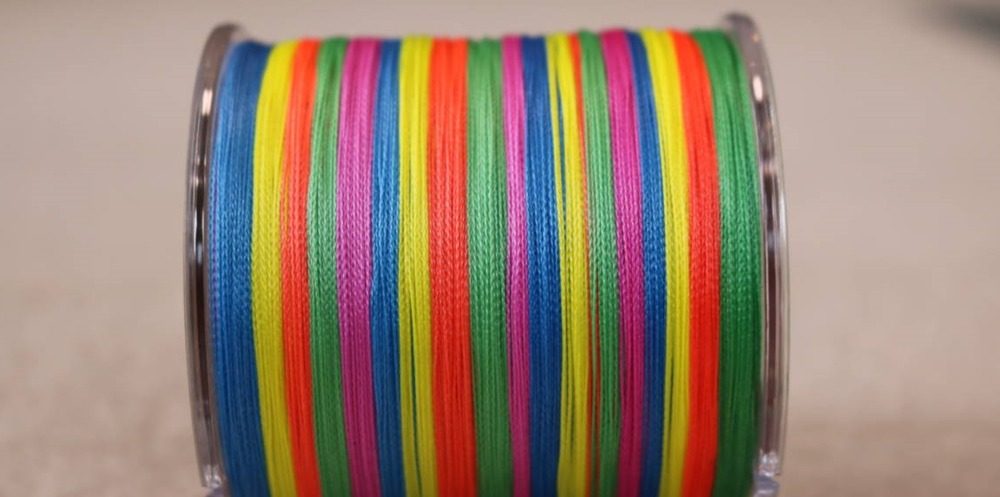
The Secret of the Square Root (√) Hidden in the Fishing Line
If you compare the fishing lines used by experienced and novice anglers, you will find that the less experienced angler is, the thicker the fishing line is.
The reason for this is probably that when a bite comes from a big fish that seems like it could be caught, there is an underlying anxiety that the fishing line might break because it is weak. But is it really difficult to hook a big fish if the fishing line you use is thin?
But to be clear, that’s absolutely not the case. In reality, it’s possible to easily catch large objects weighing more than its tensile strength, though this obviously requires skill.
So, from now on, let’s look at some things that beginners should know when choosing the thickness of the fishing line, or number.
First, let’s take another look at the most basic fishing line sizes. As we learned in “History of Fishing Line – How Are Sizes Made?”, the size of nylon lines has been used since 1947, when the company, which was originally named Dongyang Rayon but changed its name to Toray in 1970 and began producing fishing lines under the brand name Toray, first produced a nylon fishing line called “Eunrin” (Silver Scale), and designated the diameter of size 1 fishing line as 0.165 mm.
However, in the case of PE, which is the most commonly used material these days, there is no set standard, so when you buy a reel and reel in the line with the specifications that say ○○m of line can be wound, you often end up winding less.
Since Japan established a standard for PE yarn in 2010, which was different for each individual, companies that produce reels now indicate the amount of yarn in their specifications according to the following criteria. However, very few people know that the number of fishing lines is hidden in the square root of 2 (√2).
※ Note: Standard diameter of PE
|
lake
|
robbery
|
Standard value
|
Standard diameter
|
|
|
lb
|
kg
|
Denier (d)
|
mm
|
|
|
0.1
|
4
|
1.81
|
20
|
0.054
|
|
0.15
|
4.5
|
2.04
|
30
|
0.066
|
|
0.2
|
5
|
2.27
|
40
|
0.076
|
|
0.25
|
5.5
|
2.49
|
50
|
0.085
|
|
0.3
|
6
|
2.72
|
60
|
0.094
|
|
0.35
|
7
|
March 18
|
70
|
0.101
|
|
0.4
|
8
|
3.63
|
80
|
0.108
|
|
0.45
|
9
|
4.08
|
90
|
0.115
|
|
0.5
|
10
|
4.54
|
100
|
0.121
|
|
0.6
|
12
|
5.44
|
120
|
0.132
|
|
0.7
|
14
|
6.35
|
140
|
0.143
|
|
0.8
|
16
|
7.26
|
160
|
0.153
|
|
1
|
20
|
9.07
|
200
|
0.171
|
|
1.2
|
24
|
10.89
|
240
|
0.191
|
|
1.5
|
30
|
13.61
|
300
|
0.209
|
|
1.7
|
34
|
15.42
|
340
|
0.219
|
|
2
|
40
|
18.14
|
400
|
0.242
|
|
2.5
|
50
|
22.68
|
500
|
0.270
|
|
3
|
55
|
24.95
|
600
|
0.296
|
|
4
|
60
|
27.22
|
800
|
0.342
|
|
5
|
80
|
36.29
|
1,000
|
0.382
|
|
6
|
90
|
40.82
|
1,200
|
0.418
|
|
8
|
100
|
45.36
|
1,600
|
0.483
|
|
10
|
130
|
58.96
|
2,000
|
0.540
|
We know that as the lake gets bigger, the thickness of the line also gets thicker, but we don’t necessarily need to know the criteria for the thickness and whether it is proportional, but knowing it will help us understand fishing lines.
If you look at the back of the composite product that is readily available on the market and used by many anglers, you will see the specifications listed below. Looking at the diameter of No. 1, you can see that it is 0.171mm as shown in the table above, and No. 2 is 0.242mm.

Those who saw the title would have already noticed that the size of the fishing line is proportional to the square root of the diameter (√2) . (0.171mm x √2 = 0.241mm) Also, the tensile strength of a wire material such as a fishing line is proportional to the cross-sectional area, and in the product specifications, you can see that the tensile strength of No. 2 is slightly less than twice that of No. 1.
The answer to the question of which lake is best to choose for fishing lines that have the secret of square root 2 (√2) can be found in a paper written by Professor Hideki Ohama of Yamanashi University in Japan.
The paper observed the pulling force (tension) and duration of time when the fish were hooked by lure fishing with salmon and rainbow trout that were 50 cm long and weighed 1.7 to 1.8 kg. According to the results, the maximum tension at the moment was 2.4 kg for salmon and 2.9 kg for rainbow trout.

That is, it was discovered that a tension of approximately 1.3 to 1.7 times the body weight was applied, and the time until maximum tension was applied was approximately 70 seconds after being caught on the needle, and after 150 seconds, it was reduced to 1/5.
If we break this down a bit, even excluding the resistance according to the angle of the PE to the surface, the fish caught on the hook shows a struggle that reaches its peak around 70 seconds as it gradually increases its swimming speed against it. This can be said to explain that the fish caught on the hook gradually loses strength after 70 seconds due to the resistance (square of the speed) felt by its body.
For reference, if a fish is 1 m long and weighs 10 kg, has a body diameter of 20 cm, and swims at a speed of 60 km/h, the maximum tension is calculated using the following formula.
Maximum tension = (1/2) × drag coefficient × cross-sectional area × seawater density × speed². Therefore, the maximum tension exerted by a 10 kg object is approximately 13 kg.
In other words, this means that even a 10kg fish can be easily caught with a No. 2 PE line. Therefore, beginners should understand that there’s absolutely no problem using a line that’s a bit thinner than they think. Rather than using thicker lines, it’s actually more beneficial to regularly check the line for damage.


Leave a Reply
Want to join the discussion?Feel free to contribute!