
The History of Fishing Lines – Fluorocarbon Lines
Fluorocarbon, or carbon for short, is understood by anglers as a type of fishing line, but some people also understand it as the raw material for making freon gas (also called fluorocarbon), a major culprit in destroying the ozone layer.
※ HFC (Hydro Fluoro Carbon): A substance that does not contain chlorine and does not destroy the ozone layer, but contains hydrogen.
※ HCFC (Hydro Chloro Fluoro Carbon): A substance that contains chlorine, but has relatively weak ozone layer destruction properties because it contains hydrogen.
※ CFC (Chloro Fluoro Carbon): A substance that contains chlorine and has strong ozone layer-destroying properties, and its production and import were completely banned at the end of 1995.
Unlike the raw material of freon gas, the raw material of fluorocarbon line (fishing line) is polyvinylidene difluoride (PVDF), a high-purity thermoplastic fluoropolymer with high resistance. Simply put, it is a type of fluororesin and can be thought of as a plastic.
This type of PVDF is used in semiconductor manufacturing processes, and is used as a material for membrane filters used in water treatment processes around us. It is also used to make fishing lines, strings for stringed instruments, and pipes, sheets, and plates.
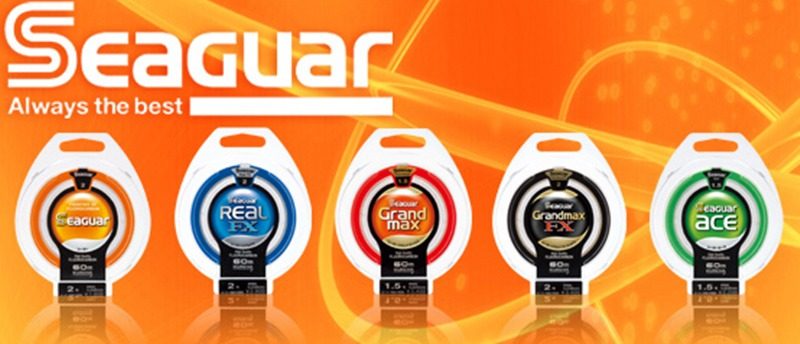
This type of fishing line made from PVDF, called fluorocarbon line, was first produced in 1971, and the company that made it is a Japanese company called Kureha, which also makes the brand name ‘SEAGUAR’, which is synonymous with fluoroline .

Kureha Corporation changed its name from Kureha Chemical Industry in 2005, but it did not originally develop polyvinylidene fluoride resin for the purpose of developing fishing lines.
After Japan’s defeat in World War II, the industry producing caustic soda flourished during the process of rebuilding the post-war economy. Caustic soda was an important raw material used in plating, paper, and soap, and while demand was overflowing, dealing with the large amounts of chlorine generated during the manufacturing process was a huge headache for companies.
This vinylidene chloride resin, developed using chlorine, was already being produced in the United States and, due to its moisture-impermeable properties, was already being used by the US military during World War II to wrap bullets and gunpowder in the jungle to protect them from moisture. Kureha Industries succeeded in producing this through its own research and development and introduced it to the market for the first time in 1953.
The first product made was a net that did not absorb moisture and did not deteriorate under ultraviolet rays. However, because it did not deteriorate easily, the replacement cycle of the product was long and it was expensive to produce, so it ended up being a failure.
Next, Kureha Industries began producing food films, and from the time it entered this business, Kureha Industries experienced rapid growth. Among the food films, the product used to wrap sausages became a huge hit.

However, they had not yet created a fishing line, and at the time, they focused on food packaging wraps that were being distributed to ordinary households in the United States. After repeated research and development, they succeeded in making the film odorless, and in 1960, they launched ‘Kure Wrap’, a wrap for household use similar to the packaging wrap we use today.

Then, in Japan, a huge fishing boom occurred from the late 1960s to the 1970s, and since the fishing was mainly for silver carp, it was so popular that, according to media articles at the time, “the rivers were so overflowing with people that you couldn’t even move.”
Riding this wave of popularity, Kureha Industries also began producing and selling fishing lines using vinylidene chloride resin in 1971, which was the world’s first fluorocarbon fishing line, called “Seaguar.”


When the cigar was first released, the price was 330 yen, and since the exchange rates between the yen and the dollar and the Korean won and the dollar in the early 1970s were almost the same, it is estimated that the difference in currency value at that time and now is about 30 times, so if converted to the current value, it comes to the calculation that 10 meters of fishing line costs 90,000 won .
However, those of you who have been fishing for a long time or are older will probably have used the ‘Cig Ace’ released in 1983 and the ‘Cig Grand Max’ released in 1996 at least once despite their hefty prices.
Fluorocarbon lines made in this way are loved by many anglers and are especially used as shock leaders for lure fishing. However, polyvinylidene fluoride, the material of fluorocarbon lines, has the characteristic of being strong against salt because it hardly undergoes chemical reactions, but it has the problem of not being broken down in the ecosystem and remaining as it is.
It may seem unrelated to the ‘marine plastic’ problem that is currently emerging as a global concern, but since this is also a type of plastic, is it really harmless even if it does not decompose? Or is it an issue that can be overlooked and overlooked when it is discarded and left as is because of other environmental damage, such as damage to animals caused by discarded fluoroline? I think many anglers need to think about this.


Leave a Reply
Want to join the discussion?Feel free to contribute!