
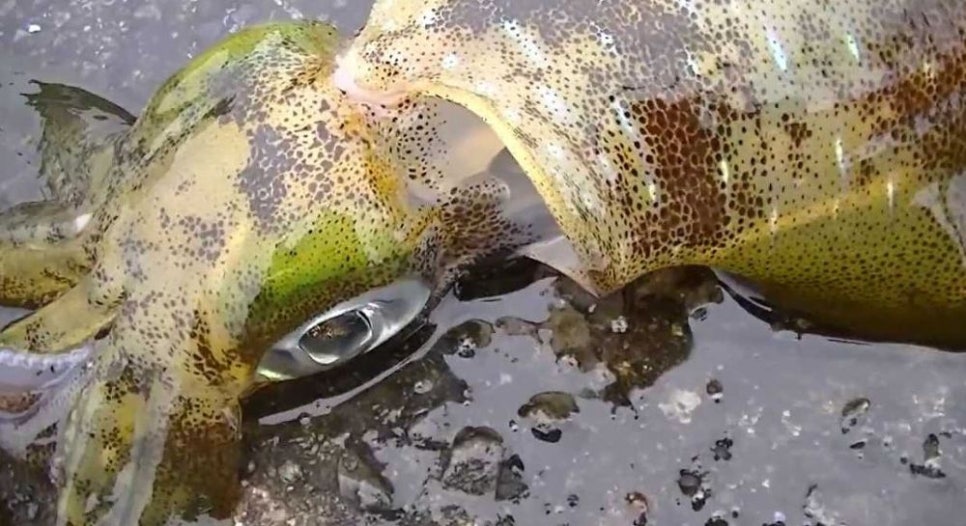
The eyesight of cuttlefish
The reef squid’s visual acuity is known to be 0.6 to 0.7, but according to a 2007 paper published by the Mie University Research Institute in Japan, which has conducted extensive research on the reef squid’s vision, the reef squid’s visual acuity is 0.63, while the flying squid’s is a whopping 1.37. If this is true, the flying squid appears to have excellent vision, comparable to my corrected vision with glasses. ^^
However, the important part here is the eyesight of the cuttlefish, so if we focus on the topic, this eyesight of 0.6 is known to be 0.05 to 0.3 for the eyesight of ordinary fish, so it is said to have eyesight up to 10 times higher than that. When we consider that the eyesight of the red sea bream, mackerel, rockfish, black sea bream, and sea bass that we commonly come across is around 0.1 to 0.15, we can imagine how excellent the eyesight is.

It is known that the angle that a cuttlefish’s one eye can see is about 180°, and if you add the two eyes together, it becomes 360°, but in reality, it is said that it cannot see backwards because the two eyes are spaced apart.
On the other hand, since the visual axis is slightly below the horizontal, it is said that when preying on prey, it often pounces from slightly above and behind the prey, and it is thought to be convincing that it reacts to the shark action but does not bite, and bites only during the fall and stay action .
Therefore, in order to increase the catch, it is effective to make the squid aware of the presence of the squid jig so that the squid jig can go down to a deeper place than the swimming layer of the squid. It is no exaggeration to say that the squid jig hitting the bottom is the most important part of eging fishing, and it can be seen that it is absolutely necessary not only to determine the water depth but also the swimming layer.
Previously, it was known that cuttlefish could not distinguish colors, but a study by Mie University on the ability of cuttlefish to distinguish colors found that the maximum absorption wavelength of rhodopsin in cuttlefish is 494 nm, which is equivalent to distinguishing objects only in black and white.
Although cuttlefish generally have poor color discrimination, they are highly sensitive to the contrast between light and color, and have a remarkable ability to perceive color contrast. This allows them to distinguish between squid and their surroundings when fishing, allowing them to bite. It is believed that this is why squid are manufactured with two different colors: a base color and a body color, to create a striking contrast.
Meanwhile, in experiments with cuttlefish, when bait is placed in a glass bottle with the stopper closed and placed in front of the cuttlefish, it stretches out its legs to try to capture it. Since the bait is inside the bottle and cannot smell it, it can be seen that the cuttlefish uses its sight to feed. However, it does not rely solely on sight, and it is said that it also uses its ability to detect the faint scent of fish or shrimp, which are used as bait, for feeding.
However, since they primarily rely on vision for their foraging, squid fishing at night is best done with adequate lighting. They are also said to perceive even the smallest amounts of light emitted by microorganisms like plankton, so using luminous squid lures at night to capitalize on this trait can be beneficial for catching them.


Leave a Reply
Want to join the discussion?Feel free to contribute!