
The Difference Between Spinning Reels and Bait Reels
The most common reels used for lure fishing are spinning reels and baitcasting reels. While there are “spincasting reels,” which appear to combine the functions of both spinning and baitcasting reels, these are not as widely used.
I plan on writing a separate post about spin casting reels, but to put it briefly, they look similar to LBD reels, and when casting, the line is released by pulling and releasing the lever, so even if a clumsy beginner uses them, there is less chance of problems such as line trouble, so I have one because I don’t have to worry too much when going out with children or family members.


However, for those somewhat experienced in fishing, this reel isn’t a good fit. This is because it only supports nylon line (other lines can be used, but they present numerous structural issues), doesn’t offer much distance, and is very difficult to cast with light tackle.
However, if you plan to enjoy fishing with young children, it may be difficult to focus on fishing yourself while taking care of children who are not familiar with using the equipment, so it might be a good idea to prepare a relatively inexpensive spincasting reel.
Now, let’s get down to business and examine the pros and cons of spinning reels and bait reels. While spinning reels are still the mainstream choice for bass lure fishing, recent advancements in bait reel technology have led to a steady increase in their use.
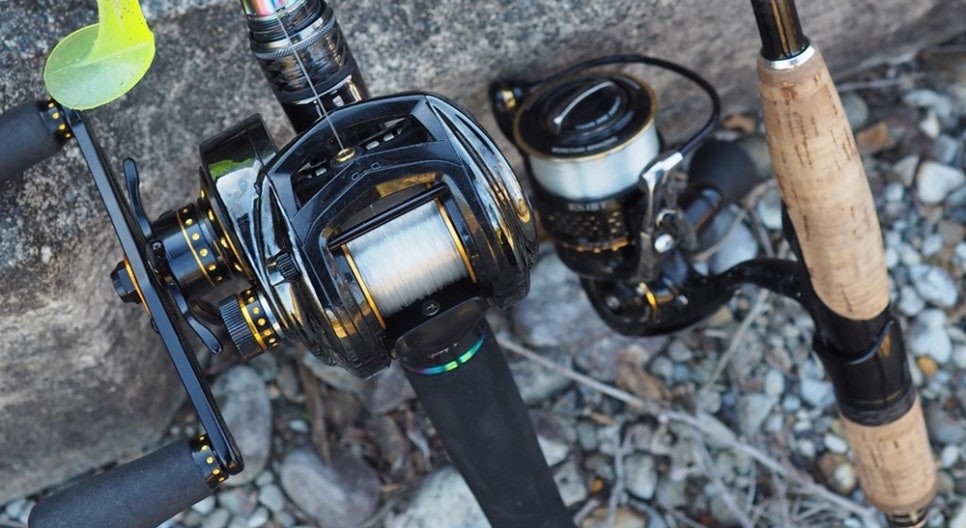
The biggest difference between a spinning reel and a bait reel is that the part that is mounted on the rod is below for a spinning reel and above for a bait reel. Next, the direction in which the spool that releases the line rotates is vertical to the rod for a spinning reel, while for a bait reel, it rotates in a straight line with the rod. This is the biggest difference that can be seen with the naked eye.
Spinning reels and rods

Bait reel and rod

The difference is that since the spools rotate in different directions, the line that is released in a spinning reel forms a spiral and experiences a lot of resistance from the guide, while the line that is released in a bait reel is released in a straight line and experiences less resistance.

Due to these structural differences, spinning reels and bait reels differ in many ways. Let’s take a look at them one by one.
distance
Spinning reels release the line wound on the spool as is, whereas bait reels release the line by rotating along with the spool, so bait reels have a longer casting distance.
There is still a lot of controversy about what word goes in the ○ space above, and the most common question about distance is, “Spinning has better distance,” “Bait is better once you get used to it,” or “Bait is the world record.” Since this is such a controversial issue, I reserved my personal judgment and left it as ○.
Sensitivity to feel
While spinning reels are held only by the rod, bait reels are used by holding both the rod and the reel together, so bait reels are superior in terms of sensitivity.
Also, when winding the line, a bait reel that can be wound in a straight line can feel the sensitivity in the water better than a spinning reel that rotates in a spiral and receives resistance from the guide.
Spinning reels have a severe line fraying problem.
Bait reels release the line in a straight line as the spool itself rotates, but spinning reels release the line from the spool in a spiral shape, making it easy for the line to become entangled.
Bait reels are inconvenient for light tackle.
Structurally, spinning reels are ideal for casting lighter tackle farther. However, “Bait Finesse,” a device designed to compensate for these shortcomings of bait reels, has recently been gaining significant attention.
The word “Bait Finesse” literally means “delicate” in French, “finesse”, and refers to a reel that is made to allow for precise and delicate casting to pinpoints using light tackle such as “no-sinker worms”.
Difference in power
Bait reels can structurally be equipped with large gears, and spinning reels that wind the line with a line roller do not fully transmit power because the load is applied to this point, while bait reels that mount the reel on top of the rod can exert greater power because the power transmitted to the rod is even and wide.
Bait reels cannot change the direction of the handle.
Most spinning reels have handles that can be swapped left and right, although there are some things that cannot be changed in the cheaper models, but bait reels cannot change direction.
Differences in casting movements
Spinning reels require more action per stroke than baitfish reels because the bail must be opened and cast before casting. This can lead to increased fatigue in situations like bass fishing, where frequent casting is required over relatively short distances.
Line Trouble
Compared to spinning reels, which are prone to line fraying, bait reels have a difference: when the spool rotates faster than the line is released, a phenomenon called “backlash” occurs. To reduce this backlash, a motion called “summing” is used. A similar motion is called “feathering” when using a spinning reel.
backlash

Difference in lines
Spinning reels can use thick lines, but the line can easily get tangled, so when using thick lines, the spool size must be larger to reduce the tangle and line trouble.
However, in the case of bait reels, it is easy to use thick lines even on small reels, and there is no difference in casting distance even if there is little line left on the spool, but in the case of spinning reels, when there is little line left on the spool, the line brushes against the edge of the spool when casting, and the resistance received increases, reducing the casting distance.


Leave a Reply
Want to join the discussion?Feel free to contribute!