
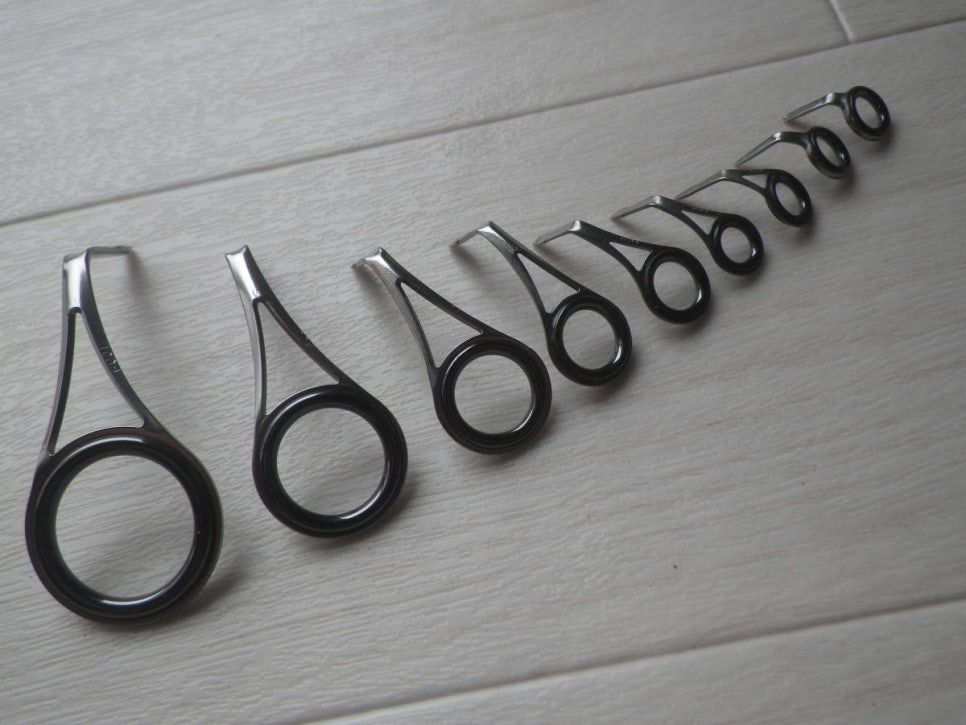
The declining Fuji Guide (Fuji Industries) of Japan
In an article titled “There is no fun in choosing a fishing rod,” it was explained that the NRX series, the flagship model of the world-famous American company G·Loomis, uses guides from REC (REC Components), which was founded in 1968. Founded in 1982, Loomis began using Fuji Industries products for its guides in 1997 when it became a subsidiary of Japan’s Shimano.

As a side note, one of the major factors that allowed Jirumis to make a name for themselves in the American market in a short period of time was that the rods were designed by an outstanding person named Steve Rajeff, a 45-time American Casting Association Champion and 14-time World Champion.
Steve Rajeff

Anyway, now that Fuji guides are being used on the road of Jirumis, many people would think that Fuji Industry’s business is on the rise, but the reality is the opposite, Fuji Industry’s sales are continuously decreasing.
In fact, the topic of today’s conversation is not so much about Fuji Industry’s guides as it is about warning people against the blind preconception that Fuji guides are the best. For example, many anglers say that rods using Torzite guides are good, but they seem unaware that Torzite guides have been criticized for Fuji Industry’s dark history for years due to problems such as noise generated when using composite rods.
Fuji Industries recorded sales of KRW 58 billion in 2018 and KRW 60 billion in 2019 and 2020, but this decreased significantly to KRW 47 billion in 2021 and recovered slightly last year, achieving sales of KRW 50 billion.
However, it is not the case that a decline has begun simply because of a decrease in sales.
Fuji Industries has been relocating its manufacturing facilities to Qingdao, China since 2002 to reduce production costs, but is now planning to relocate them back to Japan. The main reason for this is that the export volume, which accounts for 80% of the total volume produced in China, is gradually decreasing, and labor costs in China continue to rise.
Fuji Industries Japan Headquarters

Fuji Industries Qingdao, China factory

Also, the company has not been able to produce any notable hits recently. This is because half of the 170 employees left the company when the factory was relocated from Japan to China, which led to a severe shortage of development personnel and a small market size. As a result, the management is seeking to diversify its business into other fields, which leads to the outlook that it will be difficult for the company to grow any further in the guide and reel seat sectors.
There is a scene in the drama Casino where the phrase “Hwamusipilhong” is used to describe the “Gwonmusipilhong” (a type of hibiscus flower), and looking at Fuji Industries, that phrase feels real.


Leave a Reply
Want to join the discussion?Feel free to contribute!