
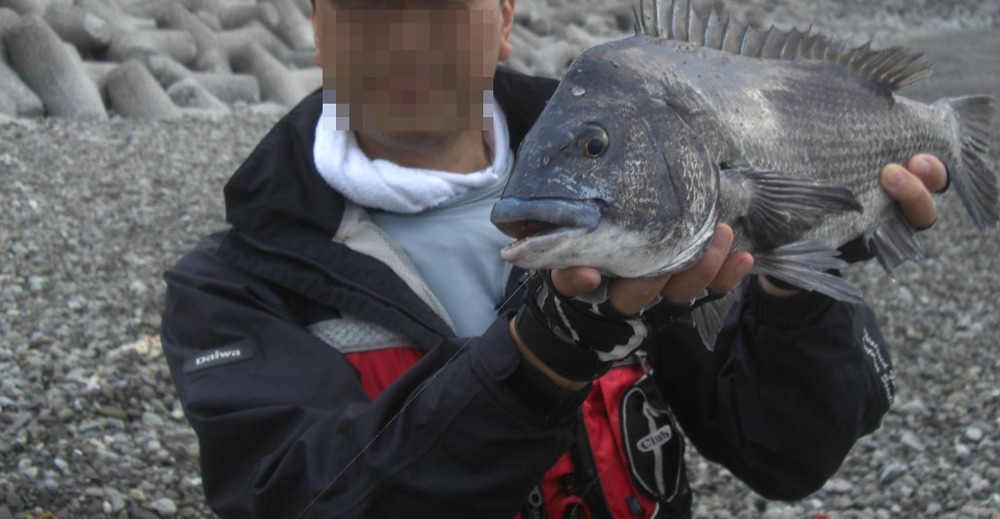
Sea bream surf fishing (Part 3)-
The fishing methods for catching black sea bream differ significantly depending on the season, so the advice in Part 2 that places with fast currents are good does not apply to black sea bream in winter.
As with other fish species, when targeting the particularly sensitive black sea bream, it is very helpful to acquire sufficient knowledge about the characteristics and habits of black sea bream in advance.
Actually, I didn’t plan to post about fishing methods that differ depending on the season, but I thought that those who don’t have much experience might have a lower catch if they apply the same method to winter fishing after reading the method on understanding the seabed topography in Part 2, so I’m going to look into how to target black sea bream in winter.
In 1986, at the Fisheries Experiment Station in Okayama Prefecture, Japan, a transmitter was attached to the body of a black sea bream in November and February to investigate its movement distance. The experimental results showed that in November, it moved about 42 km per day, while in February, it only moved about 1.4 km .
What we can learn from these experimental results is that as water temperatures drop, the effectiveness of bait and groundbait in catching fish declines. Furthermore, in the case of long-distance fishing, where groundbait cannot be distributed, this proves that, compared to float fishing, finding the exact spot where black sea bream migrate and casting to achieve a good catch is crucial.
While these large differences in travel distances are due to individual issues, the most significant factor is the temperature of the seawater. Black sea bream instinctively prefer areas with varying seafloor conditions.
However, this instinct often does not work in winter when the water temperature drops significantly, making it especially difficult for beginners to catch black sea bream in winter.
Looking at the ongoing series on red sea bream long-distance fishing, there’s quite a bit to learn. However, considering that fishing is a science and relies on accumulated data, acquiring a wealth of information will be beneficial not only for red sea bream but also for other target species. Therefore, I encourage you to build a broad and in-depth knowledge base.
As you know, the ocean has four seasons. Because the ocean temperature cools later than the atmosphere, there’s about a month’s difference between what you feel on land and what you feel on land. Therefore, February and March, including March, when we await spring, are considered midwinter at sea.
When winter comes and the water temperature drops like this, unlike homeotherms, cold-blooded fish drastically reduce their activity and stop foraging.
However, in the case of black sea bream, there is experience catching them even in water temperatures of around 8℃. This is because coastal fish like black sea bream have relatively strong cold tolerance. Those who use long-distance fishing to catch black sea bream, which has strong cold tolerance, must keep the following three things in mind.

① Find a place with deep water.
Deep waters are less prone to temperature drops than shallow waters. Just as people seek out warmer waters when the weather is cold, and anglers’ fishing trips decrease during the winter, black sea bream also seek out warmer waters, flocking to deeper waters where temperatures remain relatively stable.
This makes sense when you consider that in winter, rivers and sea water begin to freeze from the edges.

② Avoid areas with fast currents.
Currents are to fish what wind is to humans. Just as strong winds in the cold winter can make the perceived temperature drop dramatically, to catch black sea bream in winter, you should avoid strong currents like the main stream. (However, summer and fall are different.)

③ Aim around obstacles such as underwater reefs and reefs.
Emotional dome instinctively likes places with changes in terrain, and baitfish often gather in these places. However, in winter, they become even better spots because they can avoid the flow of currents (water temperature).

In order to catch red sea bream, it is best to go to a slightly warmer area south, but even if that is not possible, to increase the chances of catching one, you should find a spot where the water temperature remains relatively stable. Also, on days when the water is not very clear, it is necessary to remember that fishing after sunrise or before sunset is better than the morning and evening when the sun rises and sets as we commonly know .
Typically, the water temperature at which black sea bream begin feeding is known to be around 12℃, and they are known to stop feeding when the temperature drops below 10℃. It is natural for fish to become less active as the water temperature drops.
Therefore, in order to catch low activity fish, it is most important to focus more and find the point.
Especially in winter, since black sea bream eat their prey little by little, it is better to extend the hooking timing a little, and it is also effective to target the end of a breakwater, a quay wall, or an obstacle such as a tetra.
Between December and February, black sea bream become less active, their metabolism slows, and their lower abdomens don’t shrink, making them less active and less likely to forage. Therefore, it’s crucial to acquire sufficient prior knowledge before heading out to sea.


Leave a Reply
Want to join the discussion?Feel free to contribute!