
Sea bream surf fishing (Part 2)-How to Understand the Seafloor
When it comes to long-distance fishing, most people tend to go on one-night, two-day trips or day trips. As a result, they often focus on nighttime fishing rather than daytime, and it’s common for darkness to fall by the time they arrive at their destination and begin preparing.
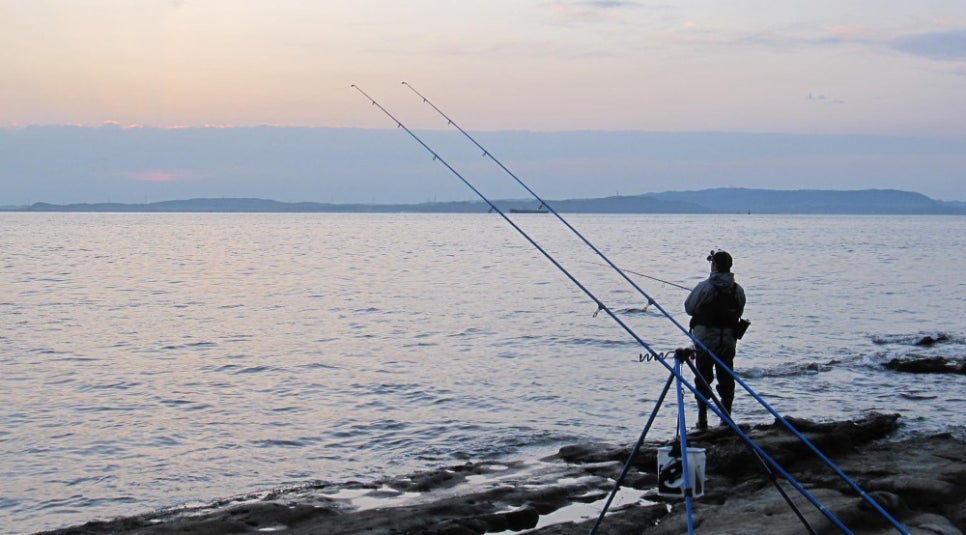
During the day, it is easy to observe the surrounding terrain, waves, and currents with the naked eye, as in photo 1, but even in the same location, as in photo 2, it is difficult to identify them at night.


So today, we’ll learn how to determine where the water depth and seabed topography are changing when fishing at night, why you should focus on areas where the seabed topography is changing, and how to determine the seabed topography and select fishing points by looking at the waves during the day.


When targeting big fish with surf lures or long-distance fishing on a white sand beach, it is true that it is somewhat difficult to judge the overall waves and currents of the sea because the casting platform is lower than when fishing on a rock.
However, if even a slight visual identifiable point is available, the first thing to look for is the tidal boundary . This is where the currents converge, where temperature and salinity fluctuate, water color changes, and plankton populations increase due to the abundant growth of seaweed.
Therefore, since there are many baitfish that feed on plankton, there are many target fish species that feed on this.


These boundary points arise due to differences in seawater flow, water quality (salinity), and temperature. However, for those less experienced anglers, changes due to wind can also be perceived as boundary points. The only way to overcome this is through extensive experience.
The next thing to look for is where the wave begins to break. As shown in the photo below, the point where the wave begins to break and foam forms is usually where the water depth gradually increases or remains constant until it’s raised by a sand dune, gravel, or underwater reef ahead.


As I’ve posted before, baitfish instinctively prefer fine terrain like this. Furthermore, these areas of change in terrain are important because plankton and crustaceans tend to gather there.
To aid understanding, let’s look at the view from the reef. The circled area shows particularly large foam formations, indicating that the seabed changes significantly compared to other areas. The area on the right, in particular, is characterized by strong currents, making it an especially advantageous spot.


However, it’s nearly impossible to identify a spot by observing these foams at night. Therefore, even in dark conditions where identification is difficult, you can still identify the waves directly ahead using a headlamp.
Looking at the photo below, you can see that the wave origins are different, whether due to water flow or differences in the bottom topography. This difference can be judged by observing how much of the incoming wave is swept away.

You can see that the waves pushing out from the circled area are much larger than those around it. This indicates a shallow sandbar, a sandy area forming a hill on the seabed ahead. Therefore, for best results, cast around the circled area rather than the area itself, which is difficult to identify with the naked eye.

These are mainly formed in areas with strong swells that run counter to the waves coming from the sea, and baitfish tend to gather in front and behind these sand bars.
Next, among the previously mentioned wave breaking points, the best point is to find the beach break, where surfers’ favorite waves begin.
This beach break also has several starting points, but the first one is the one you should focus on. Another important point to note here is that while it might be a bit difficult at night, during the day, distance is crucial for long-distance fishing. Therefore, you should aim for the starting point of the beach break, rather than focusing on absolute distance .

I think many people have probably experienced the bait constantly being washed away and ending up in front of their feet while fishing for red sea bream at night. It is important to remember that if you cast in front of the beach break like this, the bait will inevitably be washed away .
The next place to look for is where a rip current occurs . Since rip currents are frequently reported in the media during the summer vacation season, I’ll skip the detailed explanation, but if you look at the photos (spraying dye to observe the rip current), you can see that the water is swept away about 50-60 meters. Some surfers focus on targeting only the center of this rip current, but this is not a very desirable practice.


As previously explained, the point where these rip currents form is deeper than the surrounding water, so you can see the foam breaking near the point where they form. There are various ways to identify these rip currents, but since this is a lengthy topic, I’ll save that for another time and end this post here.
In the case of winter sea bream long-distance fishing, most people fish at night, and it is not easy to observe at night because it is dark. However, based on the information mentioned above, if you make an effort to observe the terrain and waves of the fishing spot, even just a little, you are more likely to get good results.
To be continued in Part 3… … … .


Leave a Reply
Want to join the discussion?Feel free to contribute!