
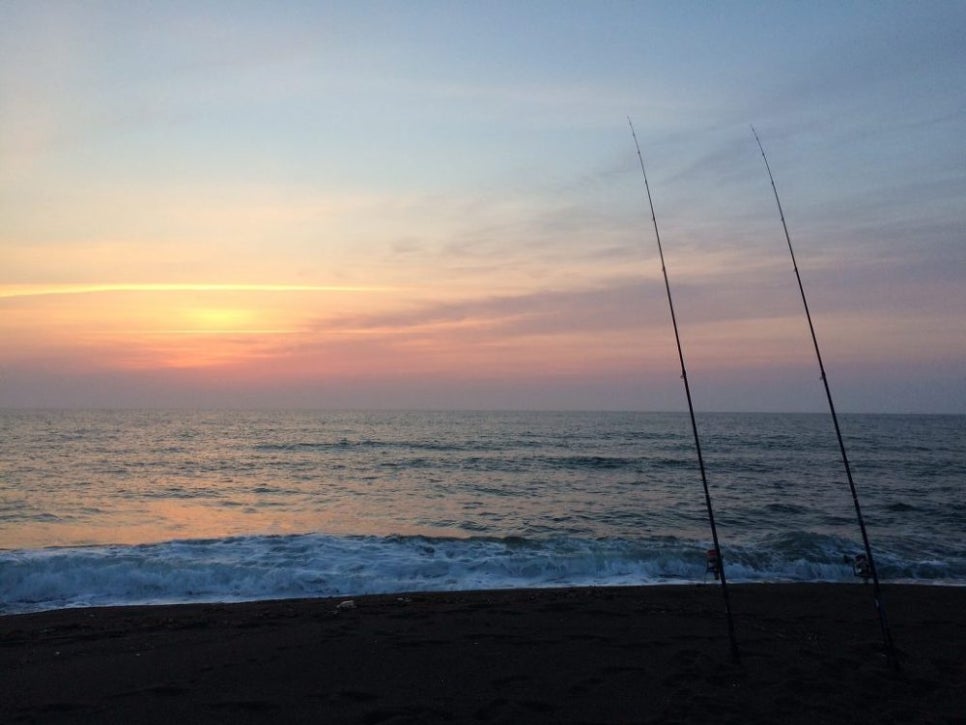
Sea Bream Fishing (Part 6) – Bait and Habits
Among the baits prepared for catching red sea bream with a long-line fishing rod, the most popular are probably sand worms (honmusi) and dogfish.
Although black sea bream can be caught with floats and lures, float fishing is probably the most popular method. However, it is important to note that the ecology of black sea bream caught with floats is slightly different from that of black sea bream caught with long-distance fishing from the shore.

A long time ago in Japan, the black sea bream was nicknamed “nezumidai” (鼠鯛) because it was a fish that would eat anything it could get its hands on, like a rat. This shows that the black sea bream is an omnivorous fish that does not discriminate between plants and animals.
However, the feeding habits of black sea breams that live in deep ocean waters and black sea breams that live in relatively shallow coastal waters are slightly different, and the closer they live to the coast, the more they are not picky about their food.
However, in proportion to this, the sea breams living near the coast are more wary of their greatest natural enemies, especially fishermen, and are also more agile.
Furthermore, since the black sea bream, with its developed sense of smell, relies more on smell than sight for its feeding activity, it reacts particularly strongly to the smell released when proteins break down. That is why bait such as pupae are also used for black sea bream fishing.

Black sea bream also eat mussels and clams, but when fishing, they sometimes intentionally rot clams to make them smell bad, and using bait made by soaking squid intestines in them can also produce good results when fishing for black sea bream.

When looking at the feeding habits of black sea bream, it is known that they generally prefer soft baits during the low water temperature period from winter to early spring, and hard baits during the high water temperature period from summer to fall .
However, since the use of bait is limited in long-distance fishing compared to jigging, it is recommended to use bait that has a long-lasting scent and spreads far as possible. When using live earthworms as bait, it is helpful to use ones with a long survival period to catch fish.
That is why in Japan, the bait called taimusi or akamusi (タイムシ or アカムシ), which costs over 6,000 yen per 100g and is more expensive than honmusi that can survive in the water for more than an hour, is preferred as bait for red sea bream long-distance fishing.

Let’s mention again what we looked at in winter black sea bream long-distance fishing. In 1986, at the Fisheries Experiment Station in Okayama Prefecture, Japan, they attached transmitters to the bodies of black sea bream in November and February to investigate their movement distances. The experimental results showed that in November they moved about 42 km per day, while in February they only moved about 1.4 km.
However, the above experiment was conducted on black sea bream living in the open ocean, and the Tokyo Bay Black Sea Bream Research Association, a private organization that has been actively promoting black sea bream resource protection and release projects in Japan, conducted an experiment in which 3,719 black sea breams were tagged and released over a period of 10 years and tracked. Among the results, the notable part is that black sea bream living in the coast use breakwaters as their main territory, and even when they move, they migrate between breakwaters and near reef areas.
As can be seen from the experiment above, in order to catch coastal black sea bream with a long-range fishing line, it is best to focus on areas with reefs or obstacles such as underwater reefs.
Like Japan, many places in Korea also practice stocking, either temporarily or periodically. However, to enjoy fishing for a long time, I believe it’s important to release any target fish caught during the fishing ban period, and to immediately release any fish smaller than the target size. With that in mind, I conclude this six-part series on “Empressed Sea Bream Long-Range Fishing.”


Leave a Reply
Want to join the discussion?Feel free to contribute!