
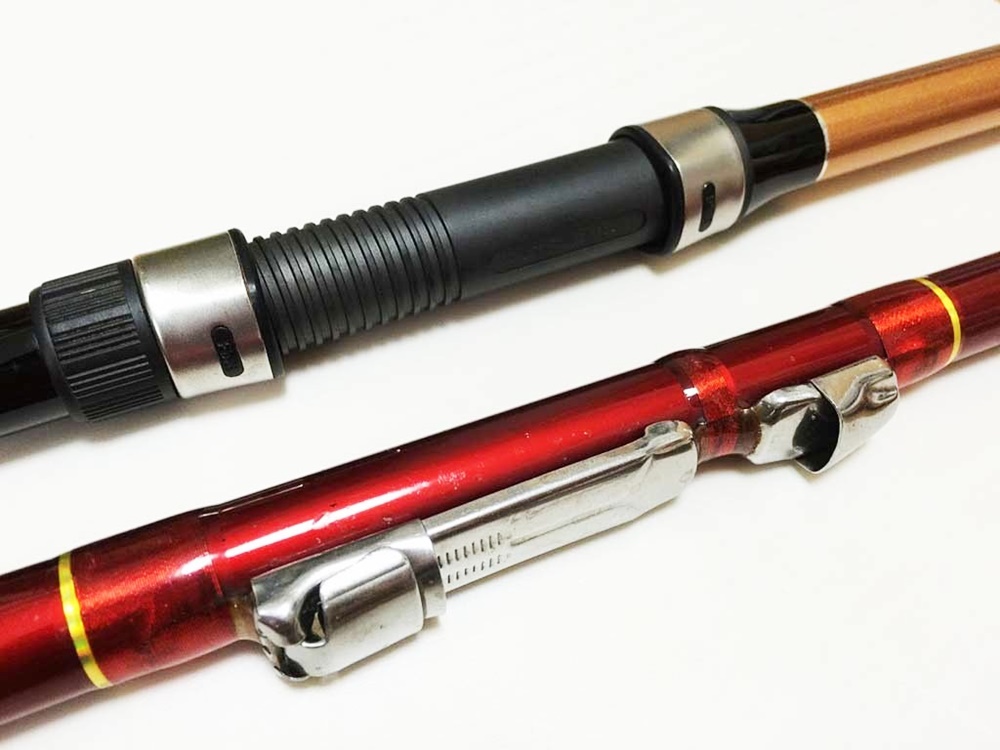
One of the most frequently asked questions about fishing rods
Today I’d like to talk about one of the most frequently asked questions I get about fishing.
The question I get asked most often is whether or not rods made by companies other than the big names or major manufacturers are good or bad.
To be honest, I don’t know for sure, and it would be wiser to ask that question directly to the company.
However, manufacturers often do not provide accurate answers to consumers’ questions, using excuses such as trade secrets or know-how that cannot be disclosed.
That’s why I tell people to use the amount of information provided as one of the criteria when purchasing fishing gear.
Oh! Of course, I’m excluding the ones that list all the dazzlingly Photoshopped, slapstick jokes.
When people design rods, they often attach promotional drawings or videos showing how to place the reel seat and guides using CAD.

However, the design of the rod can be said to begin with deciding how to wrap the carbon sheet, how many times to wrap it, and how to cut it.
However, not many companies design their own carbon sheet laminate structures. Therefore, some companies use ready-made blanks for their products.
However, as I said before, it may be an exaggeration to say that the fishing rod manufacturing industry requires investment but not cutting-edge high-tech equipment, and that it requires a lot of employees but does not require research and development in the field of raw material technology, but that is not entirely wrong.
Companies currently producing blanks made of carbon, the material used in fishing rods, are neither cutting-edge nor large-scale industries, but rather more like cottage industries.
This is because production begins with simple purchase, regardless of research, production, and development of the carbon sheets used as raw materials, and even a little thought will tell you that a company that produces rods would not invest in R&D of carbon fabric.
Companies that produce rods are usually categorized into those that own their own kilns, those that do not have kilns but purchase heat-treated blanks to manufacture them, and those that do not have kilns or buildings but outsource production to companies that do have kilns.
Therefore, if a product is made by importing carbon fiber from Japan, heat-treating it in a kiln in China or a third country, and then bringing it to Korea to be assembled and processed before being sold, then what kind of technology from which country should it be said to contain?
I am saying this because there are products that are produced and sold in this form.
Back to the main topic, the quality of rod production varies depending on the carbon sheet used, how much it is heated, and how it is painted, even if the same materials are used. It also varies depending on the guide and reel seat.
That’s why most reviews often explain things that are different from the essence, such as how expensive a guide is and how good a reel seat is because of a certain company.
But, you see, only a rod with a good guide attached to a good blank can be said to be excellent, a rod with a bad guide attached to a good blank is average, a rod with a good guide attached to a bad blank is a piece of shit, and a rod with a bad guide attached to a bad blank is a failure. So, in the end, the standard for evaluating the perfection of a rod cannot go beyond each person’s own brain, which is why I said in the beginning that the best way to evaluate the quality of a rod is to contact the company directly.
However, since companies do not provide detailed information and answers to consumers’ inquiries, they face practical difficulties. In such cases, you can make a decision by asking just one question that will serve as the basis for your purchase decision.
The reel seats of long-distance fishing rods can be divided into plate type and pipe type. In the case of the pipe type, rather than the plate type, there is a gap between the rod blank and the reel seat, so this gap must be filled in some way.

You can just ask the company about this.
In the case of companies that directly design the laminated structure of the carbon sheets they use, most of them design it so that there are almost no gaps, so they finish it with adhesive only, but in the case of manufacturing the blanks by procuring them externally, they often use a method of winding thread and bonding it or using paper-based materials to bond it, but in some cases, they fill the gaps with blue tape and then bond it.


Fishing rods made with blue tape are not used because exposing them to high temperatures for long periods of time can easily cause the reel seat to shake or become deformed, but you can see that blue tape was used in the rod production of a certain company that sells them for around 300,000 won.

I don’t remember the company’s promotional copy in detail, but I remember them bragging about how they achieved the best quality with the best technology.
Ask me now what material is used to fill the gaps in the reel seat.
If you can’t answer, it’s either not a product you designed yourself, or even if you did design it, if the manufacturer made it differently from what was designed, it’s proof that quality control is not being done properly, so wouldn’t it be wise not to buy such a product?
No matter how much people around you say it’s good.


Leave a Reply
Want to join the discussion?Feel free to contribute!