
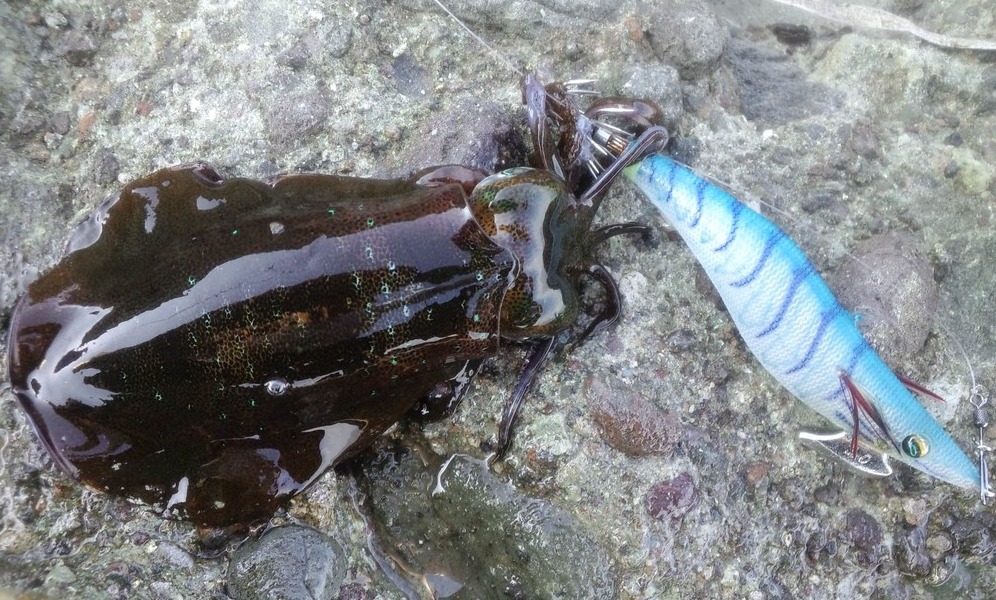
Let’s find out what a short bite is in lure fishing and how to deal with it.
The expression “short bite” used in lure fishing is difficult to find detailed information about when searching in English because it is not used in English-speaking countries.
The term “short bite” is a combination of the word “bite”, which means to bite the bait, and the adjective “short”, which means short. It is used to describe a fish that bites but only a small bite that does not catch the hook.
The expression ‘short bite’ used in Korea and Japan is called ‘short strike’ or ‘short striking’ in English-speaking countries, so when searching for related information, it is better to search for ‘short striking’ rather than ‘short bite’.
The fact that we can feel so many small bites that don’t lead to hooking can paradoxically be said to mean that the equipment has advanced to that extent.
So what should we do when these short bites are frequent? Of course, when fishing in the great outdoors, there’s no single, standard answer. Many anglers overcome short bites using their own methods, drawn from their own experiences, depending on the species and environment.
Especially in periods of low activity, if the target fish is small, the bite is basically fine, so frequent short bites are inevitable. In these cases and when the target fish is large, the countermeasures are bound to be different, so it is said that there can be no uniform countermeasure.
However, there are some universally accepted strategies, and let’s take a look at what many anglers use to overcome short bites.

The best way to overcome short bites is to maintain peace of mind. This may sound like a strange concept, but it’s important to note that many anglers who experience frequent short bites tend to rush and force their actions.
In such cases, the best thing to do is to get away from the point where short bites are frequent, have a cup of coffee, and take a rest. After that, the general method to overcome short bites is to use thin, long, and small tackle.
Specifically, it is recommended to change the lures you use from thick and short to thin and long. For example, if you were using a lure with a lip, change it to a lipless one, or if you were using a pencil bait, change it to a worm.
The key to changing the size and weight of the lure you use is to make it easier for the target fish to swallow it. This also applies to changing the tackle you use.
When short bites occur frequently, the most common method used by anglers is to change the hook. This is done by using a smaller hook so that it can easily enter the fish’s mouth. However, it is important to note that simply reducing the hook size can upset the balance.
In other words, if you are not familiar with such delicate operations, it is better to use only the rear assist hook (also called the tail assist hook) if you are using both the front and rear assist hooks. If you are using a double hook or treble (triple) hook, it will be helpful to change it to a single hook. Also, if you are using a closed-gap type hook, you will notice that short bites are reduced just by changing it to a straight-gap type.

The next thing that will be helpful to replace is the thickness and color of the line and shock leader. It has already been scientifically proven that the length, thickness, and color of the shock leader used are closely related to the fishing result.
※ Scientific research on the length and thickness of leashes
※ The effect of the thickness and color of the leash on the fish
In particular, the thickness of the shock leader, which can make the movement of the lure unnatural, is a very important factor. Therefore, in cases where short bites are frequent, it is helpful to not use a shock leader at all and connect it directly to the main line, and it is more effective to use a monoline rather than a braided line.
Lastly, it is said that changing the color of the lure you use helps overcome short bites, but I personally did not feel much of a difference in this regard, so I will omit it.


Leave a Reply
Want to join the discussion?Feel free to contribute!