
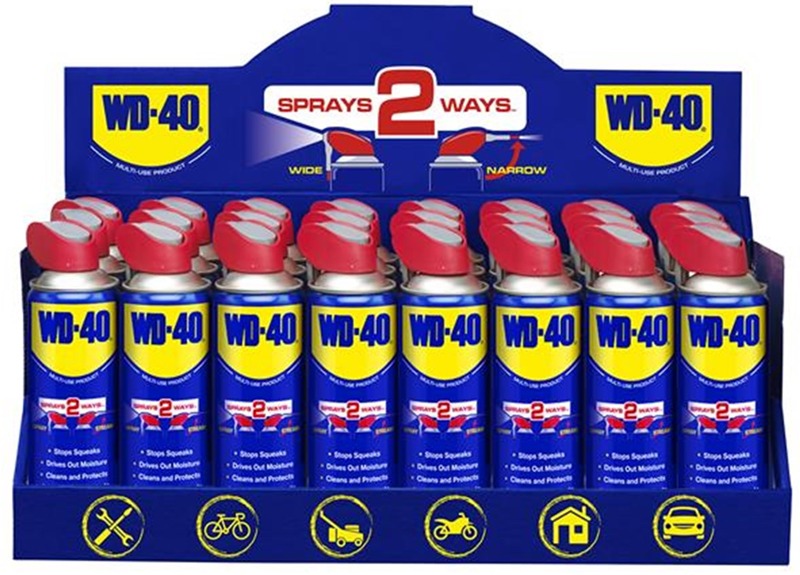
Is it okay to use WD-40 when servicing a reel?
Although it is not very common, you will often see posts saying that they used WD-40, which is readily available on the market, as a lubricant for their reels. Some people even claim that spraying WD-40 on their reels made them spin better, eliminating the need to buy a special lubricant. However, this is not recommended as it can damage the reel.
So this time, let’s find out why you shouldn’t use WD-40 as a reel lubricant.
WD-40 was named after Iver Norman Lawson of the Rocket Chemical Company in San Diego, California, in 1953, who was researching a formula to replace stagnant water, the cause of corrosion, and succeeded on his 40th attempt.
The official name of WD-40 is Water Displacement, 40th formula (or Attempt) when translated into Korean . However, if you look at the cautions listed on Namu Wiki, it says , “Never use it for lubricating high-speed rotating and moving parts where hard lubricants are applied.”
If you look a little more closely, you can see that it says, “High-speed rotating parts generate a lot of heat, and the problem is that if you spray WD-40 here, it will melt and remove all the existing medium- to high-viscosity lubricants, and the WD-40 components will soon evaporate due to the heat generated in the high-speed rotating parts or moving parts .”
Also, the WD-40 product instructions say, “WD-40 thoroughly removes not only impurities caused by rust and corrosion, but also dirty residues from regular oils and greases that have already been used.” Just looking at these contents alone, you can see that WD-40D should not be used as a substitute for lubricant and grease for fishing reels, but let’s take a closer look.
Lubricants typically use antioxidant additives to increase oxidation resistance by mixing in additives to prevent sludge or varnish buildup at operating temperatures, but WD-40 does not use such additives. Above all, there is no information at all about the content of rust inhibitors added to lubricants, which is important information for reel maintenance, but the general opinion of experts is that WD-40 does not contain these.
This means that depending on the operating environment, the bearings are prone to corrosion, so applying WD-40 to the bearings of the reel you are using could cause fatal damage.
A frequently asked question is about disassembling and assembling a reel. Unless the reel is in a condition that can be thrown away or it is not a big burden if it becomes unusable, it is usually more economical to leave the disassembly and assembly of the reel to a professional.
In fact, if you try it a little, you will realize that disassembling and assembling a reel is not that difficult, but I would like to point out that overlooking the fact that it requires more skilled skills than simply disassembling and assembling can increase the possibility of problems occurring or shorten the product’s service life.

As we saw in the previous article, “ Why are the screws on the reel painted?”, reel manufacturers apply a screw-locking agent to the screws to prevent them from loosening. When disassembling and reassembling the screws, it is necessary to repaint them. However, those without experience can easily miss these small details, so even if it is not immediately apparent, it can shorten the lifespan of the reel.
Even if you think of it as just a single screw, the manufacturing company sets the exact value for the strength of the screw tightening based on meticulous calculations. For anglers who do not know these details, especially when it comes to expensive reels, it is better to ask a professional to do the job.
Also, it is better not to use WD-40 when cleaning reel parts. Inexperienced anglers may not know this, but it can damage the resin contained in the reels. Therefore, it should only be used on metal parts. Since anglers do not know these details, it is better to refrain from using it at all.
Finally, although the image size is small and the resolution will decrease when enlarged, I will conclude the discussion by looking at an experiment comparing WD-40 and a special lubricant.
The parent company conducted an experiment in which they cleaned the line rollers thoroughly, applied genuine oil and WD-40 to each, soaked the line rollers in salt water with a concentration twice that of seawater for 1 minute, and then wound the line 50 meters 50 times, soaked them in salt water for another minute, took them out, left them for a day, and observed the operating condition and bearings of the line rollers. The results of the experiment confirmed that the line rollers of the reels applied with WD-40 did not work, but the line rollers of the reels applied with genuine oil worked normally.
And the results of disassembling the line roller and inspecting the bearings showed that the one that had WD-40 applied had red rust, while the bearings of the reel that had genuine oil applied had the same amount of salt crystals observed, but they still worked.
Finally, I put the genuine oil and WD-40 in a container and stored it in a refrigerator set to 8℃. When I took it out, I observed that the WD-40 had completely solidified. If this actually happened to the reel, it goes without saying that damage to the parts would be obvious.

Of course, there are WD-40 products that can be used in temperatures from -18℃ to 148℃, but it is much better to buy the genuine product, which is advantageous in many ways.
In conclusion, WD-40D is a solvent that dissolves lubricants, so it is recommended to use it only when cleaning the parts before applying lubricant to the reel. However, since many people do not know much about the specific materials of the reel, it is better not to use it at all. This is the conclusion of today’s posting.
Lastly, let me add one interesting story. Among the urban legends circulating among American anglers, there is one that says that the main ingredient in WD-40 is fish oil, which makes it so effective at catching fish. However, this is also nothing more than a rumor spread by American anglers that has nothing to do with the truth.


Leave a Reply
Want to join the discussion?Feel free to contribute!