
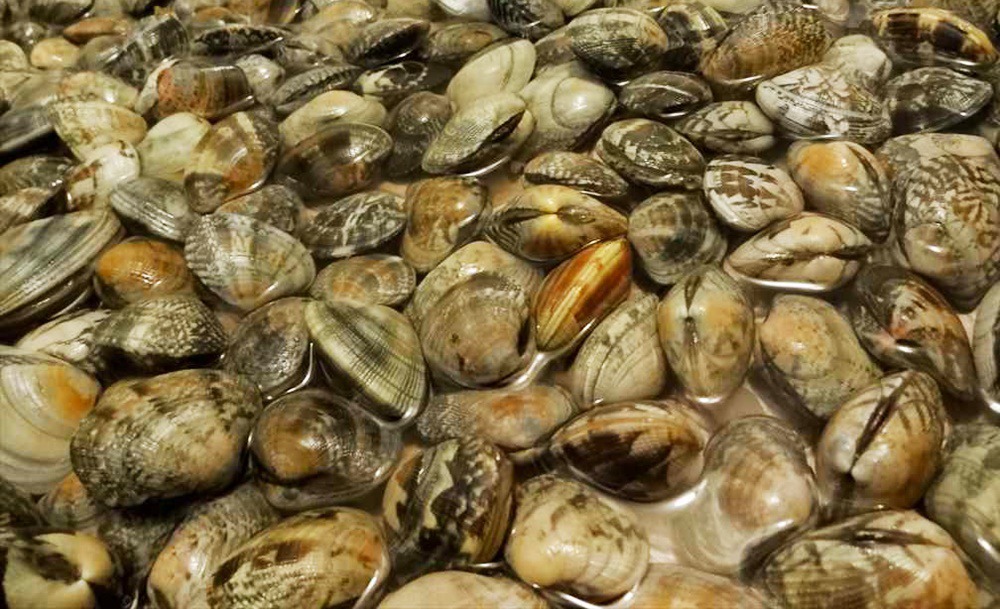
How to properly store clams
How should clams be stored? And how long can they be stored? The answer to this question can be easily found by understanding their ecology and habits. Let’s take a closer look at how to store clams at room temperature, in the refrigerator, and in the freezer.
■ When storing clams at room temperature
According to the food code, room temperature is 15℃ to 25℃, but clams start to lose weight when the temperature exceeds 18℃, some die when it exceeds 20℃, and the number of dead clams increases when it exceeds 25℃, so even when stored at room temperature, it is best to keep the temperature between 10℃ and 15℃.
As seen in ‘How to Defrost Clams’ , the optimal temperature for defrosting clams is between 15℃ and 18℃, which is the temperature at which clams are most active, and is not appropriate for storing clams.
When storing clams at room temperature, the temperature should be between 10℃ and 15℃, which is when the clams enter a dormant state. This will suppress their activity to a small extent and extend their storage period. However, even if this temperature can be maintained, storing clams at room temperature is not recommended because the water needs to be changed periodically.
■ When storing clams in the refrigerator
When storing clams in the refrigerator or freezer, they must be dehydrated before storage.
One thing to keep in mind is to check for dead clams before storing them in the refrigerator. If the water after clamming becomes significantly cloudy, check to see if any clams are not opening their mouths or check for dead ones by bumping them together and judging by the sound.
It is best to store clams in 3% salt water. To minimize the damage from residual chlorine, it is more effective to make the 3% salt water using boiled and cooled water rather than using tap water as is.
The best temperature for refrigeration is between 7℃ and 10℃. Be careful not to close the lid of the container you store it in as this can cause the clams to die. If you plan to eat it the next day, it is also a good idea to wrap it in a wet newspaper or kitchen towel before storing it.

One of the most common misconceptions among housewives is that, when purchasing clams from a supermarket or online, they are printed with instructions such as “within 5 days from the date of manufacture” or “store in a cool place” or “store at 0℃~10℃.”
However, this is mostly set based on storing clams at around 4℃, and the storage period is set to 5 days. Since clams are in a hibernation state at 4℃, the storage period can be 5 days, but if you are harvesting clams at home, it is better to store them for only 1-2 days because you cannot tell when they were harvested .
■ When storing clams in the freezer
The most important thing when storing clams in the freezer is to freeze them as quickly as possible.
To do this, it is recommended to freeze them by placing them on a metal tray with good thermal conductivity or wrapping them in foil. Another way to freeze them quickly is to make sure the clams do not overlap.

When freezing in a plastic container commonly used at home, it is best to remove as much air as possible. If the air is completely removed, it can be stored for up to a month, so if it is difficult to store in a vacuum, it is better to eat it as soon as possible.
Of course, it is okay to eat it after storing it for about two months, but in the summer, when the refrigerator door is frequently opened and closed, the temperature is not maintained consistently, so the preservation period is shortened, and unlike freeze-drying, the drying process progresses slowly, which has the disadvantage of causing the taste to deteriorate.
If you must store it for more than a month, it is best to store it in a plastic container filled with ice or ice water and quickly freeze it.

Again, instead of freezing them in a container filled with water, you should fill it with ice or ice water and freeze it as quickly as possible. The most important factor in freezing clams is how quickly they are frozen, so freezing them on a metal tray is also effective.


Leave a Reply
Want to join the discussion?Feel free to contribute!