

Global oyster production statistics and Korea’s foreign trade balance
Oysters are the product that China accounts for the largest share of global seafood production.
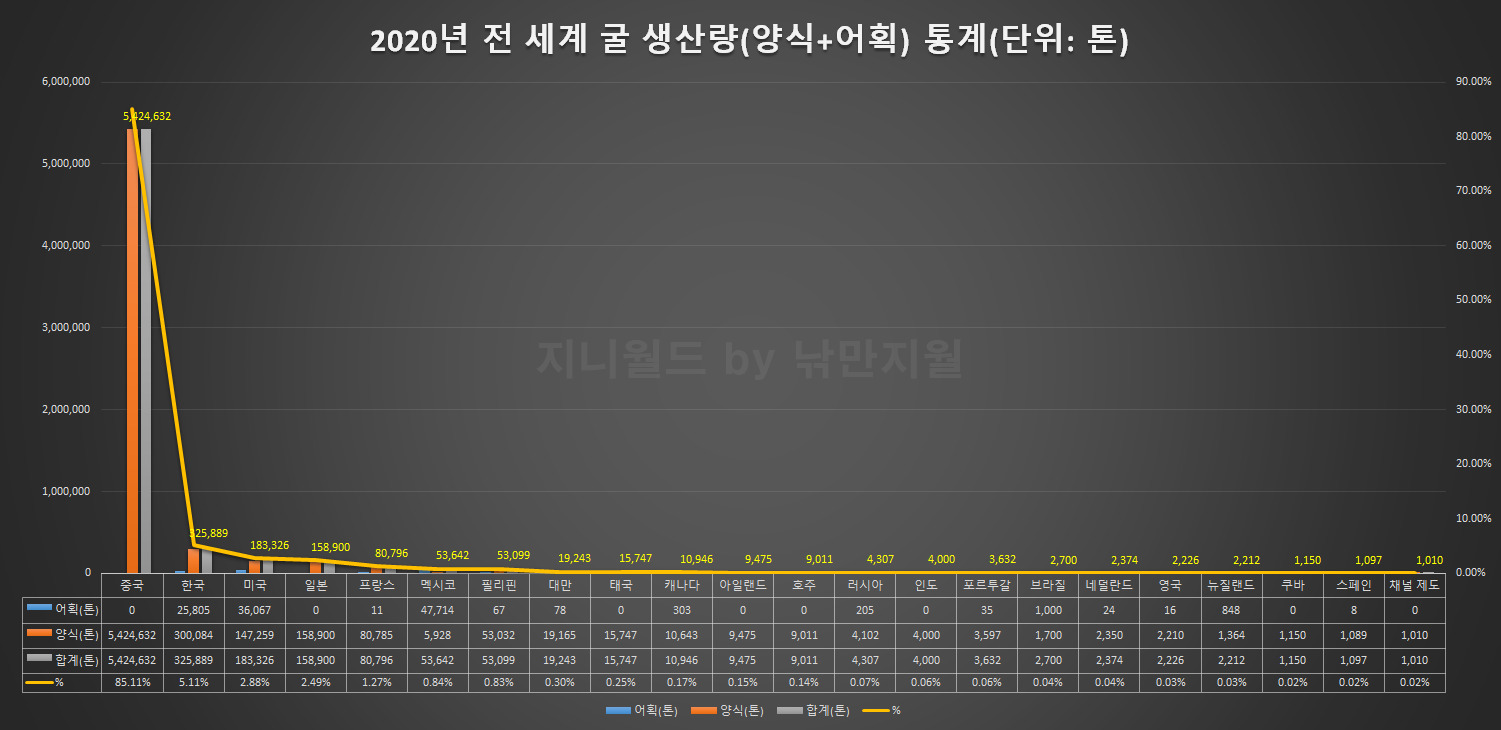
According to FAO statistics for 2020, while China’s wild oyster catch was so small that it was not counted, its farmed oysters accounted for 86.7% of the world’s farmed oysters and produced 5.42 million tons, accounting for 85.7% of the total global production (the combined production of wild and farmed oysters).
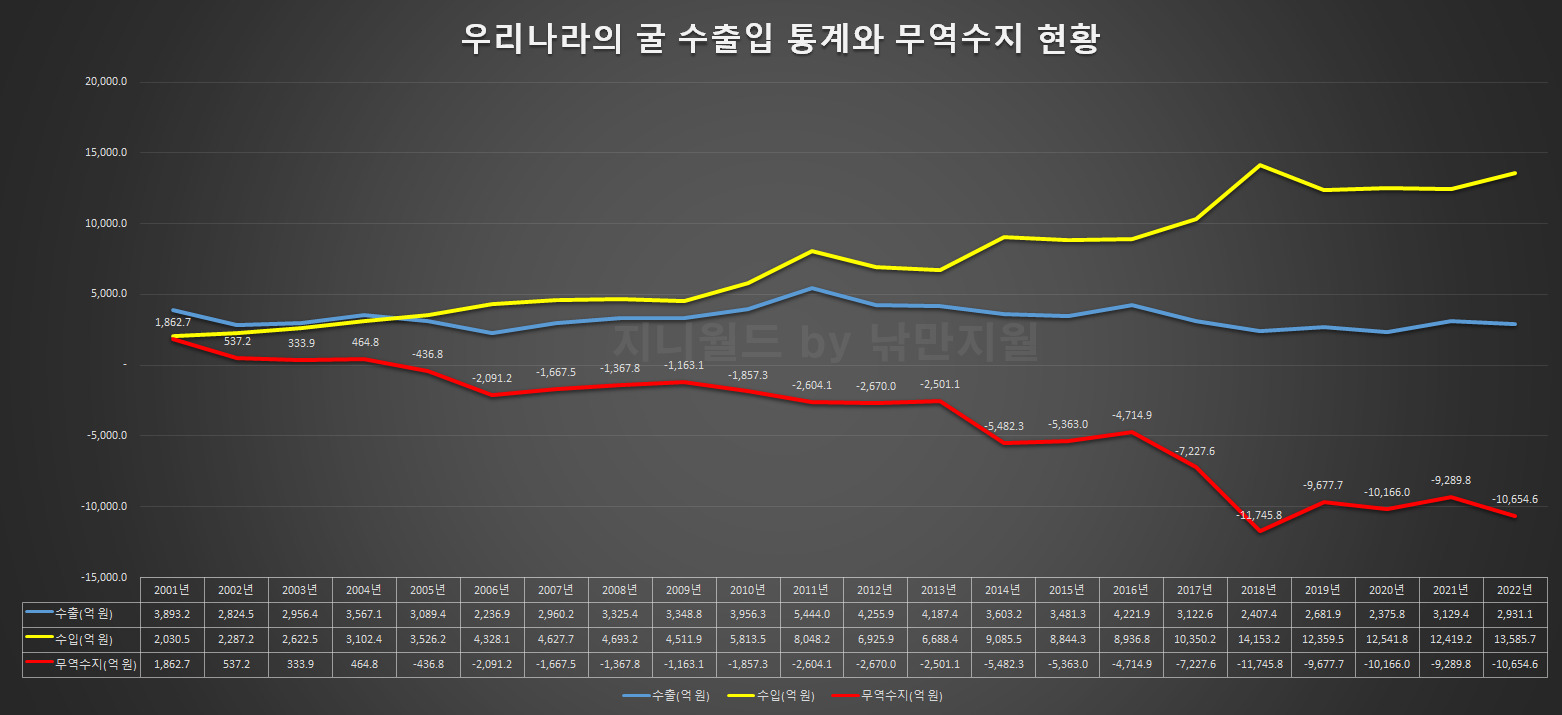
This is 16.6 times the amount produced by our country, which produced a total of 326,000 tons, and 67 times more than France. According to the 2020 statistics released by the FAO, if you look at the graph of the production of 22 countries that produced more than 1,000 tons of oysters, you can get a sense of how much China produces.
|
ranking
|
Country name
|
Catch (tons)
|
Form (ton)
|
Total (tons)
|
%
|
|
1
|
china
|
0
|
5,424,632
|
5,424,632
|
85.11%
|
|
2
|
korea
|
25,805
|
300,084
|
325,889
|
5.11%
|
|
3
|
USA
|
36,067
|
147,259
|
183,326
|
2.88%
|
|
4
|
japan
|
0
|
158,900
|
158,900
|
2.49%
|
|
5
|
france
|
11
|
80,785
|
80,796
|
1.27%
|
|
6
|
Mexico
|
47,714
|
5,928
|
53,642
|
0.84%
|
|
7
|
Philippines
|
67
|
53,032
|
53,099
|
0.83%
|
|
8
|
taiwan
|
78
|
19,165
|
19,243
|
0.30%
|
|
9
|
thailand
|
0
|
15,747
|
15,747
|
0.25%
|
|
10
|
Canada
|
303
|
10,643
|
10,946
|
0.17%
|
|
11
|
Ireland
|
0
|
9,475
|
9,475
|
0.15%
|
|
12
|
australia
|
0
|
9,011
|
9,011
|
0.14%
|
|
13
|
russia
|
205
|
4,102
|
4,307
|
0.07%
|
|
14
|
India
|
0
|
4,000
|
4,000
|
0.06%
|
|
15
|
Portugal
|
35
|
3,597
|
3,632
|
0.06%
|
|
16
|
brazil
|
1,000
|
1,700
|
2,700
|
0.04%
|
|
17
|
Netherlands
|
24
|
2,350
|
2,374
|
0.04%
|
|
18
|
uk
|
16
|
2,210
|
2,226
|
0.03%
|
|
19
|
New Zealand
|
848
|
1,364
|
2,212
|
0.03%
|
|
20
|
Cuba
|
0
|
1,150
|
1,150
|
0.02%
|
|
21
|
Spain
|
8
|
1,089
|
1,097
|
0.02%
|
|
22
|
Channel Islands
|
0
|
1,010
|
1,010
|
0.02%
|
|
Total
|
112,181
|
6,257,233
|
6,369,414
|
99.93%
|
|
The graph below shows our country’s oyster production, which may seem surprising, but our country has been unable to avoid a deficit in its foreign trade balance for oysters since 2005, and since posting a deficit of 1.1746 trillion won in 2018, it has maintained a deficit of around 1 trillion won every year. This may be surprising to many.
※ For convenience, an exchange rate of 1:1,300 won was applied here.
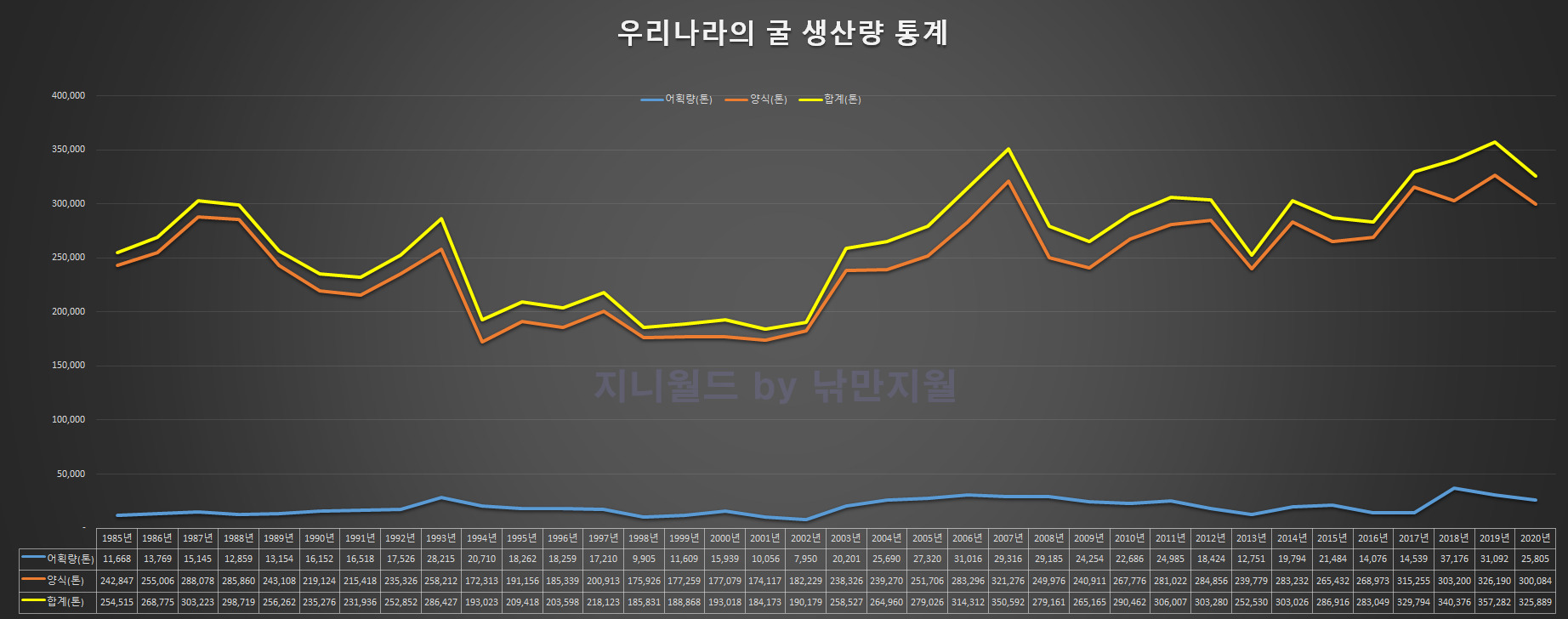
The oyster trade deficit is mostly due to the import of frozen oysters, with China accounting for 45% and Vietnam 28.5% of the trade deficit, and imports from Spain and Somalia also amounting to 19.5 billion and 1.45 billion won, respectively.
On the other hand, it is not known whether it is true or not, but it is said that Henry IV of France ate 300 oysters in one sitting, Napoleon always ate oysters before going into battle, and the philosopher Voltaire enjoyed eating oysters for inspiration, as can be seen from this, France is where all the oysters produced in Europe are gathered and is also ranked 5th in the world in oyster consumption.
As I introduced in a post titled ‘One Book, Whiskey and Raw Oysters’ a long time ago , the most famous of the European flat oysters that the French enjoy with wine is the Belon Oyster, which comes from the mouth of the Belon River in France. The Belon Oyster was especially certified and protected by the Appellation d’origine contrôlée (AOC), but it became extinct in the 1970s, and now only about 1% of the peak is distributed, using the same species from Ireland.
You can guess how famous the Belon oyster is just by the fact that it is the first image that appears when you Google Belon River. It is a variety that does not grow well, has a weak vitality, and has to be raised in tidal flats, so it takes a lot of time and effort to farm, so it was expensive to begin with, but after it became extinct, its price skyrocketed even more, and now it is being imported in large quantities from China, so its price is rising even more.
In 2022, South Korea produced 325,889 tons of oysters, exporting 41,410 tons (12.7%) and importing 236,442 tons, or 72.6% of total production. This means that one in two oysters (whether fresh or frozen) I’ve ever eaten was imported.


Leave a Reply
Want to join the discussion?Feel free to contribute!