
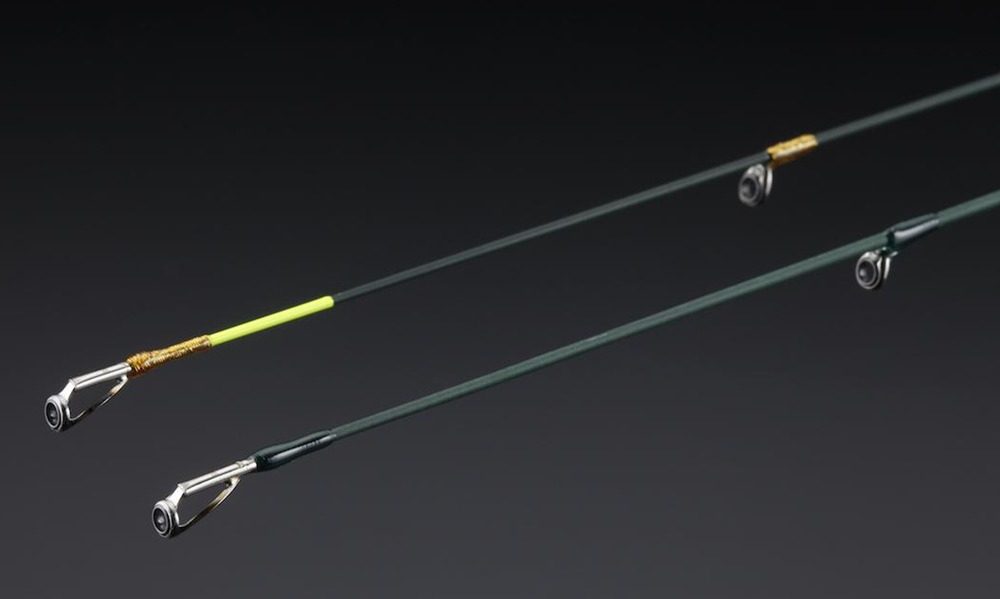
Difference between solid tips and tubular tips
The tip, which we commonly call a tip, is an English word meaning the end, and the words solid and tubular are added to it to distinguish between a hollow tubular type tip and a solid type tip that is filled with the inside.
Solid on the left, tubular on the right

In other words, simply put, you can understand that a tubular tip is hollow and a solid tip is full.
The reason why fishing rods are made by distinguishing these differences is because the bend of the entire rod differs depending on the shape of the tip, and this also results in a difference in sensitivity. Let’s take a closer look at this.
In general, tubular types are good for using heavy tackle because they have strong rebounding power, and solid types are easy to determine the bite just by bending the rod, and can be damaged even with a small impact, so they can be said to be a type that is not suitable for beginners. Unfortunately, most companies that sell fishing rods do not provide information on these specifications.
That’s why people who don’t have enough knowledge about fishing rods often mistakenly believe that the entire rod is of that type, rather than just the solid or tubular tip.
The biggest difference between a solid tip and a tubular tip is whether it is soft or hard, as shown in the photo below. This difference in softness results in different sensitivity and also a difference in the size of the fish that can be caught.
Tubular on top, solid on bottom

Solid on top, tubular on bottom

Since it is impossible to say with certainty whether a solid tip or a tubular tip is better, it is even more so that companies that produce or sell rods should provide detailed information on this, but they do not provide any information on this at all, which makes me think that this is a violation of consumer rights.
Therefore, even if we leave aside the price difference, I think it would be appropriate to allow people who purchase rods to choose one that suits their personal preference for the style of fishing they intend to do.
The biggest difference between solid and tubular tips, in addition to what has been mentioned above, is that solid tips can be made thin and flexible, which means they feel less discomfort when fish bite, and tubular tips have the advantage of superior sensitivity. Since the tubular type has a hollow shape, it is naturally lighter, but it has the limitation of being harder and thicker than the solid type.
Also, in the case of tubular tips, when a load is applied, the circular shape that makes up the hollow section of the cross-section becomes distorted into an oval shape. If this condition persists or there is a defect, the rod’s bending will not be normal. This does not make a difference in the sensitivity of feeling the fish’s bite, but it causes the fish to feel uncomfortable, which shows the disadvantage of reducing the accuracy of the hook.
When I look at information on the Internet, I see things that are close to a formula that divides solids and tubulars into which types of fishing solids are suitable for and which types of fish tubulars are suitable for. To be honest, I cannot agree with this distinction at all.
This isn’t my intention to write this post, but coincidentally, the tubular and solid type rods I was using were damaged and couldn’t be repaired, so I took a picture with my smartphone on a whim, but the quality isn’t great so I can’t post it, but among these two, I personally think that the solid tip rod has better sensitivity than the tubular tip rod.
Therefore , I think it is wrong to make a general statement about the difference, except that the tubular type with a hollow shape is naturally lighter depending on the method of making the rod .
The last thing we need to know is why we call them solid tips and tubular tips, rather than solid and tubular.
Although there are rods that have a solid shape throughout the entire rod, most rods have a tubular structure with only the stem portion being solid.
This means that if the process of joining parts with different structures is not precise and detailed, the joint area may be damaged or broken .
In most of these cases, since they are not entirely solid, there must be a connecting part, and most connecting points are usually made by inserting a solid rod into the tubular rod near the guide, gluing it, and then finishing it with epoxy. This can be observed in cheap fishing rods, as shown below, where the diameter of the rod decreases rapidly at the connecting part.

Especially for rods designed to catch fish with strong pulling power, such as sea bass, it goes without saying that good design technology is required to reduce the deviation caused by the difference between the flexible tubular type rod and the rigid solid type connecting part, and the user must also pay close attention.
As the number of posts increases, the number of promises that cannot be kept also seems to increase. If I have the chance, in addition to these two types of tips (salt rods), I will also cover the “high-elasticity solid tip” that has been increasingly used by anglers recently .


Leave a Reply
Want to join the discussion?Feel free to contribute!