
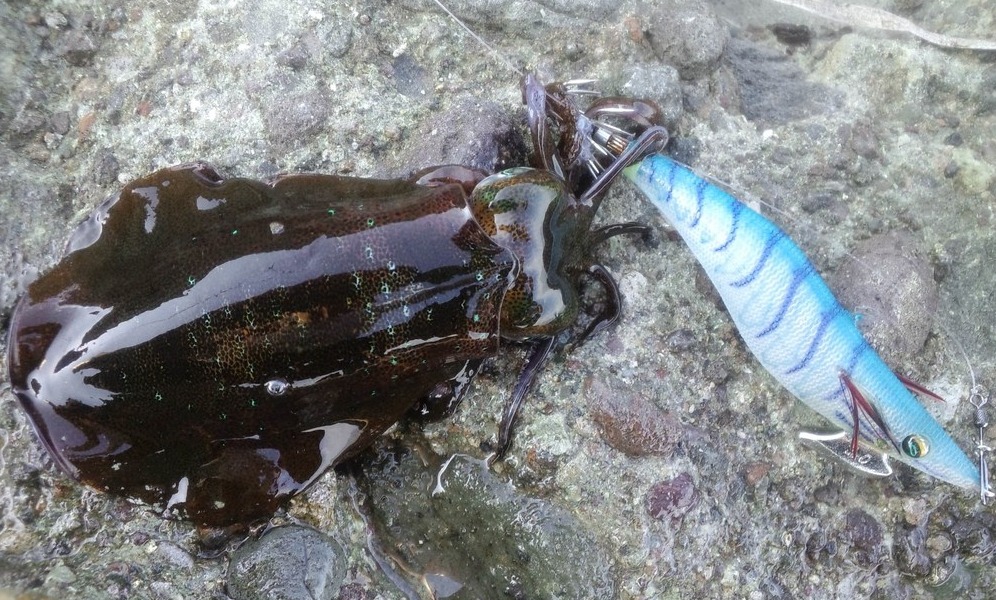
Classification of egi by sinking speed and fish-shaped egi
Today, we will learn about squid, a type of lure used in egi fishing, and its seasoning.
I would also like to make it clear in advance that even if you know this, it will not help you at all in the morning.^^
In previous posts related to egi fishing, we looked at “What are squid and egi fishing?”, how to do squid fishing, the criteria for selecting squid, and briefly looked at the history of squid.
Although the history of squid fishing is long, there is a lot of fabricated information based on stories that have been passed down without sufficient historical verification, and it is regrettable to see that even Naver, the best portal in Korea, has an encyclopedia full of incorrect information.
When you think of squid, you probably think of shrimp. However, there are also squid that look like fish.

It is said that when the squid was first created, it was modeled after the shape of a baby red snapper, not the shrimp it is today, and many people say that this is better for fishing.
Of course, there are still fish-shaped squids being sold on the market, but if you look closely, you can see that their shape is closer to that of shrimp.

However, there are a few squid shaped like fish that are sold, and they are so popular that they often sell out as soon as they are released.


Lastly, I would like to briefly mention the classification of squid according to sinking speed, which was not covered in previous articles.
First of all, the reason for classifying squid according to their sinking speed is closely related to water depth and current.
In deep water, the squid lure is easily swept away by the current, making it difficult to land. On the other hand, in shallow water, the squid lure sinks quickly, making it difficult to get a bite during fall squid fishing. That’s why squid lures are used. In shallow water and fast currents, deep lures are used. The classification of squid lures according to sinking speed is as follows.
① Normal type
This is the basic pole type with a sinking speed of approximately 3 to 3.5 seconds/m, which is the standard. It can be used except in deep waters or when the wind is strong and the current is fast. It can also be used as a deep type by adding weight, making it the most commonly used type.
② Shallow type
Based on No. 3.5, it has a sinking speed of approximately 5.5 to 6.0 seconds/m, and is a type that can be used especially when fishing in coastal areas, except when the wind is strong or the tidal current is fast.
③ Deep type: Sinking type
The 3.5 model has a sinking speed of approximately 2.3 to 2.7 m/s, making it ideal for shallow waters with strong winds and fast currents. Note that because of the fast sinking speed, the tension pole action must be used to ensure the jig lands slowly.
④ Super Deep Type: Fast Sinking Type
The 3.5-size squid sinks at approximately 1.3 to 1.7 seconds per meter, making it ideal for deep waters, fast currents, and other adverse conditions like strong winds. However, this type is also recommended for use with a tension pole.


Leave a Reply
Want to join the discussion?Feel free to contribute!