
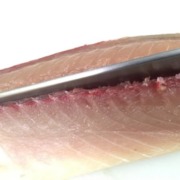
Things to watch out for when preparing mackerel sashimi and its fishy smell
There are many people who enjoy mackerel fishing, but not many people eat mackerel sashimi. The reason for this may be that they don’t know how to prepare sashimi, but I think it’s more because they’re worried about histamine food poisoning, which mainly occurs from anisakis or blue-backed fish.
However, some people are reluctant to take home mackerel they caught while fishing and cook it because of the strong fishy smell. Recently, a rumor has been spreading on the Internet that removing the skin of the mackerel will eliminate the fishy smell. However, not only is it difficult to peel the skin of the mackerel, but it is not entirely true that removing the skin will eliminate the fishy smell.
Mackerel skin is often removed, especially when preparing sashimi. This is often done to remove the scales (which many people don’t know about) found on mackerel, or to accommodate those who dislike the texture of the skin. However, mackerel skin is also used to prepare special dishes.

People who fish catch fish and cut their nerves or drain their blood, but housewives usually catch fish in large quantities using nets when cooking at home, so they cannot drain the blood individually, and the fish die because they cannot breathe.
Especially when a quick-tempered fish like mackerel suffocates to death, ATP (adenosine triphosphate) is rapidly depleted, leading to immediate rigor mortis. This rapid progression of rigor mortis can cause the skin to lose its luster, and the fish’s body temperature can rise, causing discoloration.
Also, since fish blood contains various enzymes, if these remain in the body, they can break down or change proteins. In particular, in blue-backed fish such as mackerel, the risk of causing histamine food poisoning increases as the bacteria called Morganella morganii acts as an enzyme on histidine, one of the 20 or so amino acids that make up the protein contained in the food, converting histidine into histamine .
In addition, red-fleshed fish with sarcomeres, which are dark red muscles distributed along the sides of the fish’s body, are mostly migratory fish that have to swim continuously, and as their freshness decreases, their color turns black.


Therefore, when purchasing fish fillets, it is best to choose ones with a clearer color of blood. And the biggest cause of the fishy smell in mackerel is that the blood remains in the blood of mackerel that was caught with a net and not drained. When cooking at home, the fishy smell of the small bones in the blood area is strong, so removing them before cooking is actually more effective in removing the fishy smell.
Therefore, it would be good to remember that the main cause of the fishy smell in red-fleshed fish such as mackerel is that the blood that has gathered in the blood-clotting area is not properly removed .
Not only that, the fish skin is rich in protein including collagen, and it is also rich in vitamins A and B₂. In particular, 10% of the vitamin B₂ contained in the whole fish is distributed in the skin. DHA and EPA, which come to mind when thinking of blue fish, are also abundant on the back of the skin, so unless you avoid it because it gives a bad texture, it is not a very desirable thing to remove it when cooking, and that can be said to be the same as peeling and eating an apple.
So, finally, let’s look at what you need to be careful about when preparing mackerel sashimi and finish.
When cutting mackerel sashimi, it is usually done by cutting it into three parts as shown below. However, if you do not remove the small bones in the belly area, the texture will not be good and it may even have a fishy taste, so it is better to cut it like the second picture.


Lastly, when you have time to prepare sashimi at home, it is a good idea to remove all the bones in the blood-stained meat mentioned above. However, since it is inconvenient to remove them one by one using tongs, it is better to cut off the boney part and then prepare the sashimi.