The relationship between fishing and wind


Many anglers tend to focus only on the wind speed, which is the most important factor when looking at the weather forecast.

However, more important than wind strength is wind direction. The sea breeze we learned about in school is the wind that blows in coastal areas or areas where large lakes meet. During the day, sea breezes blow from the sea or lake toward the land, and at night, land breezes blow from the land toward the sea or lake. Sea breezes are generally stronger than land breezes.

It’s better to understand that wind direction affects your fishing by causing changes in water temperature rather than simply causing problems when casting.

How wind causes water temperature to drop is easy to understand when considering an aquarium with tropical fish. Tropical fish are generally at risk when water temperatures exceed 28°C (80°F), and they die when temperatures exceed 30°C (86°F). This is evident from the persistent heatwave last summer, which resulted in the deaths of numerous fish in caged aquaculture farms.

Therefore, people who raise tropical fish sometimes install cooling fans in their aquariums to lower the water temperature, which is said to lower the water temperature to a certain extent.

In summer and fall, when the wind blows, it not only lowers the temperature of the sea water, but also moves plankton, which in turn increases the movement of baitfish, which are food for large fish, helping with fishing.

On the other hand, in winter and early spring, not only are anglers cold, but fish do not gather at points where cold winds blow. In Korea, understanding the influence of the southeast monsoon that blows in summer and the northwest monsoon that blows in winter is also an important point for fishing.

Especially now that we are entering the Yeongdeungpo season, please remember that when fishing in the sea during winter and early spring, it is helpful to do so in a place with less wind to catch a good catch.

Do the thickness and color of the leash really affect the outcome?

Nylon or fluorocarbon are the primary materials used for leaders and shock leaders in sea fishing, and it’s no exaggeration to say that anglers generally agree that fluorocarbon is the most suitable. (Coated PE line is sometimes used as a leader, while polyester line is also used.)

If you ask anyone with some fishing experience which one they would choose for a leader between nylon and fluorocarbon, regardless of the type of fishing, nine times out of ten they would choose fluorocarbon. The main reason is that it has a high specific gravity so it sinks easily in water, it is stronger underwater than nylon but has less elongation, has good sensitivity, is resistant to damage caused by brushing against underwater reefs or obstacles, and is less visible to fish so it does not cause them to be wary.

However, in addition to choosing a line based on material, many anglers also have questions about the thickness (size) of the line and whether it is okay to use a colored line.

To quote again the conclusions from the previous post,  “Do fish recognize colors?”, fish can be divided into species that can distinguish colors, species that cannot, and species that are colorblind.

【Fish species that identify colors】

Sea bass, mullet, black rockfish, flounder, rock bream, flatfish, black sea bream, eel, etc.

Fish species that cannot distinguish colors

Squid, mackerel, sharks, and other deep-sea fish where light cannot reach

※Other octopuses, cuttlefish, and squid are color blind.

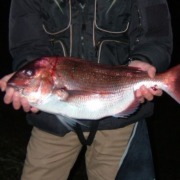
The above distinction is the result of extensive research in the academic world. Now, with the red sea bream fishing season approaching, red sea bream is listed as a species that can distinguish colors. Let’s take a look at the results of an experiment to see if this is indeed the case.

The lines (fishing lines) used in the experiment are as follows.

· Fluorocarbon No. 14

· Fluorocarbon No. 1.2

· PE line 1.5 (composite)

· 1.7 translucent yellow nylon line


◉ When using No. 14 fluorocarbon as a leash

The red sea breams that spotted the bait and approached it turned away without taking it. However, they later took the bait.


◉ When using 1.2 fluorocarbon as a leash

The red sea bream that spotted the bait and approached immediately ate it. Clearly, the feeding behavior of the fish with a thinner leader is completely different from that of the fish with a thick No. 14 fluorocarbon.


◉ When using colored 1.5 PE line (composite yarn) as a leash

Upon spotting the bait, they immediately approached it, but then turned away from it. However, after a few explorations, they returned and were observed eating the bait.


◉ If you use 1.75 yellow colored nylon as a leash

They were seen approaching the bait, but turning away when it got close, and later returning to eat the food.


◉ Experimental results

We were able to find out that the thinner the leader, the less wary they were when eating the bait. The thin leader may have something to do with the sinking speed due to the weight of the leader and the appearance underwater, but the experimental results showed that when a thick and colored leader was used, the red sea bream that came up to the bait turned its body and moved away.

We also found that red sea bream were more wary of colored PE lines and nylon compared to fluorocarbon.

However, in the end, we saw that the sea bream ate the bait on all the leaders, and this was an experiment that confirmed that when the target fish species is not very active, it is better to use a thin leader and, if possible, a transparent line without color.

Are fish really biting more actively just before sunrise and sunset?

Among the expressions used by anglers, there is one called feeding time. Its original meaning is the time when babies are fed or animals are fed, but it is also used to refer to the time when fish are actively feeding, that is, the time when they are actively biting.

And the time when fish are most active in biting is often said to be just before sunrise and sunset. The most important reason is, as discussed in the article “Why shouldn’t you shine a headlamp on the water?”, among the plankton in the sea, phytoplankton start to move for photosynthesis just before the sun rises, and nocturnal zooplankton start to move actively just before the sun sets. Fish also increase their feeding activity to eat these plankton, which is why it is said that early morning fishing is good. 

However, this is not the only reason why the fishing is good. The better the conditions are, the better the fishing is. Today, among the various factors that affect the fishing, let’s find out how the ecology of fish changes just before sunrise and sunset.

Let’s learn about the times when fish are most active in biting, based on a 1994 paper (Effect of Diurnal Activity of Rainbow Trout and Light Intensity on Gillnet Catching in Water Tank Experiments) that not only do the times when plankton are most active coincide with the times when fish are most active in moving, but also that fish are less alert during those times.

The purpose of the study on rainbow trout was to determine when they were most active and to determine the correlation between ambient brightness and entanglement in nets, and the paper contains information that is also very useful for anglers.

According to the research results, rainbow trout were more active during the day, showing high activity in the morning and evening when day and night change, and while activity decreased at night, activity increased sharply just before sunrise.

If we look a little more closely at the movements of rainbow trout in response to light in nature, we can see that they show more active movements just before the surroundings become dark or bright, which means that the fish become more active just before sunrise.

This is because, just like humans, fish also have various reactions that occur in a 24-hour cycle. This is similar to why we feel sleepy at night even when we are under bright lights, and why we wake up in the morning even when the darkness persists with the curtains drawn.

Meanwhile, the researchers who participated in the experiment released 50 rainbow trout into a tank 4 meters wide and 1 meter deep, then installed a gill net in the middle of the tank and observed how the number of fish caught in the net changed depending on the lighting.

As a result, rainbow trout became more active as the light grew brighter, while the number caught in nets decreased. This means that the darker the surroundings, the higher the rate of trout caught in nets. This result shows that the thickness and color of the leader do not significantly affect the catch in night fishing.

The relationship between rainbow trout activity, net catching rate, and lighting is shown in the figures below. From these figures, we can see that the number of trout caught in the net is high just before sunrise and just before sunset, and during the daytime when they are active. This clearly shows that it is difficult for fish to notice fishing gear just before sunrise and sunset. Soldiers on guard duty in the military are familiar with the period from Begin Morning Nautical Twilight (BMNT) to End Evening Nautical Twilight (EENT), which makes it difficult to distinguish the outlines of objects with the naked eye. Therefore, various nighttime military operations such as ambushes and guard duty begin around BMNT and end around EENT the next day. This also applies to fish.

Changes in light brightness according to time of day


Changes in rainbow trout activity over time

If we combine the two pictures above, we get the following:

Figures 7 and 10 in the paper show the correlation between the activity of rainbow trout and the number of fish caught in nets according to the brightness of the surroundings. They clearly show an inverse relationship in which, as the brightness increases, the movement becomes more active, while the number of fish caught in the net decreases.

People who enjoy night fishing often miss the feeding time just before sunrise because they are tired. However, this experiment clearly shows that  you must not miss this time and concentrate on it as the movement of plankton and baitfish, which are the prey, becomes more active and the activity of the target fish also increases.

Why can’t I shine my headlamp on the water?

When night fishing, you may occasionally hear the phrase, “Please turn on the light!” This is something that beginner anglers often do not understand.

Many people think, “Some people keep shining a light on the surface of the water, but how much of a hindrance can a lighted headlamp have on fishing?” This time, we will learn about the effects of light and headlamp on fishing.

In fact, since fishing is a hobby that involves dealing with nature, there are many aspects of it that can be easily understood with just a little thought about natural phenomena and ecosystems. The same goes for the lighting used in night fishing.

The biggest reason fish gather is because there is food there, and the relationship between plankton, which is at the bottom of the marine food chain, and light (illumination) can be said to be the most important factor that determines the success of fishing.

You’ve probably heard people say that the best fishing times are just before sunrise or sunset. Of course, it’s even better if these times and the tides are perfectly aligned. However, since we’re talking about night fishing lighting here, let’s focus on the sun-related aspects.

There are phytoplankton and animal plankton in the ocean. Just before the sun rises in the morning, phytoplankton start to move for photosynthesis, and in the evening, nocturnal animal plankton start to move actively. Fish also increase their feeding activity to eat this plankton, which is why it is said that early morning is good.

So now you understand the principle that fishing at night with lights on attracts plankton, which attracts smaller fish to eat them, allowing you to target larger species.

However, these types of lights can continuously collect plankton by shining for a long time at night, but lights such as headlamps are not used for a long time, so if they suddenly shine on the water surface, it only increases the fish’s alertness, so it is not good to shine the light toward the water surface, so you will hear voices saying, “Please turn off the light!”

If you turn on the fishing lights at night and observe carefully, you will see that even though the light from the lights illuminates the sea surface, the fish that are flocking gather at the point where light and dark are separated, that is, the dark part rather than the center of the light. This is because the fish are accustomed to the darkness.

Experiments on color transmission underwater at night have shown that at depths of 5 meters, red appears black, pink appears gray, and green appears blue. Below 10 meters, fish perceive only varying degrees of brightness for colors other than blue. This explains why some anglers use red as their cap lights or headlamps.

Lastly, although it is said that there are fish species that like light, strictly speaking, it is not that they like light itself and gather around the light, but rather that various fish species gather around the place where the light shines because prey gathers there.

Therefore, I hope you understand that shining a headlamp on the water surface, which is only used for a short time, is one of the manners that anglers should avoid, as it does not attract plankton and only increases the fish’s alertness.

Why are the two hours before and after low tide considered good for fishing?

It is well known that the high and low tides, which are closely related to the fishing season and are of interest to everyone, are caused by the gravitational pull of celestial bodies and repeat periodically.

However, when I look at people who fish, I see that they think that the best time to fish is within 2 hours of the start of the high and low tides, that is, 2 hours after low tide and 2 hours after high tide. This is a bit of a mistake, so let’s take a look at this today.

If you were to ask everyone to name the best time to fish, they would all unanimously say that the best time is in the morning or evening, before the sun rises or sets.

It is related to the food chain of the ocean. When it is bright, zooplankton that stays on the seabed moves to the surface of the water as it gets dark and eats phytoplankton. This attracts small fish, and then large fish that prey on the small fish gather, making it the best time for fishing.

Similarly,  the tide is closely related to the success of fishing because the movement of plankton becomes more active when there is a water flow caused by the difference in tides rather than when there is no water flow, and thus the movement of small and large fish also becomes more active.

The times of low tide and high tide vary slightly, but here we will look at the best times for fishing around low tide and high tide, so let’s assume that low tide and high tide occur twice a day and occur every 6 hours.

When the difference in water height, or tidal level, between low tide and high tide occurs, it is called a great tide, followed by mid tide and neap tide in that order. It is known that the period when fish activity increases significantly is between the high tide and mid tide.

During these high and low tides, the tide level rises, but the water flow also becomes faster. The speed of the water flow also changes during the high and low tides that occur twice a day due to the Earth’s rotation, and the activity of fish also varies depending on the speed of the water flow, so it is said that the two hours before and after the high and low tides are the best for fishing.

However, there is a misunderstanding about when the water flows the fastest during high and low tides. Let’s take a closer look.

It is a well-known fact that the period of time between high and low tide, which lasts from 30 minutes to an hour and makes it seem as if the current has stopped, is called the tidal period.

If you look at the pictures below, you can see that there is no tidal movement for a certain period of time after high tide and low tide, so the time when the tide changes from high tide to low tide and from low tide to high tide is a certain amount of time after the peak. So, when the high tide starts, the time from the red point to the gray point is the fastest, and when the low tide starts, the time from the blue point to the gray point is the fastest.

Therefore,  the water flow becomes the fastest two hours after the start of low tide and high tide, and as a result, the amount of oxygen in the water increases, which in turn increases the movement of plankton and the activity of fish .

Therefore,  the best time to fish is not within two hours of high or low tide, but rather after two hours.  Understanding this subtle but crucial difference is crucial, as it’s closely tied to the tide cycle.

Of course, in the case of boat fishing, there are fishing boats that do not go out during the spring tide (sari) when the water flow is fast because the tackle often gets tangled, and it also varies by region, and in shallow waters, not many fish come in even after 2 hours, so it cannot be applied uniformly, but in general, it can be said that the best time for fishing is after 2 hours when the water flow is fast.

Along with the speed at which the water flows, another important factor is the height of the water .

In general, the tidal range of the bay is large because water flows from the wide sea into the narrow water area, and the activity of fish increases around high tide, but the water level drops significantly during low tide, causing a rapid decrease in the number of fish, so the fishing is not good, and it is better to avoid this time period, especially when fishing for sea bass.

Finally, depending on the direction of the tide and the water level, you should adjust your fishing time accordingly. For example, fishing along the coast and in areas with river water inflow can vary depending on the low and high tides.

However, the important point is that points with good tidal flow are helpful for fishing, and it is good when the water flows quickly, so  I would like to conclude that the time when fish are most active is 2 hours after the start of high tide and low tide .

How to defrost clams and how to store them properly

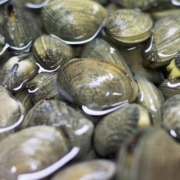
It’s clam season. Today, with COVID-19 making it difficult to eat out, let’s take a closer look at clams, which can be used to make a variety of dishes at home.


■ Why is the season for clams from February to April?

It is said that this is the most delicious time because they are accumulating nutrients for spawning in the summer, and since clams mainly spawn when the seawater temperature is around 20℃, the seawater temperature is more important than the season during the spawning period.


■ Things to keep in mind when peeling clams

The method of salting clams is not much different from the one posted yesterday  , “Why salt is sprinkled when catching clams and the correct way to salt them,” so here I will only look at the points to be careful of.

1.  It is recommended to adjust the concentration of the salt water to around 3% .

2. To ensure that the environment resembles the natural habitat of clams, cover the container containing the clams with cooking foil or black plastic to promote sunbathing.  Remember that if you sunbathe in a bright place, the clams will not open their mouths, which will hinder sunbathing .

3. The ideal water temperature for sun-drying is approximately 15°C to 20°C.  Above or below this temperature, sun-drying will not only be difficult, but the clams may not even open. Therefore, except during the hot summer months, it is better to sun-dry at room temperature rather than in the refrigerator.

4. If you use too much water and soak the clams for a long time, they may not be able to breathe and may die, so  it is best to pour water to a level where the clams are slightly submerged.

5. Many housewives seem to wonder how many hours it is good to soak clams in the water.  If you did not pick them yourself, soaking them for 1 to 2 hours is good. Remember that soaking them for longer than that can cause the clams to die while the container is covered.


■ How to store clams (freezing and refrigeration)

When storing clams, whether frozen or refrigerated, they must be thawed. Refrigeration is recommended if possible. Most clams purchased at the supermarket are already somewhat thawed, so storing them in that state is fine. However, storing them for more than three days is not recommended.

If you store them in the refrigerator, the clams will be in a state of pseudo-death, and if this continues for too long, they will die, so it is best to avoid storing them in the refrigerator if possible .

Even when storing clams in the freezer, they must be defrosted. After defrosting, it is recommended to remove moisture with a kitchen towel and store them in a container. In particular, it is recommended to remove the air and quickly freeze them in a flat state, avoiding overlapping as much as possible.


When cooking frozen clams, you must be careful to heat them all at once over high heat . If you let them thaw naturally or heat them slowly, the clams will not open, so when making soybean paste stew, you must put the clams in after the water has boiled.
 

Freezing tips

If you are freezing clams, you can defrost them, boil them, and then separate the broth and clam meat for easy use.


■ If there is an odor after peeling the clams

If clams smell after being soaked, it is easy to assume that there is something wrong with the clams you purchased, but keep in mind that the smell can also occur if the clams are killed due to the incorrect soaking method.

If clams smell when purchased, they’re usually dead or harvested from a contaminated area. However, even if you purchase live clams, improper handling can cause them to die and develop an odor. This is most often due to the following reasons.

1. When the water temperature is not appropriate

2. When the salt concentration is not correct

3. When the amount of water is too much

4. When the sun sets in a bright place


■ Phenomenon that appears in dead clams

Dead clams have an odor and their shells do not open. Some of these do not open even when heated, but this does not necessarily mean that they are only found in dead clams.

Clams with two shells, such as clams (bivalves), have a hinge-like connecting part and a scutellum that open and close the shell. The hinge opens the shell, and the scutellum closes the shell.

However, when heated, the strength of the spores attached to the shell weakens, allowing the clam shells to open, but dead clams do not open because the spores do not change even when heated.


Also, if the part where the shells are connected is damaged when washing the clams, the clams will not open, but in this case, there will be no odor.

Therefore, since you can only tell whether a clam is dead or alive by looking at the shell that has opened,  it is best to discard any clams that have not opened for safety reasons.

※ Lastly, as mentioned above, I want to emphasize this once more. When cooking frozen clams, you must heat them all at once over high heat. Otherwise, if you heat them slowly or let them thaw naturally, rigor mortis will occur, damaging the sac cells and preventing the clams from opening. Remember this.

How to properly store clams

How should clams be stored? And how long can they be stored? The answer to this question can be easily found by understanding their ecology and habits. Let’s take a closer look at how to store clams at room temperature, in the refrigerator, and in the freezer.


■ When storing clams at room temperature

According to the food code, room temperature is 15℃ to 25℃, but clams start to lose weight when the temperature exceeds 18℃, some die when it exceeds 20℃, and the number of dead clams increases when it exceeds 25℃, so even when stored at room temperature, it is best to keep the temperature between 10℃ and 15℃.

As seen in ‘How to Defrost Clams’ , the optimal temperature for defrosting clams is between 15℃ and 18℃, which is the temperature at which clams are most active, and is not appropriate for storing clams.

When storing clams at room temperature, the temperature should be between 10℃ and 15℃, which is when the clams enter a dormant state. This will suppress their activity to a small extent and extend their storage period. However, even if this temperature can be maintained,  storing clams at room temperature is not recommended because the water needs to be changed periodically.


■ When storing clams in the refrigerator

When storing clams in the refrigerator or freezer, they must be dehydrated before storage.

One thing to keep in mind is to check for dead clams before storing them in the refrigerator. If the water after clamming becomes significantly cloudy, check to see if any clams are not opening their mouths or check for dead ones by bumping them together and judging by the sound.

It is best to store clams in 3% salt water. To minimize the damage from residual chlorine, it is more effective to make the 3% salt water using boiled and cooled water rather than using tap water as is.

The best temperature for refrigeration is between 7℃ and 10℃. Be careful not to close the lid of the container you store it in as this can cause the clams to die. If you plan to eat it the next day, it is also a good idea to wrap it in a wet newspaper or kitchen towel before storing it.


One of the most common misconceptions among housewives is that, when purchasing clams from a supermarket or online, they are printed with instructions such as “within 5 days from the date of manufacture” or “store in a cool place” or “store at 0℃~10℃.”

However, this is mostly set based on storing clams at around 4℃, and the storage period is set to 5 days.  Since clams are in a hibernation state at 4℃, the storage period can be 5 days, but if you are harvesting clams at home, it is better to store them for only 1-2 days because you cannot tell when they were harvested .


■ When storing clams in the freezer

The most important thing when storing clams in the freezer is to freeze them as quickly as possible.

To do this, it is recommended to freeze them by placing them on a metal tray with good thermal conductivity or wrapping them in foil. Another way to freeze them quickly is to make sure the clams do not overlap.

When freezing in a plastic container commonly used at home, it is best to remove as much air as possible. If the air is completely removed, it can be stored for up to a month, so if it is difficult to store in a vacuum, it is better to eat it as soon as possible.

Of course, it is okay to eat it after storing it for about two months, but in the summer, when the refrigerator door is frequently opened and closed, the temperature is not maintained consistently, so the preservation period is shortened, and unlike freeze-drying, the drying process progresses slowly, which has the disadvantage of causing the taste to deteriorate.

If you must store it for more than a month, it is best to store it in a plastic container filled with ice or ice water and quickly freeze it.


Again, instead of freezing them in a container filled with water, you should fill it with ice or ice water and freeze it as quickly as possible.  The most important factor in freezing clams is how quickly they are frozen, so freezing them on a metal tray is also effective.

Are there any fish that are easy to catch?

In “Do fish remember being caught with a hook ?” we looked at “Beukema’s learning theory” which states that fish remember being caught with a hook. This time, we will look at “Martin’s hypothesis” which states that there are certain fish that are good at being caught with a hook.

The so-called “Martin’s hypothesis” was first proposed by American oceanographer John Martin, and states that there are some individuals that are naturally less cautious but more curious, making them good fish to catch.

To verify Martin’s hypothesis, an experiment was conducted in Japan in 1992, in which Mozambique tilapia were placed in an experimental pond and fished.


Mozambique tilapia


The total number of Mozambique tilapia used in the experiment was 144. If the hypothesis that there are individuals that are easy to catch by fishing is true, then even if only the Mozambique tilapia caught by fishing are collected and fished again, a certain percentage must continue to be caught for the hypothesis to be established. The subject of the experiment was.

So the researchers placed 144 Mozambique tilapia in a halved pond, caught half (72 fish) and placed them in a new pond, fished them a second time, and collected the fish from there and caught them a third time. They observed whether a certain ratio would be maintained.

However, contrary to expectations, the experimental results showed that out of the 72 fish caught in the first fishing trip, 51 were caught in the second fishing trip, and out of the 72 fish not caught in the first fishing trip, 51 were not caught in the second fishing trip either.

The results of the third fishing trip showed the difference more clearly, that is, it was confirmed that Mozambique tilapia that were caught once were easily caught the second time as well, but those that were not caught in the first fishing trip were not caught well in the second and third fishing trips either. The number of individuals that were not caught well in fishing trips predicted before the experiment to be 18 individuals (12.5% ​​of the total) actually exceeded the number, which was 41 individuals (49% of the total), confirming that there are definitely individuals that are difficult to catch by fishing.

Finally, the researchers observed individuals easily caught by fishing and discovered that they reacted more strongly to food than other individuals. This suggests that individuals with a stronger appetite were more likely to catch fish. This once again demonstrates that greed is the root of all evil.

However,  “Beukema’s learning theory” and “Martin’s hypothesis” had inherent limitations: the experiments were conducted in an artificial experimental environment without other fish competing for food  .

Accordingly, in 2002, neighboring Japan conducted a rather crude experiment in which they selected four sections of 500 to 700 meters deep in a mountain valley in Hokkaido, which is rarely visited by anglers, and caught trout by fishing from sunrise to noon. They then shocked the remaining trout with electricity, caught them all, tagged them, and released them. After 50 days, they conducted a second experiment.


And 50 days later, when the researchers investigated the trout caught by fishing again, they found that the ones that were caught by fishing for the first time, tagged, and released were caught in similar ways to the ones that were not caught by fishing for the first time. This showed that both “Beukema’s learning theory”, which states that fish caught by fishing remember that experience and are therefore less likely to be caught, and “Martin’s hypothesis”, which states that some fish are inherently more likely to be caught, were not correct. Therefore, they concluded that observations in artificial experimental facilities are different from the actual state in nature, and that the habits of fish cannot yet be scientifically explained.

Of course, I, the author of this article, have no background in oceanography or ichthyology, just an individual who enjoys fishing. I also know that there is no perfect technique for achieving success in fishing.

While most fishing experiences are a result of a coincidence of various conditions, often in different weather and environments, catching a fish is a matter of luck. I believe that the true joy of fishing lies in analyzing why a catch occurred, interpreting it in your own way, developing your own new hypothesis, and then testing it.

Finally, let me share the main points of this article, which I’ve written in two parts. In my previous  article, ” Can Fish That Swallowed Hooks Survive If You Release Them ?” , I examined the results of releasing 77 trout that had swallowed hooks. The hooks decayed and were released from their bodies, and nearly 70% of them were re-caught.

In other words, if “Beukema’s learning theory” and “Martin’s hypothesis” are correct, then it would be wiser to release fish so that they can grow properly in order to catch the big fish that anglers hope for. Even if the two theories are wrong, released fish can be caught again in the wild, so I expressed it this way to say that it would be good for us anglers to at least practice the standards for closed fishing periods and body lengths.

How to prepare scallops and what to watch out for when eating them raw

Now that scallops are in season, if it were any other year, the clam grill restaurants would be bustling, but this year, due to the coronavirus, I often see the lights of the Daebudo clam grill restaurants that I pass by on my way to fish turned off.

However, since live scallops can be easily purchased online, many people seem to be steaming or grilling them at home.

And in rare cases, you can see on the internet that people prepare scallops they have purchased and eat them raw. Let’s find out what you need to be careful of when eating scallops raw.

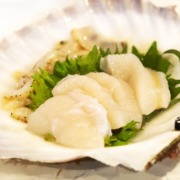
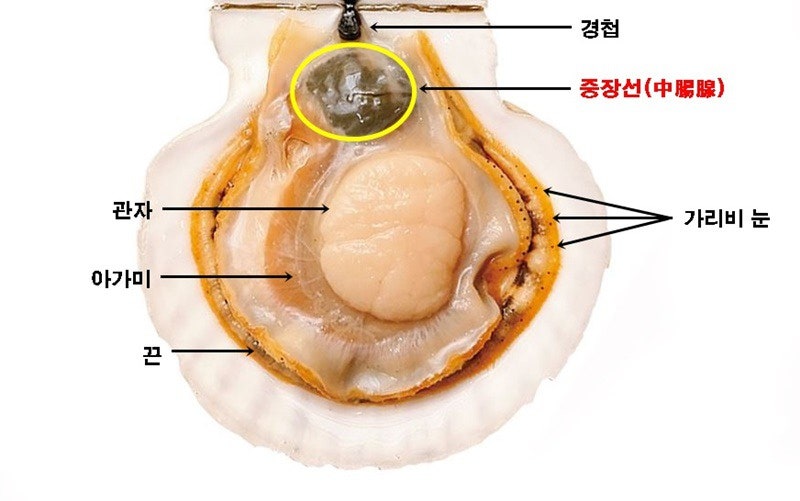
When eating scallops raw, you must remove the midgut gland. (It is also best not to eat them when cooked.)

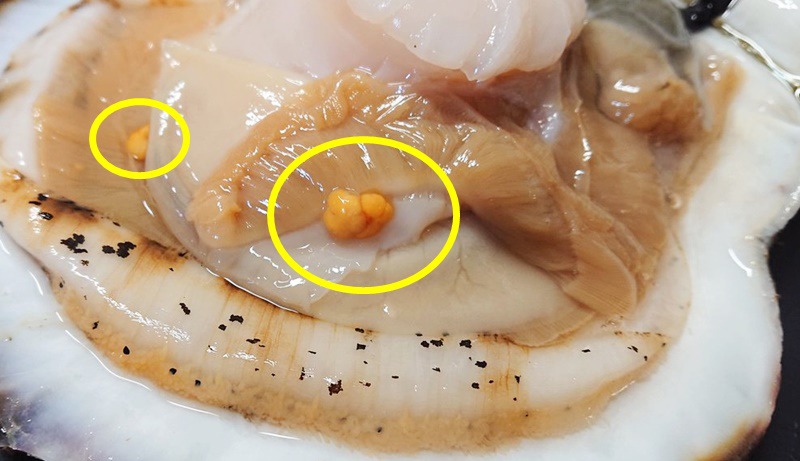
When you open a scallop, there is a black area below the hinge, which is the midgut gland, which plays the role of the liver and stomach.

Shellfish, including scallops, consume phytoplankton, but  they also consume toxic plankton such as dinoflagellates . These toxins accumulate in the midgut gland and can cause food poisoning when eaten by humans, so they must be removed.

In particular, unlike other shellfish, scallops often retain the poison for a long period of time because the metabolic rate at which the toxins accumulated in the midgut gland are excreted from the body is very slow.

The next inedible part is the gills of the scallop, which must also be removed.

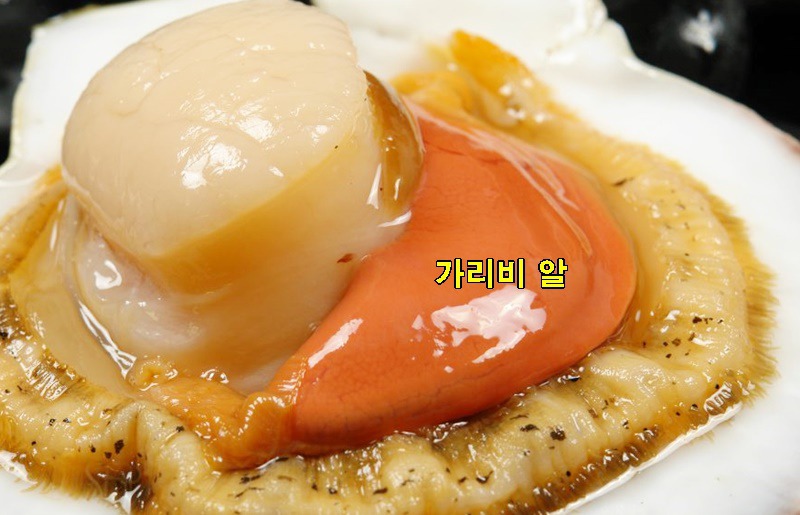
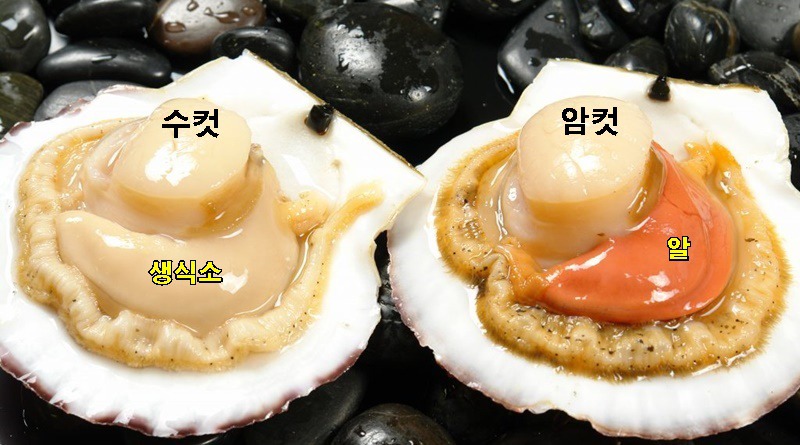
Meanwhile, when eating scallop sashimi at a sushi restaurant, in rare cases, you may see a red part like the one in the photo below. This is scallop roe.

On the other hand, the gonads of male scallops are white and should be eaten cooked unless they are very fresh.


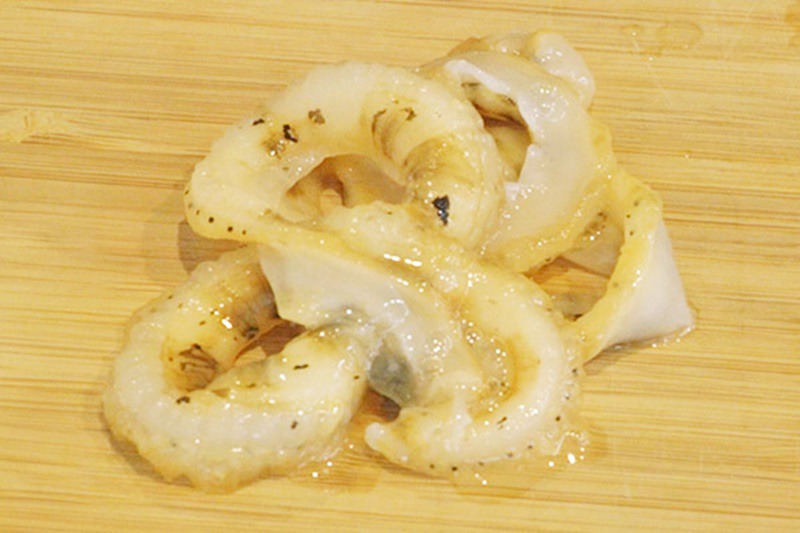
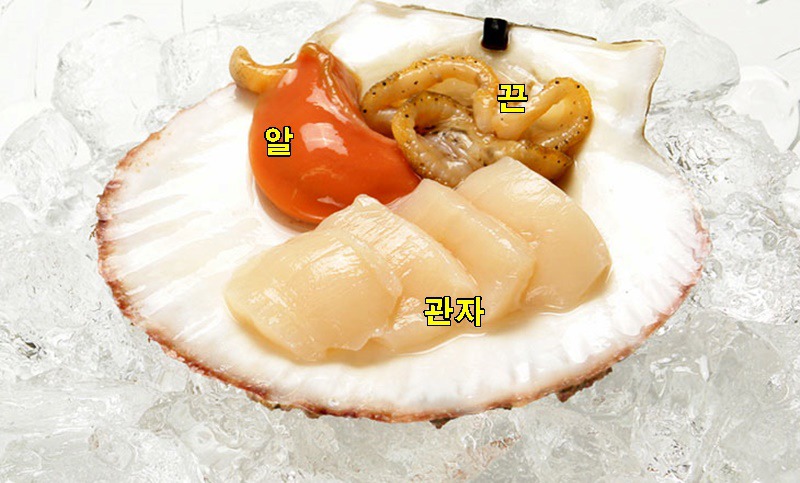
The following is the string with the scallop’s eyes, which has been reported in the media. It is an edible part, but it is better to remove the mucus with the back of a knife to improve the texture. The black dots are the scallop’s eyes and can be eaten.

Finally,  as I briefly mentioned in my post “How Many Japanese Scallops Are We Eating?”, 99% of Japan’s farmed scallop production is in Hokkaido, and some of the scallops caught there are found to contain parasites.

This parasite is  also introduced in  the National Institute of Animal Quarantine’s library as “Pectonophilus in scallops – a disease that can be found in farmed scallops in the northern Tohoku region and southern Hokkaido. Caution is advised as the area where this disease occurs has been expanding recently. “

The scientific name for scallop pectenophilosis is Pectenophilus ornatus. Pectenophilus means ‘loving scallops’, and ornatus means ‘bright color’, meaning that the parasite loves scallops with their bright colors.

What is unique is that the male lives inside the female’s body, and it is not a problem because it can grow up to 8mm in size and cannot live inside the human body.

There have been no reports of this parasite being found in Korea so far, so if you find it in a scallop, it is likely that the scallop came from Japan.

To summarize,  when preparing scallops yourself and eating them raw, you should not eat any parts other than the scallop shell, strings, and roe (or gonads).


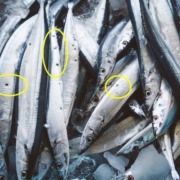
What are the blue spots on the skin of sauries?

Sauries, which is in season in the fall, has become a staple side dish served at raw fish restaurants year-round as it has become natural to eat frozen imported sauries due to the decrease in catch.

However, while purchasing sauries online, it seems that the seller does not know what the blue spots on the sauries’s skin are, so I would like to write a few words, even though it may be presumptuous.

If you look at the product description posted by the seller, the blue spots on the sauries are written as follows : “Just as people have spots, sauries and other fish also have spots. The blue spots on the surface of the sauries are not caused by a rotten product, but rather occur naturally on the sauries’s body~(omitted) . ”

However, these are not dots but scales of anchovies. Let’s find out why anchovies’ scales are embedded in the skin and why they are light blue in color.

Before we delve into that, let’s briefly examine Korea’s import situation for anchovies. Taiwan accounts for over 90% of Korea’s total anchovies imports, followed by Vanuatu. Combined, these two countries account for over 98% of imports.

Imported sauries is caught through net fishing, and when a large number of sauries are caught in large nets, the sauries collide with each other, causing their scales to come off. These scales are then swallowed by the sauries, and when freshly caught sauries is grilled and eaten, sometimes the scales come out of the intestines.

Image source: National Institute of Fisheries Science, Fisheries Operations Diagram


Most of the scales of sauries caught with a net fall off during the landing process, but those that remain are discovered during the rapid freezing and then thawing process.

Heme, the pigment part of hemoglobin that contains iron, is broken down in the liver and changes into biliverdin, a blue-green bile pigment, or bilirubin, a reddish-brown bile pigment. In some fish species, including sauries, biliverdin becomes calcium salt, turning the bones and scales blue.


The scales of the sauries that have turned sky blue like this are stuck to the skin and are noticeable to us during the thawing or preparation process.

Finally, there’s a lot of information out there on how to choose fresh sauries when buying live sauries, but I feel like I’m missing the most important part, so let’s just cover what it is and end this article.

When selecting a fresh sauries, the most important thing to keep in mind is its lower jaw .  A yellowish lower jaw indicates freshness , meaning it was caught less than three days ago. After that, it begins to turn brown as freshness declines. It’s not easy to find such a fish, but it might be helpful to keep this in mind. ^^