The Difference Between Jigging, Slow Jigging, Shore Jigging, and Light Shore Jigging

First of all, the difference between jigging and shore jigging  is that jigging is done on a ship, and shore jigging is done on the shore . 

Note: What is the difference between surf lure and shore jigging?

Compared to jigging, which targets target fish by dropping a metal jig directly from a boat, shore jigging lures target fish by moving the metal jig horizontally. Another difference is that when jigging from a boat, you don’t have to cast far, but in shore jigging, you cast far.

Of course, the gear used for fishing on a boat and fishing on the shore or a breakwater cannot be the same, but this is not entirely impossible, and  I think that there is no need to prepare different types of gear for each genre, especially when it comes to surf lure fishing.

As to why this is so, you can see why it is divided into “shore jigging” and “light shore jigging.”

Shore jigging and light shore jigging both use metal jigs to catch fish such as mackerel, flounder, and sometimes even flatfish, but  there is no clear definition of what is shore jigging and what is light shore jigging.

That is, even though there is no clear distinction between the weight of a metal jig of up to a certain number of grams as light and the weight of a metal jig of more than a certain number as shore jigging, it cannot be overlooked that many anglers use the terms shore jigging and light shore jigging without even knowing their meaning.

I have mentioned many times that this type of fishing is a way for rod manufacturers to increase their sales, and they have  gone a step further than simply categorizing rods into shore and light shore to increase sales, and now the term “super light shore” is also being spread.

Here is an example of a product being sold without a clear definition of shore and light shore.  Among the jigging rods from Japanese company D, there is one that states, “This is the standard rod for light shore,” and states that the maximum weight of the metal jig that can be used is 60g.

Because of this, there is an increasing number of people in Japan who are famous for fishing who call rods under 60g “light shore” and rods under 20g “super light shore,” and this is becoming established as a genre . I would like to emphasize once again that whether it is 60g or 10g, they are all considered shore jigging, so there is absolutely no need to purchase a separate rod . 

One more thing to add is that in this segmentation of shore jigging, terms created by anglers such as “shore slow jigging” and “shore wall jigging”  are now being used. Fishing terms that are created or accepted indiscriminately without a definition of the concept should be refrained from being used for the sake of establishing a healthy consumer culture.

It’s obvious to everyone that these things are especially often caused by Japanese companies, but  when I see some programs featuring famous celebrities (this is not an outdated idea of ​​favoring domestic products)  , wearing clothes that are practically plastered with Japanese products, holding Japanese products in their hands, and fishing in Japan’s Tsushima Island,  I can’t help but feel bitter and wonder , “Have they ever made an effort to think about the issue of comfort women, where they claim even Dokdo is their land, and where there has been no progress at all?” 

Let’s return to the topic and look into “shore slow jigging” and “shore wall jigging” a little more. There is no clear explanation of the concept of slow jigging, and even if there is, there are many incorrect explanations. First, let’s define the concept. “It is a method used when targeting rockfish with low swimming ability or when the activity of target fish species such as bushfish or yellowtail is low, and it does not require intense action.”

The fact that it doesn’t require any intense action means that you can use somewhat softer rods than with regular jigging, which also means that it’s easy for anyone to enjoy.

In fact, slow jigging is known to have originated in the Akashi Strait of Japan, where the currents are very fast and the target fish species on the seabed do not move much. Slow jigging was created to apply this type of application, and those who enjoy lure fishing now can enjoy slow jigging with the equipment they have (sea bass, egging, jigging rod).

“Shore slow jigging” is a combination of slow jigging that started on a boat and shore jigging. Compared to regular jigging, when the fish are less active, the fish cannot keep up with the speed of the metal jig, so the moving action is limited to allow for a bite.

And quay jigging is similar to ship jigging, and it is a type of jigging where a metal jig is dropped vertically from a quay wall, which is a structure that allows ships to safely dock to unload cargo and board passengers.
Let’s find out what a short bite is in lure fishing and how to deal with it.

The expression “short bite” used in lure fishing is difficult to find detailed information about when searching in English because it is not used in English-speaking countries.

The term “short bite” is a combination of the word “bite”, which means to bite the bait, and the adjective “short”, which means short. It is used to describe a fish that bites but only a small bite that does not catch the hook.

The expression ‘short bite’ used in Korea and Japan is called ‘short strike’ or ‘short striking’ in English-speaking countries, so when searching for related information, it is better to search for ‘short striking’ rather than ‘short bite’.

The fact that we can feel so many small bites that don’t lead to hooking can paradoxically be said to mean that the equipment has advanced to that extent.

So what should we do when these short bites are frequent? Of course, when fishing in the great outdoors, there’s no single, standard answer. Many anglers overcome short bites using their own methods, drawn from their own experiences, depending on the species and environment.

Especially in periods of low activity, if the target fish is small, the bite is basically fine, so frequent short bites are inevitable. In these cases and when the target fish is large, the countermeasures are bound to be different, so it is said that there can be no uniform countermeasure.

However, there are some universally accepted strategies, and let’s take a look at what many anglers use to overcome short bites.

The best way to overcome short bites is to maintain peace of mind. This may sound like a strange concept, but it’s important to note that many anglers who experience frequent short bites tend to rush and force their actions.

In such cases, the best thing to do is to get away from the point where short bites are frequent, have a cup of coffee, and take a rest. After that, the general method to overcome short bites is to use thin, long, and small tackle.

Specifically, it is recommended to change the lures you use from thick and short to thin and long. For example, if you were using a lure with a lip, change it to a lipless one, or if you were using a pencil bait, change it to a worm.

The key to changing the size and weight of the lure you use is to make it easier for the target fish to swallow it. This also applies to changing the tackle you use.

When short bites occur frequently, the most common method used by anglers is to change the hook. This is done by using a smaller hook so that it can easily enter the fish’s mouth. However, it is important to note that simply reducing the hook size can upset the balance.

In other words, if you are not familiar with such delicate operations, it is better to use only the rear assist hook (also called the tail assist hook) if you are using both the front and rear assist hooks. If you are using a double hook or treble (triple) hook, it will be helpful to change it to a single hook. Also, if you are using a closed-gap type hook, you will notice that short bites are reduced just by changing it to a straight-gap type.

The next thing that will be helpful to replace is the thickness and color of the line and shock leader. It has already been scientifically proven that the length, thickness, and color of the shock leader used are closely related to the fishing result.

※ Scientific research on the length and thickness of leashes

※ The effect of the thickness and color of the leash on the fish


In particular, the thickness of the shock leader, which can make the movement of the lure unnatural, is a very important factor. Therefore, in cases where short bites are frequent, it is helpful to not use a shock leader at all and connect it directly to the main line, and it is more effective to use a monoline rather than a braided line.

Lastly, it is said that changing the color of the lure you use helps overcome short bites, but I personally did not feel much of a difference in this regard, so I will omit it.

Classification of egi by sinking speed and fish-shaped egi

Today, we will learn about squid, a type of lure used in egi fishing, and its seasoning.

I would also like to make it clear in advance that even if you know this, it will not help you at all in the morning.^^

In previous posts related to egi fishing, we looked at “What are squid and egi fishing?”, how to do squid fishing, the criteria for selecting squid, and briefly looked at the history of squid.

Although the history of squid fishing is long, there is a lot of fabricated information based on stories that have been passed down without sufficient historical verification, and it is regrettable to see that even Naver, the best portal in Korea, has an encyclopedia full of incorrect information.

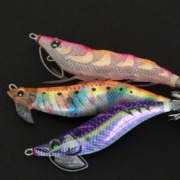
When you think of squid, you probably think of shrimp. However, there are also squid that look like fish.


It is said that when the squid was first created, it was modeled after the shape of a baby red snapper, not the shrimp it is today, and many people say that this is better for fishing.

Of course, there are still fish-shaped squids being sold on the market, but if you look closely, you can see that their shape is closer to that of shrimp.


However, there are a few squid shaped like fish that are sold, and they are so popular that they often sell out as soon as they are released.


Lastly, I would like to briefly mention the classification of squid according to sinking speed, which was not covered in previous articles.

First of all, the reason for classifying squid according to their sinking speed is closely related to water depth and current.

In deep water, the squid lure is easily swept away by the current, making it difficult to land. On the other hand, in shallow water, the squid lure sinks quickly, making it difficult to get a bite during fall squid fishing. That’s why squid lures are used. In shallow water and fast currents, deep lures are used. The classification of squid lures according to sinking speed is as follows.


① Normal type

This is the basic pole type with a sinking speed of approximately 3 to 3.5 seconds/m, which is the standard. It can be used except in deep waters or when the wind is strong and the current is fast. It can also be used as a deep type by adding weight, making it the most commonly used type.


② Shallow type

Based on No. 3.5, it has a sinking speed of approximately 5.5 to 6.0 seconds/m, and is a type that can be used especially when fishing in coastal areas, except when the wind is strong or the tidal current is fast.


③ Deep type: Sinking type

The 3.5 model has a sinking speed of approximately 2.3 to 2.7 m/s, making it ideal for shallow waters with strong winds and fast currents. Note that because of the fast sinking speed, the tension pole action must be used to ensure the jig lands slowly.


④ Super Deep Type: Fast Sinking Type

The 3.5-size squid sinks at approximately 1.3 to 1.7 seconds per meter, making it ideal for deep waters, fast currents, and other adverse conditions like strong winds. However, this type is also recommended for use with a tension pole.

Squid spawning

Even in Japan, where it is said that a lot of cuttlefish are caught, the catch is not that large, so much so that cuttlefish are not included in catch statistics.

In addition, as the desertification phenomenon of the seabed, called bleaching phenomenon, is gradually expanding in scope due to global warming and as a result, the reproduction of seaweed that grows by attaching to rocks is gradually decreasing, it is said that in Japan, a project is being carried out to help cuttlefish spawn by installing artificial seaweed or tree branches that are tied together in the sea.

Even in the case of cuttlefish that have just started their spawning season,  I think it is advisable to return females that have not finished spawning to the sea when caught by fishing.

“The problem is the overfishing of springtime baby octopus that continues every year.” “No. The problem is the anglers who catch them indiscriminately.” Along with these voices, our food culture of enjoying foods such as fish with eggs also contributes to the depletion of resources. However, I would like to say that now is the time for all citizens to take the lead in protecting nature and the environment with the mindset of “at least it’s me” rather than pointing out whose fault it is first.

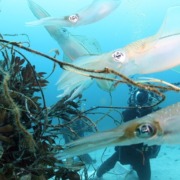
Also, as I have mentioned in several posts about eging fishing, there are many male cuttlefish around the female cuttlefish during the spawning season, so  I think it is wise to release the female cuttlefish that have not finished spawning and  target the male cuttlefish around them.

When cuttlefish lay eggs in seaweed such as the one in the photo below, they are initially white, but as time passes, the eggs change to brown, and after an incubation period of about 20 days, or as long as 60 days, the baby cuttlefish inside the egg sac emerge.


It is said that the baby cuttlefish born this way cannot yet eat, so they grow by consuming the nutrients contained in the circled area in the photo, and that cuttlefish eggs contain substances that fish dislike, so they can grow relatively safely.


When they emerge from their eggs one by one, they move to the surface of the water. During this process, many baby cuttlefish are sacrificed to fish, and if they are lucky enough to grow to a large size, they live in groups floating on the surface of the water, as can sometimes be seen in the fall.

The eggs of these cuttlefish are sometimes washed away by the current, and in these cases, they are said to not grow even if released.


Spring squid fishing, which is now in full swing, is expected to produce big catches, but if you catch a female that has not yet finished spawning, I hope that anglers will happily release it.

Egging Fishing – Tips for Choosing a Egi

There are three factors that influence the selection of squid: climate, seawater turbidity, and time of day. These factors influence the size and color of the squid.

As your skill in selecting squid increases, so does your fishing ability. So, let’s learn how to select squid.


1. Size of the squid

Squid squid comes in sizes 2.5 to 4.0, with the standard size being 3.5 and increasing in increments of 0.5. While smaller squids, down to 2.0, are now available, squid squid in sizes 3.0 to 4.0 are sufficient.

The size of the lure should be chosen in proportion to the size of the squid being caught. In the fall season, there are many small squid that were born and grew that year, so use around size 3.0. In the spring, the target is large, fully grown squid, so use around size 4.0.

However, it is not possible to say in general terms. Small squid may respond to a size 4.0 lure, and large squid may respond to a size 3.0 lure.

Remember that the size of each jig is about 3cm, and squid will eat up to 1.5 times their body length, so when you arrive at the fishing spot, it is a good idea to check the size of the squid caught by other anglers and then choose a jig.

2. Color of the squid

Among the color, size, and type of squid in egi fishing, I believe the most important is the color of the squid. The sheer variety of squid colors available at fishing shops can be overwhelming, making choosing the right one a challenge. Squid color is comprised of the base color and the body color.

The base color, also known as the “base color,” refers to the color of the tape wrapped around the body of the squid, while the body color is the color of the fabric covering the base color. Because the body color is made of fibers, the base color is visible through the mesh of the fabric.

The color of the squid lure has an appeal factor that indicates how appealing it is to squid. The higher the appeal factor, the more vibrant the color, with orange and pink being the most representative colors.

In contrast, dark colors with low appeal include olive and dark red, and colors in between, such as blue, are called natural.

When the squid is active, it is better to use something with high appeal, and when the activity is low, it is better to use something with dark appeal. Everyone knows that when the squid is actively feeding, it is said to be active, and when it is not, it is said to be low, but I am writing it down just in case^^

The easiest way to determine squid activity is to see if there are many people fishing nearby, but a common criterion is the time of day. Fish are known to be most active around dawn and dusk, so targeting these times is recommended.

During this time, it is better to use orange or pink, which have high appeal. On the other hand, if there is no fish caught, it means that the activity is low, so it is better to use dark olive or dark red colors, and if there is no reaction even after doing so, it is better to use natural blue colors.

Next, the basic colors are gold, rainbow (marble), silver, and red in order of increasing appeal. It is recommended to use gold when activity is high and red when activity is low. If you still cannot catch it, it is recommended to use rainbow (marble) and silver.

In addition, the weather and sea fog also have an effect. When the weather is clear, it is better to use colors with low appeal (dark series), and when it is cloudy or rainy, it is better to use colors with high appeal. When the sea is clear and clean without fog, it is better to use colors with low appeal (choose dark series), and when it is cloudy and the bottom is not visible, it is better to use colors with high appeal. Please refer to the table below for basic color selection criteria.

Orange/Gold
pink/rainbow
Blue/Silver
Olive/Red
Weather: Clear
Weather: Cloudy
Sea: Transparent
Sea: Fog
Just before sunrise
afternoon
Just before sunset


And there are exceptions that emit fluorescent and ultraviolet light. Fluorescent lights are used for night fishing and are also used in deep waters with high turbidity, but are not commonly used.

I think it’s pointless to use a squid that glows with UV light at night, and if you don’t get a reaction from using squid of various colors during the day, it might be a good idea to try it out once in a while.


3. Decide on the type of squid

There are three types of squid jigs: swamplow, sinking, and normal. Some manufacturers even produce sinking jigs in categories such as heavy sinking and fast sinking. These types indicate the speed at which the jigs sink, with sinking types sinking quickly and swamplow types sinking slowly.

For each purpose, the sinking type is used in deep water (where squid swim deep), the swamp type is used in shallow water, and the normal type is our favorite (^^) all-purpose type. You can also attach a sinker to the normal type to sink it quickly.

Taking advantage of this habit, a technique of slowly sinking a swamp type lure is used in deep areas, and in addition, a lure that sinks quickly is used in areas with fast tidal currents because the lure would otherwise be washed away.

If you are new to eging fishing, I think it would be a good idea to try the normal type first, and as you gain experience and personal know-how, check the depth of the sea and the flow of the tide and choose a different egi. I think there will be many people who are targeting cuttlefish this year as well, and I hope that you all get satisfactory results. I will end this article with that in mind.

What is egi and egging fishing?

Egging is a type of fishing method for squid, and is based on lure fishing, but originally refers to a fishing method that changes the material of the bait to wood (egi). Since it is based on Western fishing methods, the etymology is that the English progressive tense ing is added to egi, which means wooden bait, and read in katakana as エギング.

Korean search sites state the origin of egi (餌木 · egi) as follows, but I think it is somewhat problematic to express facts that have not been completely verified as certain.

The origin of squid fishing lures (egi) is said to be in the Amami Islands of the Ryukyu Kingdom, which existed around Okinawa in southern Japan. It is said that a fisherman on the island noticed squid clinging to a piece of wood he had discarded after using it as a torch. He then attached a needle to the charred piece and began using it.

This was introduced to Satsuma (present-day Kagoshima, Japan) about 300 years ago, and since then, catching squid using squid jigs has become a traditional Japanese fishing method. (Source: Naver)

There are several theories that say that the squid (餌木: えぎ (egi)) is a type of lure that was passed down from ancient Japanese times, but the general theory is that it originated from the squid that would stick to the torches that fishermen dropped into the sea while working on a boat.

According to a curator at the Kagoshima Prefecture Historical Materials Center’s Meiyōkan, who spoke to SHIMANO, there are no clear records left, but it is believed that it was passed down from the mid to late Edo period.

This center houses the egis (egi) from that time, and it shows that the large fish-shaped egis gradually became smaller and developed into the current shrimp-shaped egis.

Currently, many types of squid (egi) have been developed, but they are basically shaped like shrimp with various patterns added, and are made of wood or plastic.

In addition, many have colored tapes, such as gold or marble, attached. Straight needles are attached to the bottom to hook squid tentacles, and these are called canna.

Also, a sinker is installed at the front lower part of the squid (餌木: えぎ (egi)), but its weight varies by manufacturer depending on the sinking posture and sinking speed. Recently, there has been a tendency for each manufacturer to develop squid (餌木: えぎ (egi)) specialized for each purpose, rather than the existing regional variations.

For example, there are various types of squid lures (egi) that have fast sinking speeds, slow sinking speeds, or those with improved jumping performance, and there are also types that produce a rattling sound when operated to attract squid.

There are many theories about the color of squid (餌木: えぎ (egi)), but the accuracy is established based on individual experience. It is known that the squid’s reaction varies depending on the state and shape of the sea, weather, fog, etc., and since the color that is best seen in each situation is different, each company is currently developing many colors.

And the size of the squid (egi) is also sold in various sizes, so you can choose the one that is suitable for the local conditions according to the size of the squid you are targeting.

There is no disagreement among producers or scholars that there is no difference in the quality of the squid depending on whether it is cheap or expensive, so please keep this in mind.

The eyesight of cuttlefish

The reef squid’s visual acuity is known to be 0.6 to 0.7, but according to a 2007 paper published by the Mie University Research Institute in Japan, which has conducted extensive research on the reef squid’s vision, the reef squid’s visual acuity is 0.63, while the flying squid’s is a whopping 1.37. If this is true, the flying squid appears to have excellent vision, comparable to my corrected vision with glasses. ^^

However, the important part here is the eyesight of the cuttlefish, so if we focus on the topic, this eyesight of 0.6 is known to be 0.05 to 0.3 for the eyesight of ordinary fish, so it is said to have eyesight up to 10 times higher than that. When we consider that the eyesight of the red sea bream, mackerel, rockfish, black sea bream, and sea bass that we commonly come across is around 0.1 to 0.15, we can imagine how excellent the eyesight is.

It is known that the angle that a cuttlefish’s one eye can see is about 180°, and if you add the two eyes together, it becomes 360°, but in reality, it is said that it cannot see backwards because the two eyes are spaced apart.

On the other hand,  since the visual axis is slightly below the horizontal, it is said that when preying on prey, it often pounces from slightly above and behind the prey, and it  is thought to be convincing that it reacts to the shark action but does not bite, and bites only during the fall and stay action .

Therefore, in order to increase the catch, it is effective to make the squid aware of the presence of the squid jig so that the squid jig can go down to a deeper place than the swimming layer of the squid. It  is no exaggeration to say that the squid jig hitting the bottom is the most important part of eging fishing, and it can be seen that it is absolutely necessary not only to determine the water depth but also the swimming layer.

Previously, it was known that cuttlefish could not distinguish colors, but a study by Mie University on the ability of cuttlefish to distinguish colors found that the maximum absorption wavelength of rhodopsin in cuttlefish  is  494 nm, which is equivalent to distinguishing objects only in black and white.

Although cuttlefish generally have poor color discrimination, they are highly sensitive to the contrast between light and color, and have a remarkable ability to perceive color contrast. This allows them to distinguish between squid and their surroundings when fishing, allowing them to bite. It is believed that this is why squid are manufactured with two different colors: a base color and a body color, to create a striking contrast.

Meanwhile, in experiments with cuttlefish, when bait is placed in a glass bottle with the stopper closed and placed in front of the cuttlefish, it stretches out its legs to try to capture it. Since the bait is inside the bottle and cannot smell it, it can be seen that the cuttlefish uses its sight to feed. However, it does not rely solely on sight, and it is said that it also uses its ability to detect the faint scent of fish or shrimp, which are used as bait, for feeding.

However, since they primarily rely on vision for their foraging, squid fishing at night is best done with adequate lighting. They are also said to perceive even the smallest amounts of light emitted by microorganisms like plankton, so using luminous squid lures at night to capitalize on this trait can be beneficial for catching them.

Why do shock leaders use a lake that is 3 to 5 times larger than the PE?

It is said that the size of the shock leader, which is mainly used in lure fishing, is better to use nylon or carbon line that is 3 to 5 times the size of the synthetic line used. Let’s find out why.

Let’s skip the explanation of the PE line and just learn about the knot strength of the fiber, which is related to today’s topic.

If you look up knot strength on the Internet, you will see that it refers to the tensile breaking strength measured when fibers or threads are combined.

To explain this a little more easily with a picture, number 1 represents tensile strength, number 2 represents loop strength, and number 3 represents knot strength.

Fibers generally have the characteristic of being weak in the direction perpendicular to the axis. Among those used for fishing lines, polyester, which is the material for braiding, has the weakest characteristic. Nylon, which has excellent knot strength, is also used to make automobile airbags and stockings by taking advantage of its characteristic.

When expressing the strength of a fiber, the unit called g/d is used, which means the load when a weight is attached to a fiber of 1 denier and the fiber breaks.

Now, let’s take a look at the knot strength of PE, nylon, and carbon lines.

As you can see, the knot strength of the braided line is superior to that of nylon and carbon lines, but when knotted, the strength drops to 40%, so when the nylon line and the braided line are directly connected, the calculations show that the strengths of the two lines are roughly the same.

However, the most important point here is that polyester is 4 to 7 times stronger than nylon or carbon, and yarns made from polyester are on average 5 times stronger.

In other words, the strength of a No. 1 braided line is the same as that of a No. 5 nylon and carbon line. This is why, when using a shock leader, it’s recommended to use a leader size that’s three to five times the size of the main braided line.

But here’s a curious question. When I listen to experienced anglers, they all say that shock leaders tend to burst at the knot.

Why is that? Let’s find out now.

As mentioned before, the tensile strength of the composite is only 40%, that of nylon is 85%, and that of carbon is 70%.

This means that among the knotting methods used when connecting shock leaders, the knot made by only turning the main line, the braided line, without turning the leader, is stronger.

To explain what I mean, looking at the picture, in the case of the FG knot, the leader monoline remains as is, and the yarn is wound to make a knot.

Ultimately, the strength of the monoline remains unchanged, but the strength of the braided yarn at the knot site is reduced by 40%. In contrast, the brad knot, as you can see here, involves twisting both the braided yarn and the monoline to form the knot.

That is, the strength of the knot area is reduced to 40% for the main line, the braided line, and to 85% for the leader, the nylon line.

Therefore, it is said that the FG knot is stronger than the brad knot or similar tank knots.

So, what is the strength of each knot? Let’s look at the test results from a Japanese fishing line manufacturer, as you can see here.

One thing to note here is  that the knot strength, expressed as a percentage of the straight line strength of the knot, is based on the monoline used as the leader, not the braided yarn .

This can be seen in the results of an experiment conducted in 2017 by JGFA, the Japanese branch of IGFA, which manages world records for fish caught by fishing, which posted a video a few days ago. Since the story is getting long, I will introduce it next time.

As such, the knot strength of the fibers is weak in the perpendicular direction, so nets for catching fish generally use a knotless mesh.

To summarize the main point of today’s posting, the strength of the straight knot that connects the short leader refers to the ratio of the straight strength of the monoline, which is the leader, and using a number 3 to 5 times greater than that of the main line, the plywood, means that the tensile strength when pulled in a straight line is set to a similar value.

You know summing, but not feathering?

When casting, the line (fishing line) is released from the reel and flies away, and when it hits the water, the tension of the line suddenly decreases and becomes loose. If you handle this incorrectly, it can cause line trouble, and especially when using a bait reel, you will often experience a phenomenon called backlash.


So, when bait casting, you use a thumb motion to gently press down on the spool as it rotates at high speed to prevent the line from getting tangled due to excessive line release.


This action of reducing line trouble is the same for spinning reels, and when casting with a spinning reel, the action similar to summing a bait reel is called feathering.


Feathering, as the name suggests, is a light, feather-like action. The fingers used are mainly the index and middle fingers. The reason for feathering is that when the lure touches the surface, the line tension is lost and the line on the spool relaxes. If you reel in this relaxed state, a phenomenon like the one in the photo below will occur.


If you reel in the line without knowing this, the line will be reeled in again due to the weight of the lure and the resistance of the water, and if this reeling is repeated, line trouble will occur.

Surf Lure Points: How to Find and Attack Rip Currents

Rip currents are a constant presence in the news, causing fatalities at sea during the summer vacation season. However,  the locations where these dangerous rip currents occur are also essential surf lure fishing spots .

Places where rip currents are likely to occur include places with a long shallow coastline, places with artificial structures such as breakwaters nearby,  places with offshore breakwaters installed parallel to the coastline , and places where rocks, reefs, or artificial underwater structures are installed.


They also occur where rivers flow and along concave coastlines. These concave areas are where baitfish gather, and the spots described above also serve as good targets for other species.

First, to identify rip currents, you can look at the photo below, which shows dye sprinkled on the sea and the flow observed, to understand rip currents a little more easily.


In places where rip currents occur, the sand is eroded by the water flow, and as a result, the seabed becomes deeper than the surrounding area. This is where the topography changes, and flatfish gather, making it the first point considered in surf lures.

Here’s how to find where these rip currents occur:

Areas where rip currents occur are deeper than other areas, so white waves don’t form. However, for those with limited surf lure experience or fishing experience, it can be difficult to discern the difference. In such cases,  looking down from a slightly elevated position can help you spot them.

Learn more
Daiwa
lure fishing
lure fishing
Daemodo
Daiwa
aquatic plants
bass
fish

The second step is to find white waves perpendicular to the shoreline. The shallow water on either side of the rip current creates white waves, but the center of the current doesn’t.

The third point is in front of the point where gravel, seaweed, and other debris collect, which is where rip currents are likely to occur.

The fourth is where headlands, which are natural or man-made structures that jut out from the shore, are formed, and even if rip currents do not occur, the area around the headlands is a good spot.

When trying to find and attack a point where a rip current occurs, the first thing to be careful of is that you should not just aim for the center of the rip current.

Baitfish instinctively gather in areas where the seabed changes, so while there are certainly flatfish in the central area, it is better to target the boundary areas where rip currents occur.


The next thing to remember is that even if you find a rip current, you shouldn’t just fish that spot. As you explore the coastline, you’ll find multiple rip currents, and even within the same rip current, the magnitude of the current varies. Therefore, if you haven’t seen results after 30 minutes of fishing, it could be a sign of a change in location, or a problem with your gear or fishing method (I’ll post more about spot selection once I’ve finalized it). Therefore, it’s a good idea to double-check.