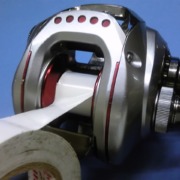
How much line should I wind on the reel?

All reels are marked with a spool rating, or the recommended amount of line to wind on the reel. If you wind too little line, the line will brush against the spool more during casting, affecting your casting distance. Overwinding can also cause line trouble.

When the winding capacity of a reel is 200M for PE1, the lines we purchase on the market are usually 100M, 150M, and sometimes even over 300M for large-capacity lines. If you continue to use only PE line 1, it would be best to purchase a line with 200M or 400M spooled, but reality is not like that, and sometimes you may need to change the line to a thinner one, so you may end up having to spool the underline.

However, those who say, “I’m not greedy for distance and I don’t care about line trouble,” don’t need to underline it^^

There are various ways to wrap an underline, such as using tape or tying a plastic bag, but today we will learn about the commonly used method of wrapping a nylon line.


First, there is a method of calculating and calculating the exact length of the line.

Second, there is a way to do it without calculating, although it takes time and is inconvenient. Let’s learn about each method.

Ⅰ. How to calculate the amount of underlining

The reel in the photo shows a 75cm reel per revolution, which translates to 200m of line for PE 1.5. However, if I wanted to reel in 0.4 line, I would need to calculate the appropriate amount of line, as the line diameters would be different.


PE 1.5 is 0.209mm and PE 0.4 is 0.108mm, so 0.209÷0.108=1.9351. Therefore, the calculation is that 0.4 needs to be wound 200m×1.9351=387m. In other words, this means that I can wind PE 0.4 (the amount of line I have is 150m) 150m÷387m×100=38.75%, and I need to wind the remaining 61%, or 237m, of line as the underline.

However, if the line to be used as the underline is Mono No. 1 (0.165 mm), this reel can wind 200 m of 8 lb (0.23 mm) nylon line, so 0.23 ÷ 0.165 = 1.393, so in the case of No. 1 line, 200 m × 1.393 = 278 m can be wound.

Then, based on the two calculations above, to wind 61% of the line, you need to wind 278 x 0.61 = 169.58 m, and since the amount of line wound per rotation of the reel is 75 cm, 169.58 ÷ 0.75 = 226. Therefore, the calculation is that you need to stop winding and wind the PE line after spinning 226 times.

For those of you wondering, “Ah, what’s so complicated? Isn’t there a way to just wrap it without any calculations?” I’d like to introduce a second method.

Ⅱ. How to wind the spool without calculating the amount of underlining

This method is a bit cumbersome and can be inconvenient without tools, but it’s widely used because it eliminates the need to calculate the amount of underlining. First, to wind underlining using this method, you need two empty line cases, or bobbins. It’s also convenient to have a line winding tool (a high-speed recycler).

If you look at the wrapping method in order,

① Wrap the PE line.

※ It is convenient to stick tape on after wrapping, but since regular tape has strong adhesive power, it is better to use masking tape.

② Underline the text.


※ It is recommended to wind the spool leaving about a coin’s worth of space from the edge.

③ Wrap the underlining line around an empty bobbin.

④ Wind the PE line around an empty bobbin.

⑤ Wind the monoline for the underline onto the reel.


⑥ After wrapping the underline, wrap the PE line.

What is the gear ratio of the reel?

For those who are new to fishing, there are so many different types of reels and their specifications vary that it can be difficult to choose one.

Last time,  we looked at the names and functions of each part of a spinning reel in general, but this time, we will look at the gear ratio in more detail.

The gear ratio is always indicated in the reel specifications. Both spinning reels and bait reels transmit power through gear-shaped parts. The gear ratio of the reel refers to the rate at which the spool rotates when the handle is rotated once.

If you look at the widely used Daiwa Revros, you can see that the amount of line that can be wound and the gear ratio are different for each model, as shown below.

The fishing target and method differ depending on the difference in gear ratio, but we will leave that aside for later. Generally, a spinning reel with a gear ratio of over 5.5 is called a high gear model, and a bait reel with a gear ratio of over 7.1 is called a high gear model.

Both spinning reels and bait reels have a structure in which power is transmitted by a main gear and a pinion gear. The pinion gear is, as the name suggests, the smaller of the two large and small gears that mesh with each other. The gear ratio is the ratio of the pinion gear to the larger main gear.


spinning reel


Bait reel

Now, let’s take a closer look at the gear ratio using a bait reel, which has a power transmission path that is easier to see with the naked eye than a spinning reel.


The model used is Shimano’s Metanium XT with a gear ratio of 6.2:1.


First, if you disassemble it, you will see the main gear and pinion gear.


The power transmission structure is such that when the main gear rotates, the pinion gear moves, and the pinion gear rotates in the opposite direction to the main gear. Furthermore, the spool rotates in the same direction and at the same speed as the pinion gear through the connected clutch.

Looking at the number of teeth on the gears, the main gear has 74 teeth and the pinion gear has 12 teeth. If we calculate this, 74÷12=6.166, which means that one rotation of the handle rotates the spool approximately 6.2 times.

To summarize again, a gear ratio of 6.2:1 means that the spool rotates 6.2 times per rotation of the handle. Knowing this gear ratio and the diameter of the spool, you can figure out how much line is wound when you wind the handle once. The diameter of Shimano’s Metanium XT spool is 34mm, so if you calculate the value of gear ratio × spool diameter × pi based on this, you get 6.2 × 34 × 3.14 = 661.91mm.

If you look at the specs of where Shimano’s Metanium XT is sold, the maximum winding length is listed as 66cm, which is exactly right. However, the term “winding length” is a Japanese expression, which can be expressed in Korean as the amount of winding per rotation.

What does the model name of a spinning reel indicate?

Reel size appropriate to the rod specifications

Reel number Jigging No. 1 Jigging No. 2 Jigging No. 3 No. 3 for both the jjigae and one-two No. 4 for both the jjigae and one-two No. 5 for both the jjigae and one-two One Two Road No. 10 One Two Road No. 15 One Two Road No. 20 One Two Road No. 25 One Two Road No. 30 Sea bass road Egging rod Light Game Road Shore jigging rod
Shimano 1000
Shimano 2000
Shimano 2500
Shimano 3000
Shimano 4000
Shimano 5000
Shimano 6000
Shimano 8000
 Daiwa  1500
Daiwa 2000
Daiwa 2500
Daiwa 3000
Daiwa 3500
Daiwa 4000
Daiwa 4500


Abu Garcia Reel Basics

characteristic Explanation
4 digit number Reel size (hereinafter referred to as number)
“S” after the number Shallow spool
“MS” after the number Middle shallow spool
“H” after the number High gear
“D” after the number double handle

yes

yes analyze meaning
2000SH [2000] [S] [H] Size 2000/ shallow spool/ high gear
2500MSH [2500] [MS] [H] Size 2500/ Middle shallow spool/ High gear
2500SD [2500] [S] [D] Size 2500/ shallow spool/ double handle

Shimano Reel Basics

characteristic Explanation
3 to 5 digit number Reel size (hereinafter referred to as number)
“C” in front of the number Compact body. The body is one size smaller and the spool size is the same as the count.
“S” after the number Shallow spool
“SS” after the number Super Shallow Spool
“M” after the number Medium deep spool/ between a regular spool and a shallow spool
“DH” after the number double handle
‘HG’ after the number High gear. More torque per turn of the handlebar than a normal gear ratio.
“XG” after the number Extra high gear. More power than HG.
“PG” after the number Power gear. Strong reeling power. Easy slow retrieve.

yes

yes analyze meaning
C3000 [C] [3000] Body size 2500/ Spool size 3000
2500S [2500] [S] Size 2500/ shallow spool
C3000SDH [C] [3000] [S] [DH] Body size 2500/ Spool size 3000/ Shallow spool/ Double handle
C2000HGS [C] [2000] [HG] [S] Body size 1000/ Spool size 2000/ High gear/ Shallow spool
4000XGM [4000] [XG] [M] Body size 4000/ Extra high gear/ Middle deep spool
C3000HGSDH [C] [3000] [HG] [S] [DH] Body size 2500/ Spool size 3000/ High gear/ Shallow spool/ Double handle
C2000PGSS [C] [2000] [PG] [SS] Body size 1000/ Spool size 2000/ Power gear/ Super shallow spool

Daiwa Reel Basics

characteristic Explanation
4-digit number Reel size (hereinafter referred to as the number)
Two digits other than 0 Indicates how many pounds of nylon line can be wound on 100 meters.
The two digits are not 0 and “PE” follows the number. Indicates how many PE lines can be wound
‘C’ after the number Compact body. One size smaller and the spool is the same size as the original.
“R” after the number One size too big
“H” after the number High gear. More torque per turn of the handlebar than a normal gear ratio.
“SH” after the number Super high gear. More torque than H.
“DH” after the number double handle
‘F’ after the number Models that fit the fluorine line

yes

yes analyze meaning
2004 [20 [04] Size 2000/4lb nylon line (or PE0.6) can be wound for 100m
3012H [30 [12] [H] Size 3000/ High gear/ 12lb nylon line can be wound 150m (or 200m of PE1.5)
2506H-DH [25 [06] [H] – [DH] Size 2500/ 6lb nylon line (or PE1) 100m (※ length may vary depending on model)/ high gear/ double handle
3000C [3000] [C] Body size 2500/ Spool size 3000
2500R [2500] [R] Body size 3000/ Spool size 2500
1025 [10 [25] Size 1000/ 2.5lb nylon line 100m ※ Please note that it is not 25lb
2004CH [20 [04] [C] [H] Body size 1000/ Spool size 2000/ 4lb nylon line (or PE0.6) 100m/ High gear
2510RPE-H [25 [10] [R] [PE] – [H] Body size 3000/ Spool size 2500/ PE1.0 200m/ High gear
2508PE-H-DH [25 [08] [PE] – [H] – [DH] Size 2500/ PE0.8 150m/ High gear/ Double handle
3515PE-SH [35 [15] [PE] – [SH] Size 3500/ PE1.5 200m/ Super High Gear

As such, we have looked at what each spinning reel model name represents, and next time, if we have the chance, we would like to look at how each manufacturer indicates the appropriate reel size for each line number.

Types of reel seats for lure rods

I sometimes get asked what the difference is between the reel seats used in high-end and entry-level rods, as they use the same reel seats despite having a large price difference.

So this time, we will learn about the reel seat for lures from Fuji, a Japanese company that is currently the most widely used.

As you all know, there are two types of reel seats: plate type and pipe type. Pipe type reel seats are used for lures.

However, from the perspective of a company that produces rods, the thickness of the legs of the various reels that will be mounted on the rods produced is the most problematic part.

Some reel feet (reel legs) are thick and some are thin, so it is not necessarily the case that high-end rods use expensive reel seats, and that entry-level rods use cheap reel seats. Even for the same reel seat, the price can differ by 4 to 5 times depending on the specifications, but there are not many companies that accurately inform people of this.

For example, Fuji Industries’ VSS starts at 800 yen, while B VSS or SB VSS start at 3,400 yen, but companies that produce/sell rods do not disclose detailed specifications and only say that it is a VSS sheet (since VSS has the meaning of sheet, if it is called a VSS sheet, it will not fit as it has two sheets).

Also, in the case of spinning reel seats, there are down lock and up lock types, and there are many things to consider, including the material of the reel seat. Therefore, the dichotomous distinction of “which reel seat is good and which reel seat is bad” is not correct, and  the preferred reel seat may differ depending on the user’s physical condition (hand size, finger length, etc.). Therefore,  let’s take a look at the differences between the reel seats that are most commonly used in lure rods currently sold on the market.

First, when you think of the reel seat, you think of the picture below. To be precise, the picture below can be divided into parts called the reel seat and the hood. In the case of VSS, for example, if the shape of the hood attached to the back is SD type, it is simply called VSS, and those that use other hoods have a separate name in front, such as B VSS or SB VSS.


In addition to these hoods, the part below called the “wind check” can also be considered part of the reel seat (some products do not have a wind check).


So, let’s first look at IPS and VSS used in spinning lure rods.

The S is characterized by being slightly thicker than the VSS, and among the locking methods mentioned above, it mainly adopts the up lock method. The reason for not using the down lock is to avoid the disadvantage of the down lock that can cause strain (fatigue) to the hand, especially the fingers.

It has recently been receiving attention again because it can be held with light force, and thus it is easy to feel the sensitivity and allows for delicate action. The “Evergreen Poseidon Salty Sensation PSSS-53S”, which is sold for over 400,000 won, is a product that adopts IPS.

VSS is an abbreviation for “Versatile spinning seat” and as the name suggests, it is a reel seat that can be used in a variety of ways. It is easy to think that it is used in general-purpose rods (or all-purpose rods), but this is not necessarily the case and it is also used in expensive rods.

This is because, in the case of spinning, there are only three types: the most expensive DPS, IPS, and VSS.

An example of a load that adopted VSS is

JS Company Nix Inshore (around 130,000 won)

JS Company Big Sword N A4 (around 400,000 won)

There are NS Dark Horse (around 80,000 won), etc., and looking at this, you can see that the reel seat is not decided based on the price difference.

▶Reel seat for bait

First, if we look at the release date of the most used or currently used reel seats, the order is TCS → ECS → ACS. Although the use of PTS, TVS, etc. has been increasing recently, it is still not that much compared to TCS, ECS, and ACS.

However, it is true that there are differences of opinion on the question of “Is it more sensitive to touch the blank of the rod directly or not?”,  but when the TCS was first released, the explanation from the company was that the fish’s bite is transmitted to the line, and this passes through the guide and amplifies the vibration to the grip. Now, starting with the ECS, types with blanks (or should we say holes?) in the reel seat have been released one after another, and they are being promoted as showing even better sensitivity,  which truly makes the saying “it depends” come to life.

So, let’s first look at the differences between TCS, ECS, and ACS using a diagram. You might not be able to tell the difference when the hoods are attached. (From top to bottom, in this order: TCS → ECS → ACS)

Then, let’s take a look at the difference just by looking at the reel seat with the hood removed. (From top to bottom, in order of TCS → ECS → ACS)

Now that we have a vague idea of ​​the differences, let’s delve a little deeper.

※All photos are size 16, and there may be errors in length.

TCS16: Length 11.3cm: Inner diameter 15mm
TCS17: Length 12.5cm: Inner diameter 17mm
ECS16: Length 11cm: Inner diameter 9.5-15mm
ECS17: Length 12.5 cm: Inner diameter 15-17 mm
ACS16: Length 11.3 cm: Inner diameter 9.5 to 15 mm
ACS17: Length 12.8 cm: Inner diameter 15-17 mm


First, the TCS is a sheet that is characterized by its lack of features. In the case of ECS or ACS, seawater seeps through the gaps (holes) created for the blank touch, and salt builds up, so it needs to be thoroughly cleaned with tools after fishing. However, the TCS has the advantage of being easy to maintain, and by completely covering the blank, it has high bonding strength and a stable grip. However, the disadvantage is that the part that connects to the reel is thick, which can be a strain on the fingers.

Among the products currently on the market that have adopted TCS, there are JS Company’s Jack Straw (around 65,000 won) and NS Monstick-S (around 300,000 won).

If you’ve seen the article about the arbor used to attach the reel seat A Story of Reel Seats and Arbors on Rods) from last time , you’ll know what an arbor is, but because it’s difficult (though not impossible) to use such arbors, ECS and ACS (and the most recently released TVS, etc.)  are also called “arborless” reel seats . (However, strictly speaking, they are not arborless.)

ACS stands for “accuracy casting seat” and is advertised as improving casting accuracy, but  I personally disagree with this claim and think it is exaggerated advertising.

Anyway, it may be the most familiar reel seat as it is currently the most used, but it is thicker than the ECS, and especially the trigger part is thick, so it may feel painful on the fingers touching the trigger, so it is a type suitable for people with long fingers and wide palms.

Among the products currently on sale, those that have adopted ACS include JS Company’s ChamCXT (around 270,000 won) and NS Bermuda SB (around 400,000 won).

ECS was released long before ACS, but it has recently been receiving attention again. It is considered to be the most suitable for Asians because of its overall thinness and thin trigger. Among the products sold on the market that have adopted ECS, JS Company’s Chamrod (around 180,000 won) and NS Furious Boron (around 360,000 won) are examples.

These are the most commonly used reel seats for baitcasting. Recently, the use of PTS, TVS, and SK seats has been increasing. Let’s take a quick look at them and finish.

PTS stands for Palming Trigger Seat, which means that you hold it as if wrapping it with your palm. It is recommended for those who do not like the steps of the ACS or have a small ECS and find it difficult to hold, as it uses a dedicated hood to significantly reduce the steps.


SK sheet is an abbreviation for skeleton sheet and is characterized by its separate form. SKTS is a trigger sheet where TS stands for trigger sheet and is for bait, while SKSS is a separate sheet without a trigger and is for spinning.


TVS is named “Tight V Spinning Seat” because the shape of the reel seat and the shape of the fingers form a V as shown in the picture.

The declining Fuji Guide (Fuji Industries) of Japan

In an article titled “There is no fun in choosing a fishing rod,” it was explained that the NRX series, the flagship model of the world-famous American company G·Loomis, uses guides from REC (REC Components), which was founded in 1968. Founded in 1982, Loomis began using Fuji Industries products for its guides in 1997 when it became a subsidiary of Japan’s Shimano.


As a side note, one of the major factors that allowed Jirumis to make a name for themselves in the American market in a short period of time was that the rods were designed by an outstanding person named Steve Rajeff, a 45-time American Casting Association Champion and 14-time World Champion.

Steve Rajeff


Anyway, now that Fuji guides are being used on the road of Jirumis, many people would think that Fuji Industry’s business is on the rise, but the reality is the opposite, Fuji Industry’s sales are continuously decreasing.

In fact, the topic of today’s conversation is not so much about Fuji Industry’s guides as it is about warning people against the blind preconception that Fuji guides are the best. For example, many anglers say that rods using Torzite guides are good, but they seem unaware that Torzite guides have been criticized for Fuji Industry’s dark history for years due to problems such as noise generated when using composite rods.

Fuji Industries recorded sales of KRW 58 billion in 2018 and KRW 60 billion in 2019 and 2020, but this decreased significantly to KRW 47 billion in 2021 and recovered slightly last year, achieving sales of KRW 50 billion.

However, it is not the case that a decline has begun simply because of a decrease in sales.

Fuji Industries has been relocating its manufacturing facilities to Qingdao, China since 2002 to reduce production costs, but is now planning to relocate them back to Japan. The main reason for this is that the export volume, which accounts for 80% of the total volume produced in China, is gradually decreasing, and labor costs in China continue to rise.

Fuji Industries Japan Headquarters


Fuji Industries Qingdao, China factory


Also, the company has not been able to produce any notable hits recently. This is because half of the 170 employees left the company when the factory was relocated from Japan to China, which led to a severe shortage of development personnel and a small market size. As a result, the management is seeking to diversify its business into other fields, which leads to the outlook that it will be difficult for the company to grow any further in the guide and reel seat sectors.

There is a scene in the drama Casino where the phrase “Hwamusipilhong” is used to describe the “Gwonmusipilhong” (a type of hibiscus flower), and looking at Fuji Industries, that phrase feels real.

Where exactly are the diameter and distance of the fishing rod measured?

As water temperatures and temperatures rise, more and more people are looking to enjoy outdoor activities, and the number of people going fishing is also increasing.


Accordingly, I often receive questions about fishing rods from newbies to fishing. When choosing a rod, there are many factors to consider, but for those who are purchasing equipment for the first time, it is difficult to make the right purchase considering various variables, so they use recommendations from those around them and the specifications of the company selling the product as the criteria for selection.


If you look at the specifications provided by each company that sells rods, the diameter and diameter are mentioned first, followed by the dead weight, and then the hardness of the rod, the limits of the equipment that can be used, etc.

What is the tolerance for the diameter, diameter, and displayed specifications of a fishing rod?


However, many people do not understand the exact measurement of the diameter and the distance, and we will look into whether it refers to the outer diameter or the inner diameter. Next, we will look into the allowable error in the specifications indicated by the company.


First, let’s look at the terms “선경” and “원경.” In Chinese characters, they are written as “선경” (先徑: 先径) and 원경 (元徑: 元径). As you can guess, these are expressions borrowed directly from Japanese expressions. In particular, the fact that the Chinese character for 원경 does not use the character “원” (遠), meaning “far,” is a difference from our way of thinking.


In Korea, there is an organization called the Korea Fishing Association (membership is open to individuals), which is made up of many fishing tackle makers and distributors, but I have never heard of them establishing standards for the notation of standard specifications and tolerances.


In comparison, in Japan, the “Fair Competition Regulations on Fishing Rod Labeling” and its “Enforcement Rules” were created and recommended by an organization called the “Fishing Rod Fair Trade Council.” In particular, before the regulations were newly revised, each company had its own standards for marking the line diameter and the distance between …


For example, in the case of Daiwa of Japan, the diameter of a float fishing rod is measured at a point 5cm from the end, and in the case of a cast rod, the diameter of the end is indicated as the diameter, and the measuring point was different for each product (even now, some products are measured differently), and this has been indicated differently for each company.


To prevent such confusion, the revised regulations provide clear standards for the distance and the line, and also set a range of tolerances for the specifications displayed on fishing rods, but these are not mandatory.

However, in Korea, where Japanese terms are borrowed and used, there is still no unified standard, so if you search for the diameter and diameter of a fishing rod on the Internet, you will often find that the diameter is generally the diameter of the very tip of the rod, and the diameter is the diameter of the very tip of the handle.


However, the diameter presented in Japan is defined as the outer diameter of the point closest to the front of the rod, where no parts (guides) are attached and where it can be measured directly, and the diameter is defined as the outer diameter of the point farthest from the rod, where no parts are attached and where it can be measured directly.

※ I think domestic companies are probably also following this standard.


That is why, if there is a guide at the end of the reed or a grip at the handle part, that is, the butt, the diameter measured from the back of the guide and the front of the grip should be called the diameter of the reed and the butt.

This diameter is called “Top Diameter” or “First Diameter” in English, and the original diameter is expressed as “Butt Diameter”. The word “Butt” that we commonly hear or use is derived from golf clubs and is used in fishing rods. The measurement of this Butt Diameter, or original diameter, is currently measured from the front of the grip as shown in the figure below.


Next, I saw an article from a domestic company that sells rods that said, “The international standard for weight tolerance is 5%.” However, there is no international standard for the tolerance of specifications for rods, and if there were, it would be a standard made in Japan.


The Japanese standard for the tolerance of fishing rods stipulates that the length (overall length) is measured when the rod is fully extended for the extended type and when the rod is fully inserted for the insert type, and that the tolerance should be within “+2cm, -1cm × number of sections.” The weight (self-weight) is measured as the weight including the guide, reel seat, grip, paint, etc., and that the tolerance should be within +5%.


Also, the length when folded is measured excluding the front plug (common in freshwater areas) and the back plug in the case of a sliding rod, and in the case of a plug-in rod, the longest length is measured, and the margin of error is set to be within ±3%.


With the rise of the domestic fishing population, many manufacturers are developing and diversifying their products. Just as Korean automobile manufacturing doesn’t have a long history, I don’t mean to nitpick the fact that terminology is being borrowed from Japan. However, I believe that standards for labeling specifications and product tolerances, which encourage informed consumption, should be established through the voluntary efforts of manufacturers, rather than being enforced.


For example, when I see that the weight error of a load made by a domestic company is as high as 9.45%, I think that it is time to set proper standards in Korea as well.

The History of Fishing Lines – Fluorocarbon Lines

Fluorocarbon, or carbon for short, is understood by anglers as a type of fishing line, but some people also understand it as the raw material for making freon gas (also called fluorocarbon), a major culprit in destroying the ozone layer.

※ HFC (Hydro Fluoro Carbon): A substance that does not contain chlorine and does not destroy the ozone layer, but contains hydrogen.

※ HCFC (Hydro Chloro Fluoro Carbon): A substance that contains chlorine, but has relatively weak ozone layer destruction properties because it contains hydrogen.

※ CFC (Chloro Fluoro Carbon): A substance that contains chlorine and has strong ozone layer-destroying properties, and its production and import were completely banned at the end of 1995.


Unlike the raw material of freon gas, the raw material of fluorocarbon line (fishing line) is polyvinylidene difluoride (PVDF), a high-purity thermoplastic fluoropolymer with high resistance. Simply put, it is a type of fluororesin and can be thought of as a plastic.

This type of PVDF is used in semiconductor manufacturing processes, and is used as a material for membrane filters used in water treatment processes around us. It is also used to make fishing lines, strings for stringed instruments, and pipes, sheets, and plates.

This type of fishing line made from PVDF, called  fluorocarbon line, was first produced in 1971, and the company that made it is a Japanese company called Kureha, which also makes the brand name ‘SEAGUAR’, which is synonymous with fluoroline .


Kureha Corporation changed its name from Kureha Chemical Industry in 2005, but it did not originally develop polyvinylidene fluoride resin for the purpose of developing fishing lines.

After Japan’s defeat in World War II, the industry producing caustic soda flourished during the process of rebuilding the post-war economy. Caustic soda was an important raw material used in plating, paper, and soap, and while demand was overflowing, dealing with the large amounts of chlorine generated during the manufacturing process was a huge headache for companies.

This vinylidene chloride resin, developed using chlorine, was already being produced in the United States and, due to its moisture-impermeable properties, was already being used by the US military during World War II to wrap bullets and gunpowder in the jungle to protect them from moisture. Kureha Industries succeeded in producing this through its own research and development and introduced it to the market for the first time in 1953.

The first product made was a net that did not absorb moisture and did not deteriorate under ultraviolet rays. However, because  it did not deteriorate easily, the replacement cycle of the product was long and  it was expensive to produce, so it ended up being a failure.

Next, Kureha Industries began producing food films, and from the time it entered this business, Kureha Industries experienced rapid growth. Among the food films, the product used to wrap sausages became a huge hit.


However, they had not yet created a fishing line, and at the time, they focused on food packaging wraps that were being distributed to ordinary households in the United States. After repeated research and development, they succeeded in making the film odorless, and in 1960, they launched ‘Kure Wrap’, a wrap for household use similar to the packaging wrap we use today.


Then, in Japan, a huge fishing boom occurred from the late 1960s to the 1970s, and since the fishing was mainly for silver carp, it was so popular that, according to media articles at the time, “the rivers were so overflowing with people that you couldn’t even move.”

Riding this wave of popularity, Kureha Industries also began producing and selling fishing lines using vinylidene chloride resin in 1971, which was the world’s first fluorocarbon fishing line, called “Seaguar.”


When the cigar was first released, the price was 330 yen, and since the exchange rates between the yen and the dollar and the Korean won and the dollar in the early 1970s were almost the same, it is estimated that the difference in currency value at that time and now is about 30 times, so  if converted to the current value, it comes to the calculation that 10 meters of fishing line costs 90,000 won .

However, those of you who have been fishing for a long time or are older will probably have used the ‘Cig Ace’ released in 1983 and the ‘Cig Grand Max’ released in 1996 at least once despite their hefty prices.

Fluorocarbon lines made in this way are loved by many anglers and are especially used as shock leaders for lure fishing. However, polyvinylidene fluoride, the material of fluorocarbon lines, has the characteristic of being strong against salt because it hardly undergoes chemical reactions, but it has the problem of not being broken down in the ecosystem and remaining as it is.

It may seem unrelated to the ‘marine plastic’ problem that is currently emerging as a global concern, but since this is also a type of plastic, is it really harmless even if it does not decompose? Or is it an issue that can be overlooked and overlooked when it is discarded and left as is because of other environmental damage, such as damage to animals caused by discarded fluoroline? I think many anglers need to think about this.

How to Clean a Reel for Beginners

After a sea fishing trip, seawater left on the line can cling to the reel’s surface, and if left untreated, the salt content of the line can damage the reel. Therefore, regardless of price, maintenance is essential to keep your gear in top condition for a long time.

However, for beginners who haven’t been fishing for long or have limited knowledge and experience with reels, disassembling and maintaining a reel can be a daunting task. Furthermore, maintenance requires the necessary equipment and consumables (reel oil, reel grease). Therefore, this article will cover simple reel cleaning and maintenance after fishing.

First, wash the reel after fishing in cold water in the following order .


①  Tighten the drag knob as far as possible .

②  Spray water on the line to remove salt .

③  Clean any areas with sand or foreign substances .

④  Clean the handle part as well .

⑤  After washing, turn the handle to blow away the moisture .

⑥  Wipe with a cloth that absorbs moisture well, such as kitchen paper or a towel, and dry in the shade .

Washing the reel as described above can extend its lifespan, but if you want to take care of it a little more, it is recommended to disassemble the main shaft, handle, and line roller and apply oil and grease .  However, I do not recommend disassembling the line roller for those who have no experience disassembling a reel . ( Most people say that it is difficult to reassemble after disassembly .)

Therefore, I think that even if you only take care of the main shaft and handle, which are relatively easy to disassemble and assemble, such as disassembling and cleaning them, excluding the line roller, which is difficult to disassemble and assemble, it will be of great help in maintaining the reel’s performance at its best and using it for a long time.

For reference, the oil and grease required for reel maintenance have different viscosities and volatility, so they are used in different areas. It is safe to say that oil is applied to areas that require lubrication, such as around the handle, and grease is applied to other areas.

First, turn the drag knob counterclockwise to separate the spool from the reel. You’ll see a long, rod-shaped part in the center. This is the main shaft. As the reel rotates, this shaft moves up and down, ensuring the line is evenly wound around the reel. Oiling this shaft helps smooth the line.


Next, loosen the screw on the opposite side of the reel handle, detach the handle, and clean off any rust or foreign matter, then apply grease.
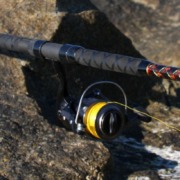
 

The most important part for maintaining the handle is the handle knob. It can be corroded by seawater and if left for a long time with salt on it, it can rust and become difficult to turn. Simply wiping it clean and applying grease is sufficient.


And if possible, it is recommended to disassemble the line roller and perform maintenance, but as shown below, there are many different types of line roller parts and it is not easy to assemble them after disassembly, so I do not recommend it until you have sufficient knowledge.


Lastly, I think that just applying grease to the screw part of the reel is enough for maintenance of a standard reel.