The Secret of the Square Root (√) Hidden in the Fishing Line

If you compare the fishing lines used by experienced and novice anglers, you will find that the less experienced angler is, the thicker the fishing line is.

The reason for this is probably that when a bite comes from a big fish that seems like it could be caught, there is an underlying anxiety that the fishing line might break because it is weak. But is it really difficult to hook a big fish if the fishing line you use is thin?

But to be clear, that’s absolutely not the case. In reality, it’s possible to easily catch large objects weighing more than its tensile strength, though this obviously requires skill.

So, from now on, let’s look at some things that beginners should know when choosing the thickness of the fishing line, or number.

First, let’s take another look at the most basic fishing line sizes.  As we learned in “History of Fishing Line – How Are Sizes Made?”, the size of nylon lines has been used since 1947, when the company, which was originally named Dongyang Rayon but changed its name to Toray in 1970 and began producing fishing lines under the brand name Toray, first produced a nylon fishing line called “Eunrin” (Silver Scale), and designated the diameter of size 1 fishing line as 0.165 mm.

However, in the case of PE, which is the most commonly used material these days, there is no set standard, so when you buy a reel and reel in the line with the specifications that say ○○m of line can be wound, you often end up winding less.

Since Japan established a standard for PE yarn in 2010, which was different for each individual, companies that produce reels now indicate the amount of yarn in their specifications according to the following criteria. However, very few people know that the number of fishing lines is hidden in the square root of 2 (√2).


※ Note: Standard diameter of PE

lake
robbery
Standard value
Standard diameter
lb
kg
Denier (d)
mm
0.1
4
1.81
20
0.054
0.15
4.5
2.04
30
0.066
0.2
5
2.27
40
0.076
0.25
5.5
2.49
50
0.085
0.3
6
2.72
60
0.094
0.35
7
March 18
70
0.101
0.4
8
3.63
80
0.108
0.45
9
4.08
90
0.115
0.5
10
4.54
100
0.121
0.6
12
5.44
120
0.132
0.7
14
6.35
140
0.143
0.8
16
7.26
160
0.153
1
20
9.07
200
0.171
1.2
24
10.89
240
0.191
1.5
30
13.61
300
0.209
1.7
34
15.42
340
0.219
2
40
18.14
400
0.242
2.5
50
22.68
500
0.270
3
55
24.95
600
0.296
4
60
27.22
800
0.342
5
80
36.29
1,000
0.382
6
90
40.82
1,200
0.418
8
100
45.36
1,600
0.483
10
130
58.96
2,000
0.540


We know that as the lake gets bigger, the thickness of the line also gets thicker, but we don’t necessarily need to know the criteria for the thickness and whether it is proportional, but knowing it will help us understand fishing lines.

If you look at the back of the composite product that is readily available on the market and used by many anglers, you will see the specifications listed below. Looking at the diameter of No. 1, you can see that it is 0.171mm as shown in the table above, and No. 2 is 0.242mm.


Those who saw the title would have already noticed  that the size of the fishing line is proportional to the square root of the diameter (√2) . (0.171mm x √2 = 0.241mm)  Also, the tensile strength of a wire material such as a fishing line is proportional to the cross-sectional area, and in the product specifications, you can see that the tensile strength of No. 2 is slightly less than twice that of No. 1.

The answer to the question of which lake is best to choose for fishing lines that have the secret of square root 2 (√2) can be found in a paper written by Professor Hideki Ohama of Yamanashi University in Japan.

The paper observed the pulling force (tension) and duration of time when the fish were hooked by lure fishing with salmon and rainbow trout that were 50 cm long and weighed 1.7 to 1.8 kg. According to the results, the maximum tension at the moment was 2.4 kg for salmon and 2.9 kg for rainbow trout.


That is, it was discovered that a tension of approximately 1.3 to 1.7 times the body weight was applied, and the time until maximum tension was applied was approximately 70 seconds after being caught on the needle, and after 150 seconds, it was reduced to 1/5.

If we break this down a bit, even excluding the resistance according to the angle of the PE to the surface, the fish caught on the hook shows a struggle that reaches its peak around 70 seconds as it gradually increases its swimming speed against it. This can be said to explain that the fish caught on the hook gradually loses strength after 70 seconds due to the resistance (square of the speed) felt by its body.

For reference, if a fish is 1 m long and weighs 10 kg, has a body diameter of 20 cm, and swims at a speed of 60 km/h, the maximum tension is calculated using the following formula.

Maximum tension = (1/2) × drag coefficient × cross-sectional area × seawater density × speed². Therefore, the maximum tension exerted by a 10 kg object is approximately 13 kg.

In other words, this means that even a 10kg fish can be easily caught with a No. 2 PE line. Therefore, beginners should understand that there’s absolutely no problem using a line that’s a bit thinner than they think. Rather than using thicker lines, it’s actually more beneficial to regularly check the line for damage.
Is there really a relationship between line thickness and casting distance?

The use of PE (composite) lines is becoming more common not only in long-distance fishing but also in lure fishing. In the last  article on “How to improve the distance of surf lures”, I was unable to provide objective and specific evidence for the content that said, “If you couldn’t go over 100m using a No. 1.5 PE line, you can get close to or exceed it by changing to a No. 1 PE line.” Then, I found that a monthly magazine called Leisure Fishing published in Japan conducted such an experiment, so I’m posting a brief summary of the content.

The experiment consisted of three parts:

First, the change in distance according to the thickness of the line

Second, the change in distance depending on the material of the arrow used (tungsten and lead)

Third, the change in distance depending on the number of needles used.

First, in order to find out the change in distance according to the thickness of the line, the rod used was a 9.8-foot bass lure rod and a 3000 spinning reel. The lure used was a 12cm minnow. Without attaching a hook, I made 3 full casts with PE lines of size 0.8 and 1.5 and compared the results.


According to the experimental results, the difference in distance depending on the thickness of the line is about 10m. In reality, if the distance differs by about 10m in a fishing spot, it can be said to be a significant difference.


Of course, the scientific objectivity of the experiment cannot be guaranteed, but the results are certainly meaningful.

Second, the equipment and supplies used in the experiment on the change in distance according to the material of the arrow used (tungsten and lead) are as follows.

Road: Kiss Special 405CX

Reel: Super Aero Kiss Special

Line: 0.6

Himsa: 0.8~7

Bongdol: Tungsten and lead bongdol of No. 30


It is commonly known that if the weight is the same, a tungsten weighted arrow will travel farther due to less air resistance, but the experimental results showed that the tungsten weighted arrow had a better distance.


Although the experimental results showed a difference in distance exceeding 13 meters,  it is right not to use lead billets because they are illegal.

However, even if it is a lead-based sinker, it is legal to use one that has been coated to prevent lead from leaking into the water.

The third experiment was conducted using barley anchovy rigs with 3 and 8 needles attached to each rig, and the results showed a difference of approximately 5 m.

Although the method and conditions of the experiment were not scientific, it was very meaningful in that it answered the question that had been raised for a long time: “How much does the thickness of the line affect the distance?” and that it allowed us to actually confirm the difference in distance depending on the material of the sinker.

How to view Shimano’s spool compatibility chart

It seems that there are not many people who have spare spools while fishing, and when it comes to replacing spools, many people don’t know which ones are compatible with their reels.

In particular, most people who use spinning reels keep a spare spool ready and use it, and I think there are probably two main reasons for this.

① When using a composite rod and connecting a shock leader, prepare in advance for line breaks.

② When you need to increase or decrease the amount of lines while using the same body size


In case ①, you can feel the effect greatly when you are doing FG knots on site in cold weather and your fingers are numb and uncomfortable. Today, following the last  “Daiwa Spinning Reel Spool Compatibility Table and How to Read It,” we will learn how to read Shimano’s compatibility table.

First off, Shimano’s spool compatibility chart is much easier to understand than Daiwa’s. However, even the compatibility chart on Yunseongjogu’s website contains some sections that beginners may find difficult to understand. Let’s take a look at them one by one.

※ Shimano spool compatibility table – Yunseongjogu

※ Shimano spool compatibility table – Shimano, Japan


There is no significant difference in the compatibility chart of Shimano spools between the one on the domestic website of Yunsungjogu and the one on the Japanese website of Shimano, but in my personal opinion, I think it would have been better if Yunsungjogu had a more detailed translation and supplementary explanation for domestic users rather than a machine translation.

Then, from now on, we will look at the spool compatibility table on the Yunseongjogu website. First, if you look at the method for viewing the compatibility table, you can see the expression ‘frame’ and the term ‘line winding type.’

One of the reasons I said that Yun Seong-jo’s compatibility table is at the machine translation level is because it uses the expression “teul” (frame). In Korea, we use the word “square” or “nemo” (square), not the expression “teul” (frame). This is the result of translating the Japanese word “waku” (frame).

Well, this isn’t that important, so let’s stop here. The most important thing to remember is that all models within the square or frame are compatible.

Next, something that is difficult for beginners to understand is  the line winding type, which refers to the shape of the spool taper.

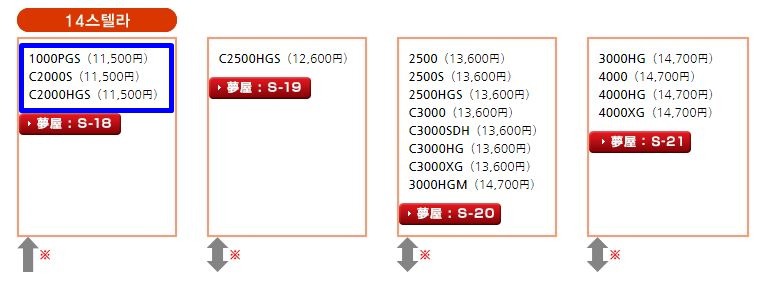
Let’s take a closer look at the 14 Stella as an example. First, if you look closely at the spool compatibility chart, you’ll notice that the square borders are colored differently. This has no significant meaning and is simply used to distinguish the models.

As we have seen above, all models within the square are compatible. For example, the spool of the 14 Stella 1000PGS can be used on the C2000S. This also means that the spool of the C2000S can be installed on the 1000PGS.


Next, looking at the 14 Stella, you can see four squares on the side. The number of squares varies by model, from two to four, but these squares represent the entire lineup of the corresponding general-purpose model. Therefore, the 14 Stella can be understood as the entire lineup of general-purpose models within the four squares.

Below, there is a red box with the words ‘Yumeya (夢屋):○○’ written on it. This indicates a Yumeya (夢屋) product that can be installed. If the numbers in the ○○ section are the same, it means it is compatible. However, it would be good to note that the Yunseongjogu website does not link to Yumeya products, and only the Japanese Shimano website links.

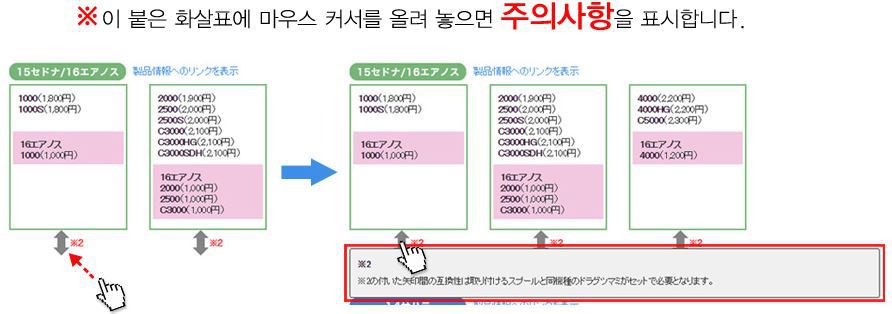
Next, if you look at the bottom of the square, you can see that there are arrows on both sides (↔), on one side only (→), and in some cases, there are no arrows at all.  The arrows indicate the compatibility of spools of different models and years, for example, the 4000HG spool of the 14 Stella is compatible with the 4000 of the 10 Stella and 07 Stella.

And in the case below without an arrow, it means that it is not compatible. In other words, the spool that fits the 2000 of the 10 Stella cannot be mounted on the 2000 reel of the 07 Stella.

Lastly, when you hover your cursor over ※, the window that appears cannot be captured and cannot be explained in a picture, but it is listed as a compatible model on the compatibility table, but it clearly states that you must change the drag knob to use it, so you must check this before purchasing the spool.

Daiwa Spinning Reel Spool Compatibility Chart and How to Read It

Daiwa Korea’s website provides information on compatible spools for each type of reel, as shown below. However, I feel that it is a bit lacking, so today I will look into the compatibility of Daiwa spinning reels based on information provided in Japan.

First, the Daiwa compatibility chart attached below differs in that No. 1 is for before the release of the LT reel, while No. 2 is for after. However, I believe No. 1 will be more useful to anglers, so I encourage anyone who needs it to download and use it.


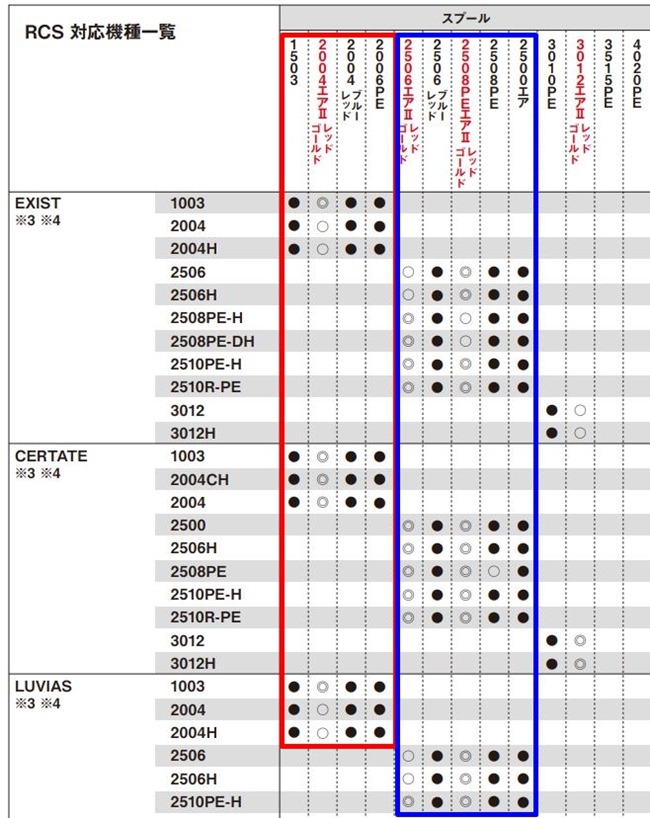
First, to see Daiwa’s spool compatibility chart, select the model of the reel you own on the left, then move to the right to find ○, ●, ◎, and then find the RCS spool above to select a compatible spool.

However, the price of a custom spool called a RCS (Real Custom System) spool is not cheap, so it is often difficult to decide on one. This post is not intended to explain how to find an RCS spool, but rather to find out how to make a general stock spool compatible using the RCS spool compatibility table provided by Daiwa. So, let’s take a closer look from now on.

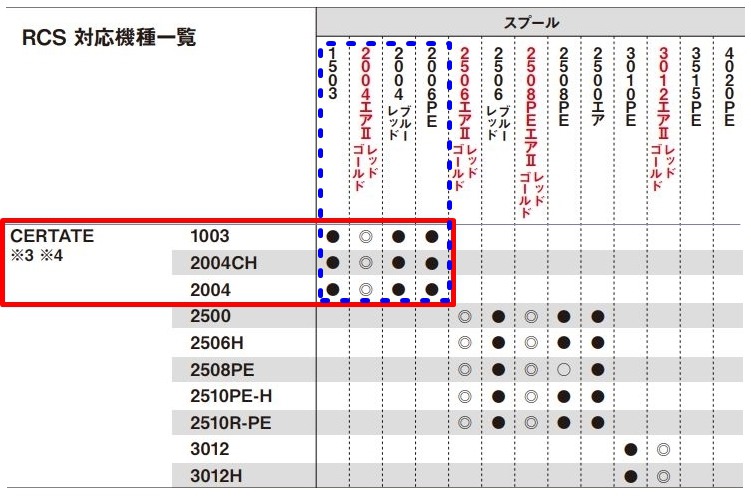
Let’s take 16 Certate as an example. First, if the reel you have is 16 Certate 1003, 2004CH, or 2004, look for ○, ●, or ◎ in the red square and find the RCS spool above it.


※ The ゴールド and レッド after the model name indicate the colors gold and red.

In the picture above, when you see that 1503, 2004 Air II, 2004, and 2006 PE match, this means that not only 1503 but also 2000 series RCS spools can be installed on the 1003 reel of the 16 Certate. In other words, this  means that the genuine spool of 2004 can be installed on the 1003 reel of the 16 Certate .

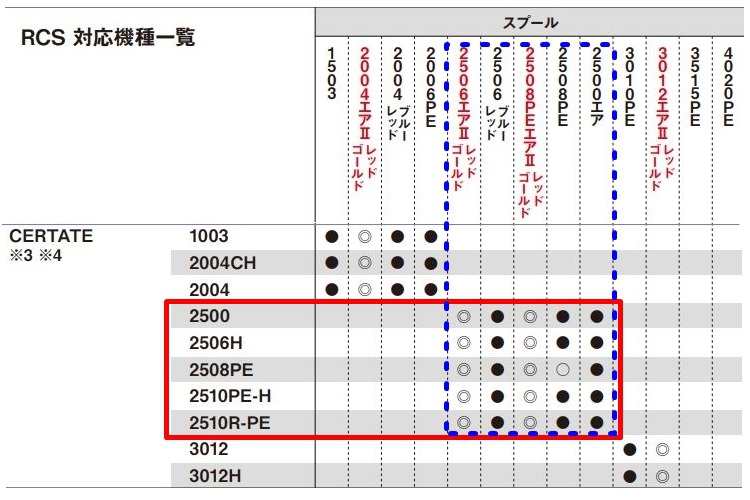
Secondly, in the case of 16 Certate 2500, 2506H, 2508PE, 2510PE-H, 2510R-PE, the types of RCS spool on the top are 2506, 2508, 2500, which means that they can be mounted on 16 Certate 2506, 2508, 2500 reels, which means that for 16 Certate 2500 series, you can choose from various types of RCS spools with different winding capacity or drag power to suit your taste.


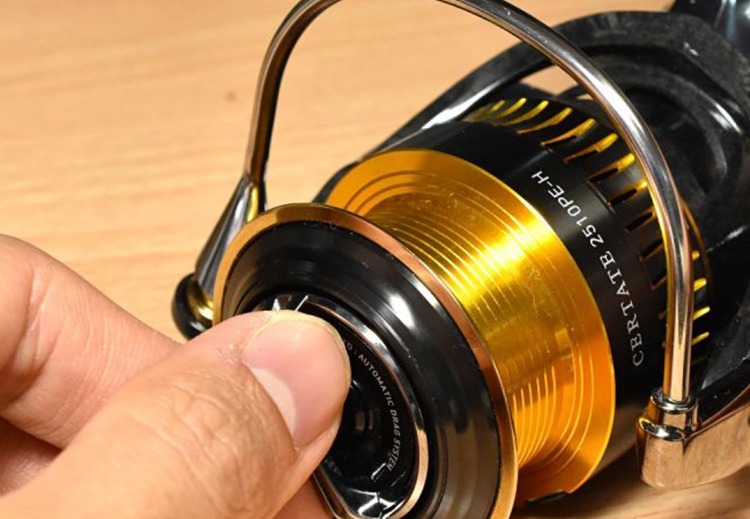
So, if you  are currently using a 2506 reel but want to increase the amount of winding and drag, you can simply replace it with a genuine 2510PE-H spool .

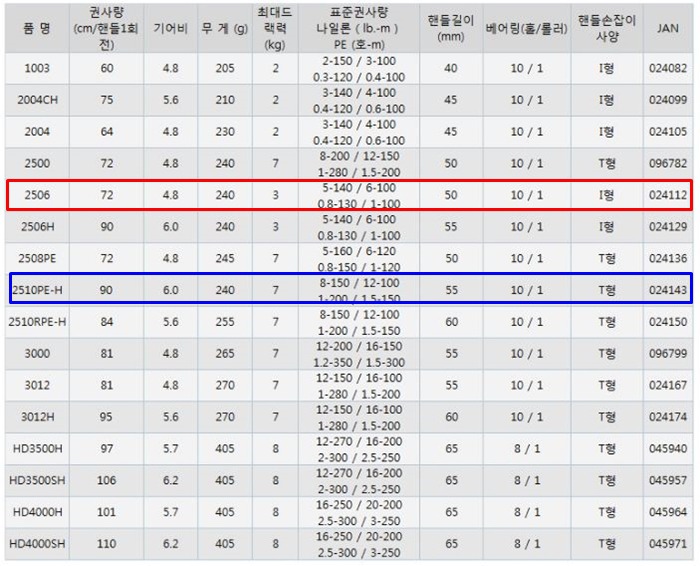
Now, let’s say you currently own a 16-Certate 2510PE-H. The 2510PE-H has a spool capacity of 150 meters of PE 1.5. What if you want to replace it with a spool capable of 150 meters of PE 0.8? The solution is to install a genuine 2508PE spool.

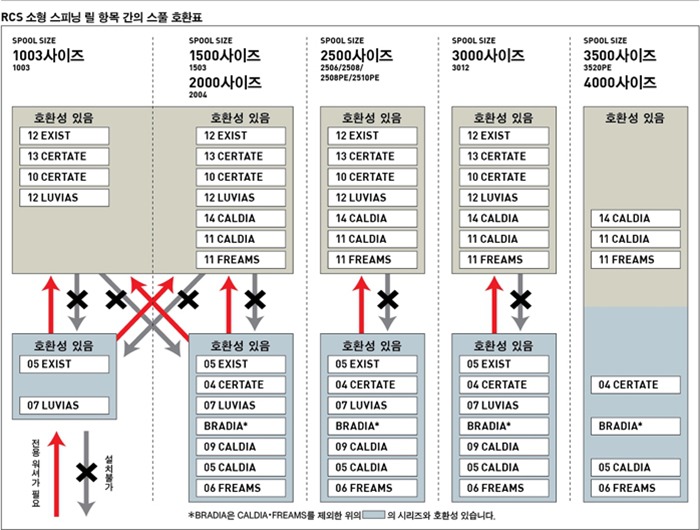
Now, going back to the beginning, if the spool size is the same as shown in the spool compatibility chart of spinning reels on the Daiwa Korea website,  you can fully understand that the spools of Exist, Certate, and Rubias are compatible with each other in the 1003 size, and are compatible with many more models in the 1500 and 2000 sizes.

However, some reels are not compatible depending on the model year, and with the release of new LT concept reels, Daiwa’s spool compatibility is considered to be lower than before.

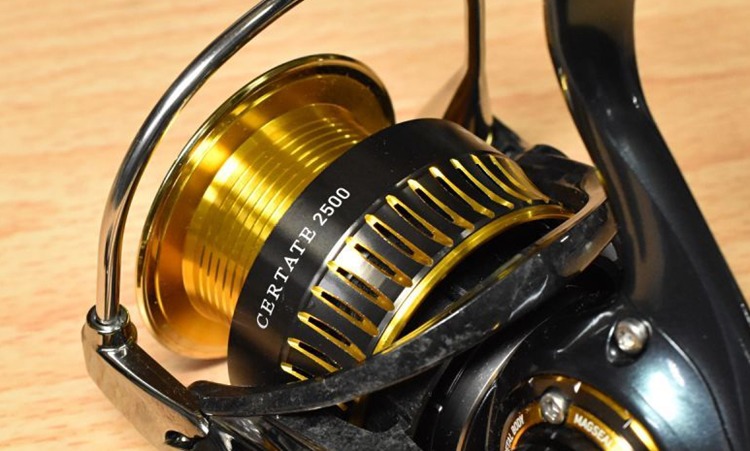
Lastly, if you look at the compatibility table, you can see that the 2510PE-H can be equipped with genuine spools such as 2500, 2506, 2506H, 2508PE, and 2510R-PE. In fact, if you replace the spool of the 2510PE-H with the genuine 2500 spool, you can see that there is no problem with compatibility.


This may not be of much use to many people, but I will conclude this article by looking at the RCS spool compatibility chart provided by Daiwa to determine the compatibility of genuine spools.

Differences in spool notation between Shimano and Daiwa spinning reels

I believe many of you are familiar with how to read the specifications of Japanese Shimano and Daiwa reels.

Well, let’s take a look at two pictures.

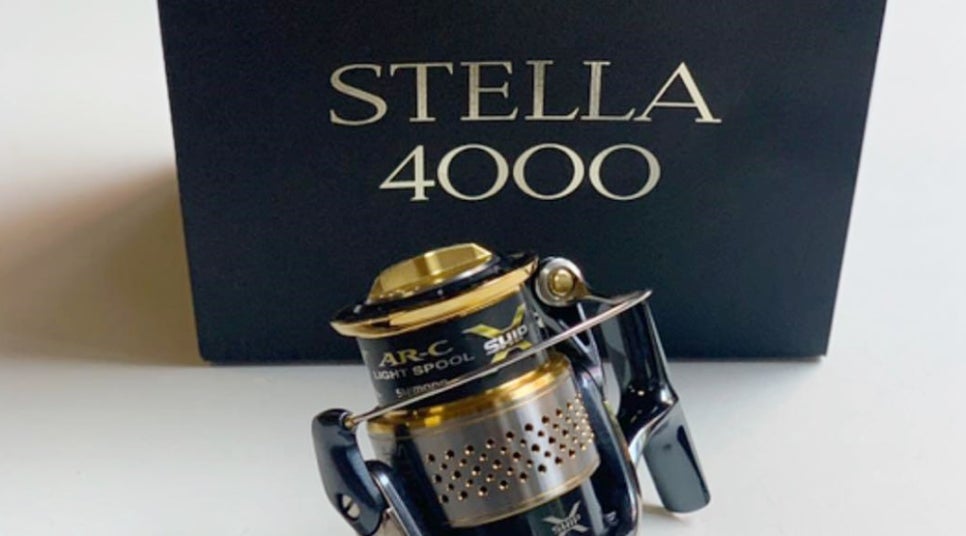
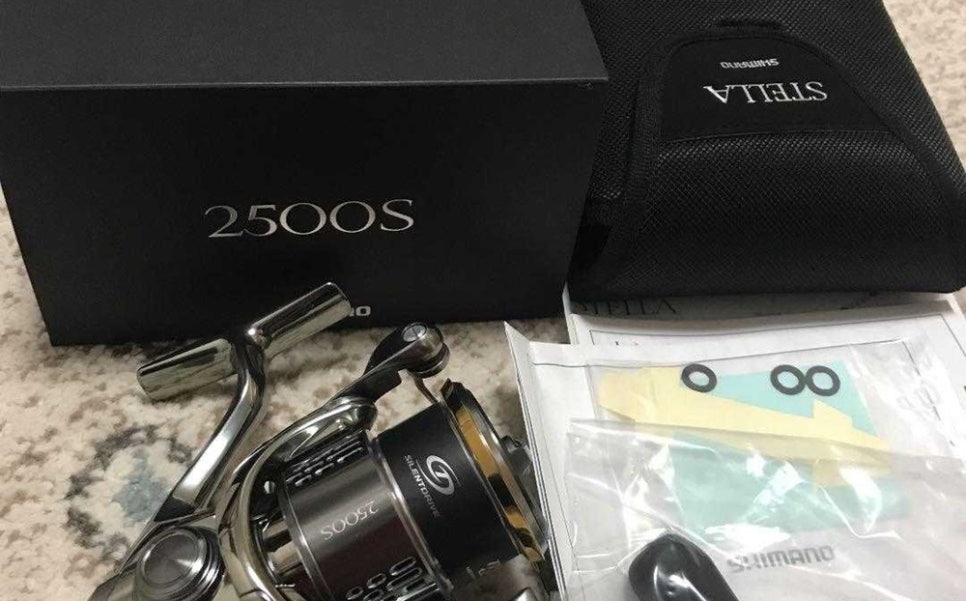
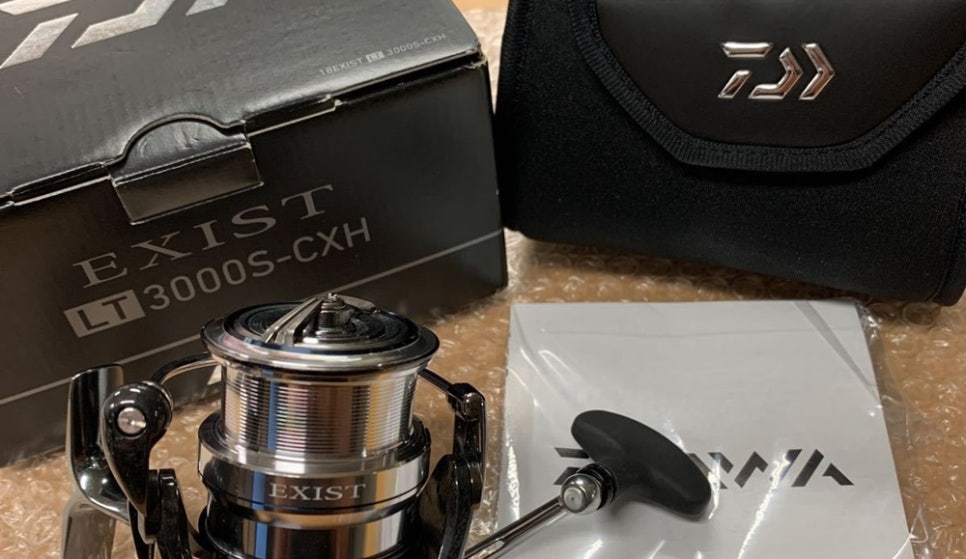
One is Shimano’s Stella 4000 and the other is Daiwa’s Exist LT4000.

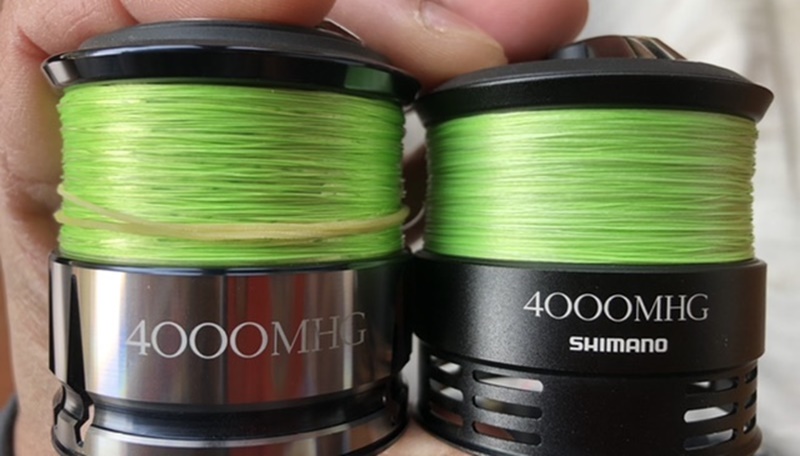
As you may know, both Shimano and Daiwa reels that use shallow spools have an S in their model names.
  

So, do you think that the two products you saw earlier that do not have an S in their model names are deep spools?

If so, you are wrong.

Shimano’s Stella 4000 has a deep spool, but Daiwa’s Exist LT4000 has a medium deep spool.

That is, there is a difference in that Shimano does not indicate anything on models that adopt a deep spool, and Daiwa does not indicate anything on products that adopt a medium deep spool.


So Shimano marks its models with medium deep spools with M, and Daiwa marks its models with deep spools with D.


The bottom line for today is that if there is no specification for Shimano and Daiwa reels, then Shimano is a deep spool product, while Daiwa is a medium deep spool product.

Difference between solid tips and tubular tips

The tip, which we commonly call a tip, is an English word meaning the end, and the words solid and tubular are added to it to distinguish between a hollow tubular type tip and a solid type tip that is filled with the inside.

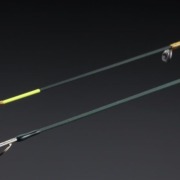
Solid on the left, tubular on the right

In other words, simply put, you can understand that a tubular tip is hollow and a solid tip is full.

The reason why fishing rods are made by distinguishing these differences is because the bend of the entire rod differs depending on the shape of the tip, and this also results in a difference in sensitivity. Let’s take a closer look at this.

In general, tubular types are good for using heavy tackle because they have strong rebounding power, and solid types are easy to determine the bite just by bending the rod, and can be damaged even with a small impact, so they can be said to be a type that is not suitable for beginners. Unfortunately, most companies that sell fishing rods do not provide information on these specifications.

That’s why people who don’t have enough knowledge about fishing rods often mistakenly believe that the entire rod is of that type, rather than just the solid or tubular tip.

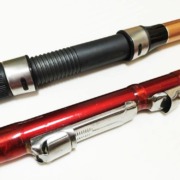
The biggest difference between a solid tip and a tubular tip is whether it is soft or hard, as shown in the photo below. This difference in softness results in different sensitivity and also a difference in the size of the fish that can be caught.

Tubular on top, solid on bottom


Solid on top, tubular on bottom


Since it is impossible to say with certainty whether a solid tip or a tubular tip is better, it is even more so that companies that produce or sell rods should provide detailed information on this, but they do not provide any information on this at all, which makes me think that this is a violation of consumer rights.

Therefore, even if we leave aside the price difference, I think it would be appropriate to allow people who purchase rods to choose one that suits their personal preference for the style of fishing they intend to do.

The biggest difference between solid and tubular tips, in addition to what has been mentioned above, is that solid tips can be made thin and flexible, which means they feel less discomfort when fish bite, and  tubular tips have the advantage of superior sensitivity. Since the tubular type has a hollow shape, it is naturally lighter, but it has the limitation of being harder and thicker than the solid type.

Also, in the case of tubular tips, when a load is applied, the circular shape that makes up the hollow section of the cross-section becomes distorted into an oval shape. If this condition persists or there is a defect, the rod’s bending will not be normal. This does not make a difference in the sensitivity of feeling the fish’s bite, but it causes the fish to feel uncomfortable, which shows the disadvantage of reducing the accuracy of the hook.

When I look at information on the Internet, I see things that are close to a formula that divides solids and tubulars into which types of fishing solids are suitable for and which types of fish tubulars are suitable for.  To be honest, I cannot agree with this distinction at all.

This isn’t my intention to write this post, but coincidentally, the tubular and solid type rods I was using were damaged and couldn’t be repaired, so I took a picture with my smartphone on a whim, but the quality isn’t great so I can’t post it, but  among these two,  I personally think that the solid tip rod has better sensitivity than the tubular tip rod.

 Therefore , I think it is wrong to make a general statement about the difference, except that the tubular type with a hollow shape is naturally lighter depending on the method of making the rod .

The last thing we need to know is why we call them solid tips and tubular tips, rather than solid and tubular.

Although there are rods that have a solid shape throughout the entire rod, most rods have a tubular structure with only the stem portion being solid.

This  means that if the process of joining parts with different structures is not precise and detailed, the joint area may be damaged or broken .

In most of these cases, since they are not entirely solid, there must be a connecting part, and most connecting points are usually made by inserting a solid rod into the tubular rod near the guide, gluing it, and then finishing it with epoxy. This can be observed in cheap fishing rods, as shown below, where the diameter of the rod decreases rapidly at the connecting part.


Especially for rods designed to catch fish with strong pulling power, such as sea bass, it goes without saying that good design technology is required to reduce the deviation caused by the difference between the flexible tubular type rod and the rigid solid type connecting part, and the user must also pay close attention.

As the number of posts increases, the number of promises that cannot be kept also seems to increase. If I have the chance, in addition to these two types of tips (salt rods), I  will also cover the “high-elasticity solid tip” that has been increasingly used by anglers recently .

One of the most frequently asked questions about fishing rods

Today I’d like to talk about one of the most frequently asked questions I get about fishing.

The question I get asked most often is whether or not rods made by companies other than the big names or major manufacturers are good or bad.

To be honest, I don’t know for sure, and it would be wiser to ask that question directly to the company.

However, manufacturers often do not provide accurate answers to consumers’ questions, using excuses such as trade secrets or know-how that cannot be disclosed.

That’s why I tell people to use the amount of information provided as one of the criteria when purchasing fishing gear.

Oh! Of course, I’m excluding the ones that list all the dazzlingly Photoshopped, slapstick jokes.

When people design rods, they often attach promotional drawings or videos showing how to place the reel seat and guides using CAD.


However, the design of the rod can be said to begin with deciding how to wrap the carbon sheet, how many times to wrap it, and how to cut it.

However, not many companies design their own carbon sheet laminate structures. Therefore, some companies use ready-made blanks for their products.

However, as I said before, it may be an exaggeration to say that the fishing rod manufacturing industry requires investment but not cutting-edge high-tech equipment, and that it requires a lot of employees but does not require research and development in the field of raw material technology, but that is not entirely wrong.


Companies currently producing blanks made of carbon, the material used in fishing rods, are neither cutting-edge nor large-scale industries, but rather more like cottage industries.

This is because production begins with simple purchase, regardless of research, production, and development of the carbon sheets used as raw materials, and even a little thought will tell you that a company that produces rods would not invest in R&D of carbon fabric.

Companies that produce rods are usually categorized into those that own their own kilns, those that do not have kilns but purchase heat-treated blanks to manufacture them, and those that do not have kilns or buildings but outsource production to companies that do have kilns.

Therefore, if a product is made by importing carbon fiber from Japan, heat-treating it in a kiln in China or a third country, and then bringing it to Korea to be assembled and processed before being sold, then what kind of technology from which country should it be said to contain?

I am saying this because there are products that are produced and sold in this form.

Back to the main topic, the quality of rod production varies depending on the carbon sheet used, how much it is heated, and how it is painted, even if the same materials are used. It also varies depending on the guide and reel seat.

That’s why most reviews often explain things that are different from the essence, such as how expensive a guide is and how good a reel seat is because of a certain company.

But, you see, only a rod with a good guide attached to a good blank can be said to be excellent, a rod with a bad guide attached to a good blank is average, a rod with a good guide attached to a bad blank is a piece of shit, and a rod with a bad guide attached to a bad blank is a failure. So, in the end, the standard for evaluating the perfection of a rod cannot go beyond each person’s own brain, which is why I said in the beginning that the best way to evaluate the quality of a rod is to contact the company directly.

However, since companies do not provide detailed information and answers to consumers’ inquiries, they face practical difficulties. In such cases, you can make a decision by asking just one question that will serve as the basis for your purchase decision.

The reel seats of long-distance fishing rods can be divided into plate type and pipe type. In the case of the pipe type, rather than the plate type, there is a gap between the rod blank and the reel seat, so this gap must be filled in some way.

You can just ask the company about this.

In the case of companies that directly design the laminated structure of the carbon sheets they use, most of them design it so that there are almost no gaps, so they finish it with adhesive only, but in the case of manufacturing the blanks by procuring them externally, they often use a method of winding thread and bonding it or using paper-based materials to bond it, but in some cases, they fill the gaps with blue tape and then bond it.


Fishing rods made with blue tape are not used because exposing them to high temperatures for long periods of time can easily cause the reel seat to shake or become deformed, but you can see that blue tape was used in the rod production of a certain company that sells them for around 300,000 won.

I don’t remember the company’s promotional copy in detail, but I remember them bragging about how they achieved the best quality with the best technology.

Ask me now what material is used to fill the gaps in the reel seat.

If you can’t answer, it’s either not a product you designed yourself, or even if you did design it, if the manufacturer made it differently from what was designed, it’s proof that quality control is not being done properly, so wouldn’t it be wise not to buy such a product?

No matter how much people around you say it’s good.

Lure rod reel seat and arbor

Choosing a rod isn’t easy for beginners, and only by gaining in-depth knowledge can you choose the right one.

There are so many factors to consider when choosing a load that no matter how much you search the internet and gather information, you can never know exactly what load it is.

There is no information that makes it easy to make a proper judgment, such as whether it “suits your style,” “suits the field you fish in,”  or  “is a product with a good reputation.”

As you can see, first, you choose a product that fits your budget, and then you make the final decision on the one with good reviews.

However, this is perfectly normal. Since it’s difficult to make a proper judgment without knowing anything about the load, it’s wise to rely on other people’s reviews as a basis for your judgment.


For example, when buying a car, Hyundai and Kia are the first brands you look for.

If you don’t have a proper knowledge of the rod , you can’t judge what the company says about “what is the blank”, “what is the taper”, “what is the sensitivity”, and “what is the guide” .

In such cases, it is better to forget about the words that the company promotes, such as  high elasticity, carbon content, or even how many tons of carbon sheet were used.

It’s wiser to prioritize the warranty as your first consideration when making your choice. Consider the warranty period, the amount of the warranty deposit after the warranty period, and  the overall after-sales service policy and processing time.

Next, when choosing a rod, beginners should definitely try it out in the store. Some fishing shops even allow you to attach your own reel to the rod, so the grip and elbow position are particularly important. Next, check the grip length and reel seat.


Anyway, sensitivity is something that beginners can’t know even if they shake it, but please shake it once and see^^

I will post more details later, but it is okay to not know at first how many axes of carbon there are, whether the ferrule (connecting part) is a spigot or ferralite, whether the paint is polished or sanded, etc.

However, let’s just remember that by examining the tolerances of lures, we can determine which product with similar specifications is more consumer-focused. Otherwise, it would be too far off topic for today. ^^

As the title suggests, today’s topic is about rod reel seats and arbors.

In fact, when you lack knowledge about the rod or something, it is easy to think that if the rod sensitivity is not good, the blank is the problem, but  what is important in transmitting the sensitivity to the hand is how much the vibration from the blank to the grip is amplified, which determines whether the sensitivity is good or bad.

This is because sensitivity cannot be judged with just a blank that does not have the reel seat and grip combined.

Currently, the reel seats for rods on the market are mainly made by Korea’s Gi-Kang Industry and Japan’s Fuji Industry.

For example, if the inner diameter of the reel seat of the A period industry is 15 mm, the outer diameter of the rod blank cannot be exactly 15 mm, so a part called an arbor is inserted into the space between the blank and the reel seat.


As I have learned through my experience customizing rods, surprisingly, there are quite a few companies that make fishing rods that fill in this gap.

If you value the sensitivity of the rod,  a urethane or cork arbor is good, but  because it takes more time to manufacture, it is often finished by wrapping tape or thread.


I hope you understand that the sensitivity of a rod is greatly influenced by these invisible parts. Next time, we will take a closer look at some of the things you should know when choosing a bass rod.

Difference in distance between 4-ply, 8-ply, and 12-ply

For those who enjoy long-distance fishing and lure fishing, improving casting distance is a crucial factor, and many people seek to improve it by changing their gear and rigging. One of the most crucial factors is the use of a polyethylene (PE) line with several twists.

There is a lot of information about fishing, but when it comes to which of the 4-ply, 8-ply, and 12-ply reels flies farther, theoretically you might think that 12-ply reels would fly farther, but there are not many cases where this is explained with data from actual experiments, so let’s take a look at the results of an experiment conducted by Shimano in Japan.

However, not revealing specific product names is a principle I have maintained while running my blog, and especially now that the boycott of Japanese products is spreading, I feel that I must actively participate in it, so I will not mention the names of the products used in the experiment and will only leave a link to the original text.

※ Original text of Shimano’s distance test

The number of braids used in the experiment was 1.2, and 200m of 4, 8, and 12 braids were wound on the same type of reel. In order to obtain accurate results, the experiment was conducted without connecting a shock leader.

The experimental method was to throw each lure produced by Shimano 8 times with a 9.6-foot rod and compare the average of 6 times after excluding the maximum and minimum values. The results are as follows.

division
4-way
8-fold
12-part syllable
average distance
48.5m
53.6m
56.1m
4-component (%)
0
10.5% increase
15.6% increase
etc(%)
0
10.5% increase compared to the previous 4 companies
4.7% increase compared to the 8th generation


This experiment shows that changing from 4-ply to 8-ply increases distance by 10.5%, and changing from 8-ply to 12-ply increases distance by 4.7%, but price ultimately becomes an issue for anglers.

Therefore, if you are satisfied with your current distance, there is no need to use the expensive 12-ply yarn, but if you want to improve your distance, this experiment shows that using 8-ply yarn is sufficient.

This is because the 5% increase in distance when changing from an 8-ply to a 12-ply is possible simply by modifying the casting posture and method!

One thing fishing line sellers never tell you!

A viewer of my YouTube channel asked me about the thickness of the line, so today I’m going to look into something that many anglers misunderstand and something that fishing line sellers never disclose.

Most anglers make their decisions when purchasing line based on the lake or pound rating. They particularly value the strength of the line, but there’s a significant misconception here.

It is a well-known fact that our country’s modern fishing culture was introduced from Japan, and in particular, the standards for the length of fishing lines are based on those of Japan.

Then, let’s continue the discussion by looking at how Banax, Shimano, and Daiwa, the representative fishing tackle companies in Korea and Japan, indicate the specifications of the PE rods they sell.

What we commonly call tensile strength is expressed as strength by Banax, while Shimano and Daiwa use the expression strength.

Banax


Shimano


Is this simply a difference in translation?

Absolutely not.

The meaning of strength and power of fishing line are completely different, and although Japan recommends indicating strength, Shimano, Daiwa, and other fishing line manufacturers rarely indicate strength.

So, let’s look at the difference between the two and why intensity is not indicated in Japan.

In 2010, the Japan Fishing Tackle Industry Association voted on a proposal to require fishing lines manufactured according to established standards to be sold with a certification mark attached, but the proposal was defeated due to opposition from many companies.

In Japan, the strength of fishing lines is expressed using two criteria: strong (强力) and strength (强度). The strength we commonly use is expressed as strong in Japan.

So, as we saw before, Shimano and Daiwa also indicate it as powerful in their specifications.

So what does intensity mean?

As you may know, the standard diameter of nylon line No. 1 is 0.165 mm, No. 0.8 is 0.148 mm, and No. 1.2 is 0.185 mm.

Therefore, if the line has a diameter between 0.149mm and 0.184mm, it can be sold as No. 1.

In Japan, the load when a No. 1 line of various thicknesses is cut randomly and both ends are pulled until it breaks is called strength, but we commonly call it strength or tensile strength.

In contrast, the strength that is referred to in Japan refers to the inherent strength of the material used to make fishing lines, and this can only be calculated by knowing the denier, which indicates the thickness.

Before the standard diameter of synthetic yarn was established in Japan in late 2010, the denier had to be indicated when selling synthetic yarn, and the standard for No. 1 was 200d.

And many people don’t know, but there are also standard denier standards for nylon and carbon fiber lines.

Denier is expressed as 1d when the weight of 9,000 meters of thread or fiber is 1g, so 200d, the standard for No. 1 ply yarn, means that 9,000 meters weighs 200g, and if you divide this by the strength of the fishing line, that is, the tensile strength, you can get the strength referred to in Japan.

Therefore, regardless of the thickness of the thread or fiber, the inherent strength is not because the diameter of the fishing line is thick, but because the material itself is strong. This is a measure that shows that thick = strong, but thin is also strong, but no company discloses this.

Except for one Japanese company.

There’s no need to reveal the name of this company, right?

If the tensile strength of 100d is 10kg and the tensile strength of 200d is 10kg, the strengths are 0.1 and 0.05 respectively, so you can see that the line made with 100d is thin but strong.

Another thing is that it is natural that the thicker the fishing line, the heavier it is, so revealing the denier reveals the quality of the product, so companies are reluctant to reveal this information if possible.

Okay, now let’s conclude today’s discussion.

The reason why the thickness of the fishing line, especially the braided line, varies greatly from company to company is that in Korea, where there is no standard diameter for braided lines, the Japanese one is used, but unlike Japan, the denier that can be used to determine the strength of the braided line is not disclosed.

Furthermore, even if the thickness is measured with a micrometer, there is a constant problem that the measured area is pressed due to the nature of the composite yarn, resulting in a thin measurement. Therefore, I believe that it is necessary to disclose the denier of the yarn and fiber used as raw materials for line manufacturing in order for consumers to make a reasonable judgment.

The fishing lines we sell don’t need flashy advertising like they’re thin and strong, made with the best technology. Simply revealing the denier would be enough. Sales would skyrocket if we just revealed that. Which company would be the first to do so?

I will start promoting it extensively.