
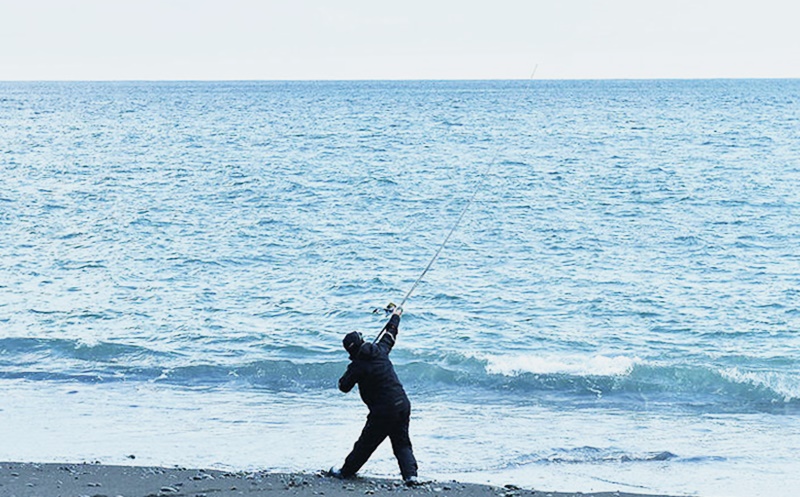
As the length of the fishing rod increases, will the casting distance also increase?
Many anglers who enjoy long-distance fishing seem to believe that longer rods increase distance and that casting at a 45° angle will allow for the furthest throw.
Of course, this isn’t entirely wrong, but it’s not 100% accurate either.
So how much does a longer rod length increase distance? And is throwing at a 45° angle ideal?
Let’s take a closer look at these two extremely common yet somewhat misunderstood facts, using the power of physics, in several installments.
Today, let’s look at the difference in distance depending on the angle of flight and the height of the release point of the casted ball in the first order.
First, as is commonly known, when casting at angles of 30°, 45°, and 60°, the 45° angle will fly the farthest. However, there’s a hidden assumption here.
That is, it is assumed that the angle when thrown from 0m above the ground is 45°.

For example, beginner shot putters are taught to release at a point closer to 42° rather than 45°, and as their skill level improves, they are taught to lower the release angle to 36°, thereby improving distance.


Why is it 36° and not 45°? That’s because shot putters release their weight not from the ground, but at a point about 2m away, depending on their physique.
Let’s take a closer look at this in a picture.
First, if the end of the rod is cast at an angle (θ₀) that is horizontal to the sinker, the landing (or launch) angle is 90°-θ₀, which we will call θₑ. Therefore, θ₀+θₑ=90°, and the most appropriate casting angle for θ₀ is as shown in formula (2) in the figure.

So, assuming all participating athletes are of equal physical condition, what is the most important factor in achieving the shot put record of 23.37 meters set by Ryan Crouser of the United States on June 19, 2021? The answer is throwing speed!
If all athletes release the shot from a height of 2 meters, to achieve a record of 23.37 meters, the throw would have to be at a speed of 14.5 meters per second and an angle of 42.5 degrees. Otherwise, if the throw were to be at 14 meters per second, the record would remain at 21.89 meters.
Likewise, let’s remember that even with the same length of rod, the distance will inevitably differ depending on the speed at which you swing it when casting, and then move on.
When casting a rod, the rod bends as you can see now due to the weight of the sinker and the speed at which the rod is swung, but here, let’s assume that there is no spare line and the rod does not bend, and let’s find out how much of a difference there is in the casting distance using rods with lengths of L₁ (4.5 m) and L² (5.3 m).

But while I see people claiming that using longer rods increases their distance, no one can tell me how much of an increase they actually get. Furthermore, even the companies that manufacture and sell rods don’t seem to know. In fact, they don’t seem to even try to find out.
But it is sad and ironic that they only advertise that it is increasing.
The reason you don’t know how much distance you’ve gained after using a longer rod than you’ve been using is likely because the difference wasn’t noticeable or you don’t have the physique and physical condition to handle a rod of that length.
First of all, it is scientifically clear that in order to achieve the effect of increasing distance by using a slightly longer rod, the swing speed must be the same as when casting with a shorter rod.
In order for the distance to increase when throwing with a 5.3 m rod compared to when throwing with a 4.5 m rod, the angular velocities of θab and Xab XAB as shown in the figure must be equal to or faster.
As you can see in the picture below, the distance of one-two fishing differs when the release points are B, C, and D. If the location of the release point changes, the projection angle changes, and if the projection angle changes, the reaching height changes, which ultimately results in a difference in the distance.


Therefore, the difference in distance depending on the length of the rod must be calculated by calculating several important factors as described above, so we will cover that next time. Today, let’s compare the distance when throwing the shot put, which weighs 7.257 kg, which is the international standard, from 2 m to 3 m in 20 cm increments at a speed of 14.5 m/s, which is the speed at which a world record was set.
1) Release height 2.0m: distance 23.35m
2) Release height 2.2m: Distance 23.53m
3) Release height 2.4m: distance 23.71m
4) Release height 2.6m: distance 23.89m
5) Release height 2.8m: distance 24.07m
6) Release height 3.0m: Distance 24.25m
If we draw a graph of the difference in distance according to the release height, it is as follows. A higher release point height for shot put means a longer rod length for long-distance fishing, so it is clear that the longer the rod, the greater the distance.

So how much does the distance increase? We’ll discuss this next time, but we’ll end today’s discussion with an example.


Leave a Reply
Want to join the discussion?Feel free to contribute!