
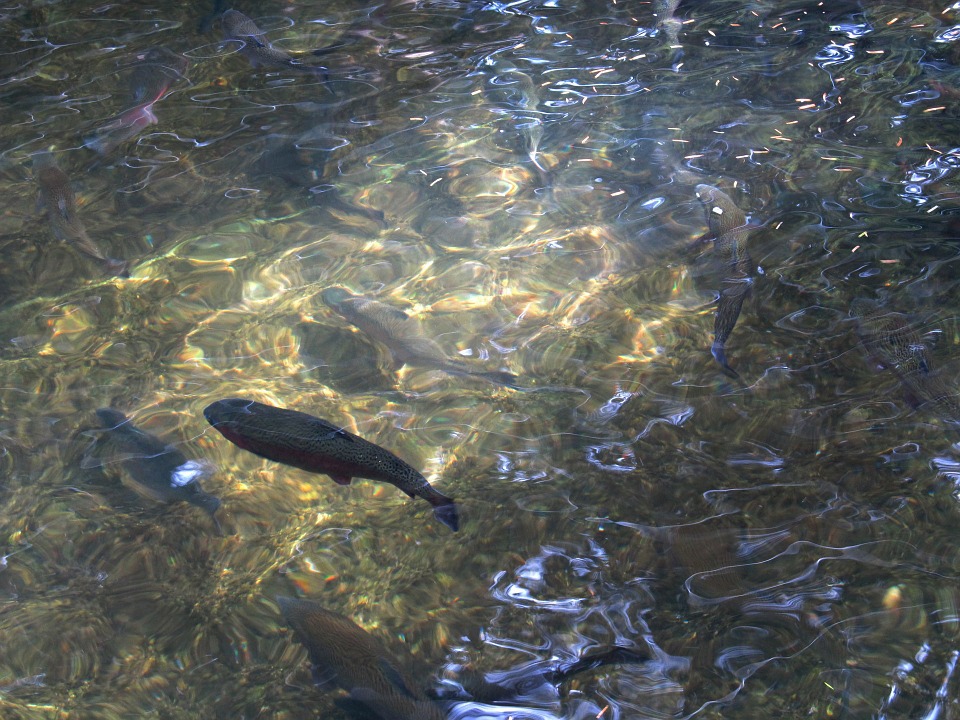
Fish react differently to bait depending on their growing environment.
Just arriving at the fishing spot and casting with all your might feels like the stress of everyday life has flown away, but if you catch a fish as a bonus, it becomes a real source of energy.
However, from the fish’s perspective, the drop of a lure or a sinker into the water can be seen as a sudden change and the appearance of an unfamiliar object, and in such situations, anglers try to find patterns in the fish’s behavior.
Today, we’ll look at a paper that presented the results of an experiment on fish responding to sudden and unfamiliar changes, as discussed above.
The paper cited today was presented at the Royal Society in December 2018 and is titled “Density-dependent changes in neophobia and stress-coping styles in the world’s oldest farmed fish . ”
This paper, which can be translated as “Changes in the dependence of stress on the boundary behavior and school density of tilapia, one of the oldest farmed fish species in the world,” records the results of observing the behavior of 10-day-old Nile tilapia raised in groups of 20 (low density) and 80 (high density) after 6 weeks.
The purpose of this paper is to discuss animal welfare, which recommends providing sufficient space for fish to behave normally while causing minimal pain and stress to the fish during the fish farming process, but I believe it is also worth considering from the perspective of anglers.
The tank used in the experiment was divided into four sections. The frontmost section was used as an acclimatization section to help the Nile tilapia adapt to the aquaculture environment. A partition was installed in the front section, and a cover was installed above it to create shade and allow the fish to hide.

Image source: Flickr WorldFish
And then, in the middle of the three sections, a green plastic toy that the fish had never seen before was placed, and then the same number of Nile tilapia were taken out from the high-density and low-density tanks and placed in the acclimatization section for 10 minutes, and then the partition was opened and their behavior for the next 15 minutes was videotaped and analyzed for the following five items.
※ I added a translation because there may be some parts that are a little difficult to understand.

1. Latency to leave shelter : The time it takes to leave the taming area.
2. Number of approaches : The number of times the green plastic toy was approached within 2 cm.
3. Number of attacks : Number of times the child came into contact with the green plastic toy.
4. Neophobia (average distance) : The dictionary definition of neophobia is the cautious behavior that animals show toward unknown objects, but here it refers to the average distance maintained from a green plastic toy for 15 minutes, so it was translated as average distance.
5. Skin and eye darkening (activity) : Fish raised at high density have darker eyes and darker skin than those raised at low density. This experiment analyzed how evenly the three sections of the tank after the acclimatization section were used, so it was translated as activity.
The observation results are summarized as follows. Nile tilapia grown at low densities showed aggressive and active responses to novel objects, while those grown at high densities showed passive behavior, showing that even fish in the same group react differently to unfamiliar situations or objects depending on the environment in which they grow.
|
Measurement items
|
Tilapia raised at low density
|
Tilapia raised at high density
|
|
Time taken to exit the taming zone
|
69.9 seconds
|
184.3 seconds
|
|
Number of accesses
|
5.9 times
|
0.79 times
|
|
Number of attacks
|
1.62 times
|
0.17 times
|
|
Neophobia
|
9.7cm
|
10.8cm
|
|
Activity
|
1.47
|
0.84
|
|
Observation results
|
Active
|
passive
|
Another interesting experimental result is that the behavioral patterns of tilapia reared at high density were completely different when a cover was placed over the acclimation zone and when it was not.
When there is a cover, the taming area acts as a hiding place, so it is difficult for the animals to come out even when the partition is opened. However, when there is no cover, the animals come out as soon as the partition is opened because it cannot act as a hiding place. The results of the experiment show that.

With the proliferation of broadcasts and various content related to fishing, we often see stereotypes of fish behavior, such as, “In this situation, fish move like this,” or, “Fish raised in this environment react like this.”
Most of this information comes from brainwashing rather than official sources, and I think any true angler would know how inadequate it is to describe the fish’s constant changes as they adapt to nature in just a few words.


Leave a Reply
Want to join the discussion?Feel free to contribute!