
Is it true that the more expensive the reel, the better?
When it comes to fishing, is a more expensive reel necessarily better? The answer is yes . However, the question, ” Is an expensive reel right for me? ” doesn’t necessarily have a definitive answer.
I recently met with a group of people who enjoy fishing and I expressed my opinion that my thoughts on fishing gear are like those of cars.
Some people use cars as a means of livelihood, others use them for convenience, and still others use them to show off their wealth…
Even if someone owns an expensive car that may seem excessive to those around them, if they look at it only from an economic perspective, they will clearly have to sacrifice something to own that car, or in economic terms, there will be a loss of opportunity cost.
Therefore, it is clear that we should be cautious in evaluating anglers solely based on the price of fishing gear, and it seems that excessive consumption or consumption of equipment for show is something that deserves some consideration.
Today, let’s take a look at the two pieces of equipment that most people who are new to fishing face the problem of choice paralysis: fishing rods and reels. Let’s take a look at the spinning reel as an example.
For beginners, the main reasons for their difficulty in choosing are either “I honestly don’t know what the difference is” or “There are so many different types of reels, I don’t know which one to buy.”
However, this question is one that every angler has felt at least once, and as equipment becomes increasingly specialized and scientific in modern times, it seems that making a choice becomes more difficult.
So, let’s find out if the reel that was said in the introduction to be “expensive is good” is really the right one for me, and how to choose the reel that suits me, that is, the reel that is “the best for me and has the most economical price.”
First of all, although not all of them are like this, I think there is no major disagreement that the biggest factors that affect the price of a reel are the number of bearings used in the reel and the material of the reel.
Of course, this article may not be suitable for those who have difficulty choosing between a large and small fishing rod, but I think it will be helpful to know once you get past that stage, so I am writing a few words about it.
Are more bearings on a reel better?
When looking at the number of bearings in a reel, you’ll notice that more expensive reels have more bearings. For example, Daiwa’s flagship model, the “15Gist,” features 12 ball bearings.
Ball bearings are placed in high-speed rotating parts and serve to reduce friction. In spinning reels, they reduce frictional resistance, improving reel smoothness and sensitivity.

While bearings are certainly better than none, they aren’t necessarily required for high-speed reel rotation. What’s more important isn’t the number of bearings, but where they are located on the reel.
A spinning reel requires at least four bearings: one on each side of the drive gear and one on each side of the pinion gear. The presence of bearings in these areas significantly impacts the reel’s performance.


Also, since there are many differences in performance and price depending on the type of bearing, it would be good to know about the types and materials of bearings if we go into more detail, but since that would make the article too long, let’s say that we will mention it later, which is a promise we cannot keep, and move on to the next one^^
Differences depending on reel material
Beyond bearings, the biggest difference in price lies in the material. Currently, spinning reels are made of three main materials: metal (magnesium or aluminum), carbon, and resin.
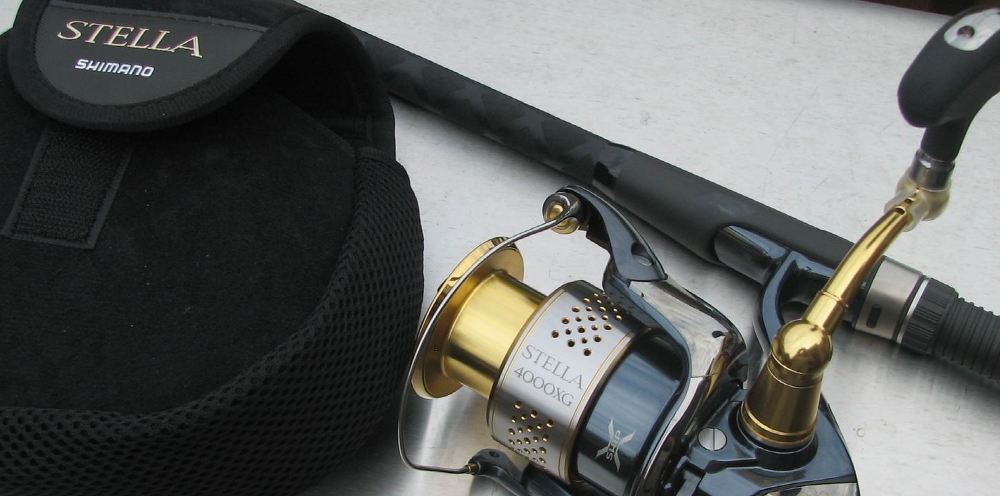
A lighter reel doesn’t necessarily mean a better one. If you compare it with Shimano’s 4000 series, the 15 STELLA 4000XG is 265g, the 12 VANQUISH 4000XG is 245g, and the 12 RARENIUM 4000XG is 240g. The price is in the order of Stella > Vanquish > RARENIUM, with Stella being the most expensive.
That is, price and weight are not necessarily inversely proportional.
Nowadays, most reels are lightweight, but if you look at the body and rotor material of the Shimano reel above,

The order of strength is aluminum > magnesium > CI4+, and the order of weight is CI4+ > magnesium > aluminum.
For models over 2500, the rotor material is aluminum, not magnesium.
CI4+ stands for Carbon Interfusion, and it is said to be a lightweight and durable carbon material made with Shimano’s own technology. (Well, that’s all I know^^)
When it comes to smooth reeling, a metal rotor with a metal body is the best, and the smoothness of rotation depends on the weight of the rotor; the heavier the rotor, the smoother the rotation.
However, this does not apply in all cases, and it is especially important to choose a reel that is balanced with the load you are using.
Is it resin or metal? Does the price vary depending on the material?
Simply put, resin lacks rigidity but is lightweight. Therefore, it’s often used in reels for float fishing, where sensitivity is paramount. For long-distance fishing, where the rod and reel weigh significantly, there’s a tendency to replace only the reel spool with a resin spool to reduce weight, even if only a small amount.
In contrast, metal reels, despite their heavy weight, possess high rigidity. Therefore, they are often used in offshore fishing reels targeting powerful species.
Additionally, metal reels often have the advantage of sustained spinning performance due to their self-weight. As such, differences in materials have their pros and cons, so it’s best to use them appropriately based on the fish species you’re targeting and the intended use.
Differences in internal structure and materials
Along with the number of bearings and the material of the body rotor, what affects the price of a reel is its internal structure and the materials used in its construction.
The material and rigidity of the gear, which can be considered the heart of the reel, significantly impacts its durability and performance. Therefore, the aluminum alloy often used in high-priced reels is ultra-lightweight duralumin. This material is lightweight and strong, making it an ideal choice for reel gears.
Furthermore, models designed for fishing with higher loads often use aluminum bronze, an alloy of aluminum and copper. This is also the material used in the Hyper Digi gears of Daiwa’s large spinning reel, the “Saltiga.” In contrast, cheaper reels often use gears made of zinc and brass.
Next, the difference in price in the internal structure is the presence or absence of a waterproof function.
Shimano’s “Core Protect” and Daiwa’s “Magshield” are waterproof models, but they’re quite expensive. However, it’s also true that even entry-level reels are actively adopting features from higher-end models, improving their performance.
※ Consumer complaints about Daiwa’s MagShield feature are high, and skepticism about its functionality persists. At this year’s Osaka Fishing Show, a Daiwa representative was widely reported by a Japanese blogger to have turned pale and evaded answering a question posed by a visitor about the MagShield.
Price differences depending on whether the reel handle is folding or screw-in.
Screw-style handles have less vibration than folding handles and transmit power completely to the gears. However, reels with folding handles, on the other hand, can feel a bit of shaking when turning the handle after prolonged use, and power transfer is not perfect. For this reason, reels with screw-style handles are widely used in lure fishing.

Price difference depending on drag performance
What makes a difference in drag performance is the presence of bearings inside the spool and on the shaft. Cheaper reels often use a plastic “collar” instead of ball bearings.
Naturally, bearings in the spool and spool shaft ensure smooth line release and reduce line break. Shimano offers what it calls a Rigid Support Drag, a model that incorporates bearings in the spool and spool shaft.

※ The photo shows the parts that came out after disassembling the line roller. Please understand that the differences in the bearing and collar are as follows.
We’ve examined the differences in price based on reel material and function. While it’s undeniable that expensive reels with superior features are superior, the question remains: is it truly the right reel for me?
In conclusion, isn’t the best reel the one that gives you the greatest satisfaction? That’s why I still prefer to use the cheaper model.


Leave a Reply
Want to join the discussion?Feel free to contribute!